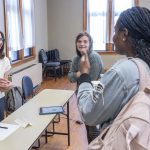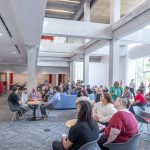
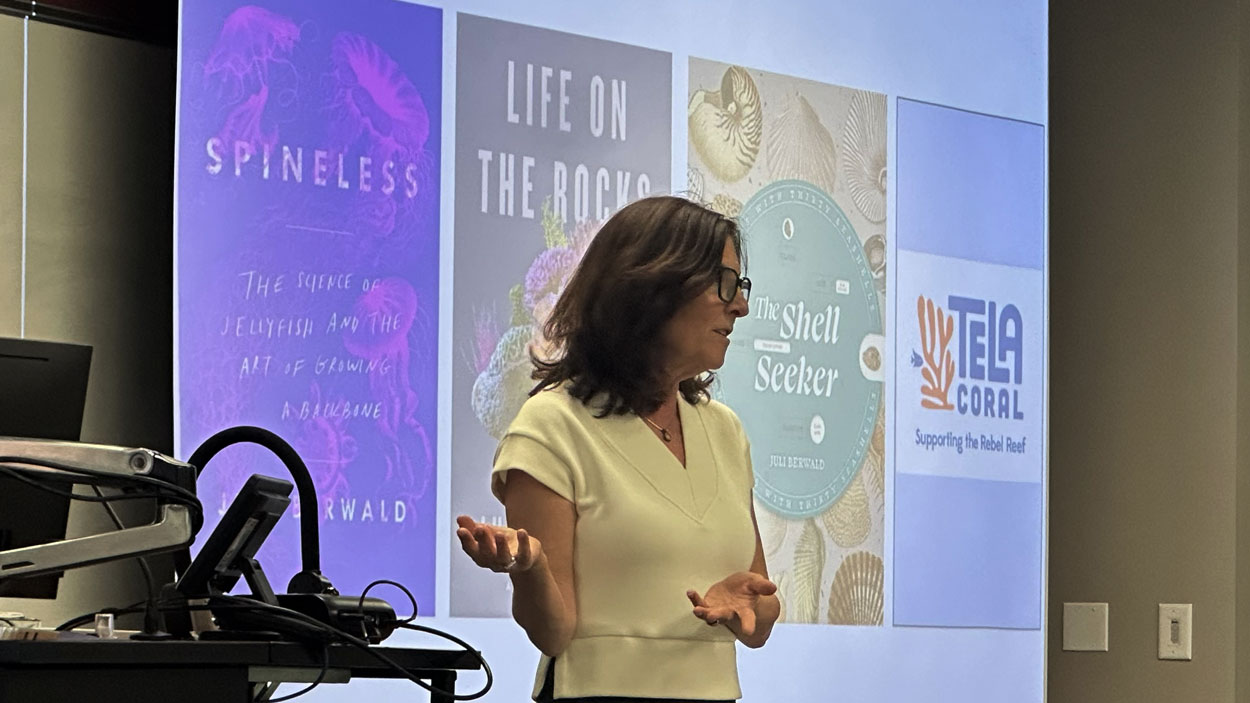
Author Juli Berwald talks to graduate students in the Department of Biology during a visit to campus last Wednesday afternoon. (Photo by Steve Walentik)
St. Louis native Juli Berwald was glad to be back in her hometown last week helping to present “Music for the Ocean” on Friday evening at the Blanche M. Touhill Performing Arts Center at the University of Missouri–St. Louis.
The multimedia concert experience was the vision of Emmy-nominated composer and violinist Chad Cannon and featured Cannon performing with pianist Hui Wu and other musicians, including members of the Arianna String Quartet. The show has toured across the United States and as far away as Japan since launching last year.
As they listened to the mix of classical and electronic music, members of the audience were treated to colorful images of fish, coral and other sea life from Emmy-winning animator Timothy Rauch flashing across a screen behind the stage in the E. Desmond and Mary Ann Lee Theater.
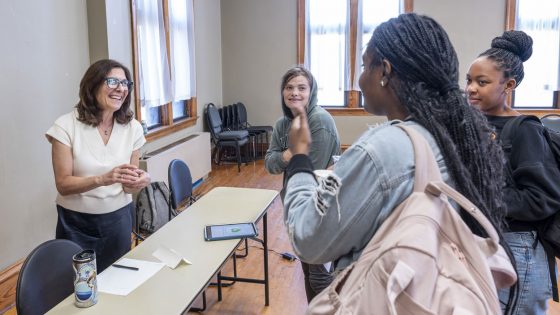
Author Juli Berwald engages with UMSL students at a Writers Talk Writing event hosted by the Department of English last Wednesday morning in the Museum Room of the Provincial House. (Photo by Derik Holtmann)
UMSL’s Whitney R. Harris World Ecology Center played a role in sponsoring the show. Proceeds from the performance went to support Tela Coral, a nonprofit organization Berwald co-founded that is working to preserve some of the last healthy elkhorn and staghorn coral colonies in the world off the Caribbean coast of Honduras.
But Harris Center Director Aimee Dunlap also invited Berwald to campus earlier in the week to meet with UMSL students and discuss her other work as an ocean scientist and science writer. Berwald, who now lives in Austin, Texas, is the author of three books, including “Life on the Rocks,” which tells the story of the fight to save coral reefs around the world and why it’s important. She’s also written popular science articles for publications such as National Geographic, The New York Times, The Wall Street Journal, Smithsonian and Texas Monthly, among others.
“Her career path is really cool, starting as a scientist, an oceanographer, and becoming a popular science writer, and working on conservation,” Dunlap said. “And the way that she’s doing it, supporting these concrete actions and connecting people.”
Berwald covered it all during back-to-back-to-back events on Wednesday. First, she took part in a panel discussion about writing with Assistant Teaching Professor Lauren Terbrock-Elmestad from the Department of English and Assistant Teaching Professor Lesley Sieger-Walls from the Pierre Laclede Honors College. Nearly 50 students turned out in the Museum Room of the Provincial House for the latest installment of the Writers Talk Writing series organized by Terbrock-Elmestad and her colleague Lauren Obermark.
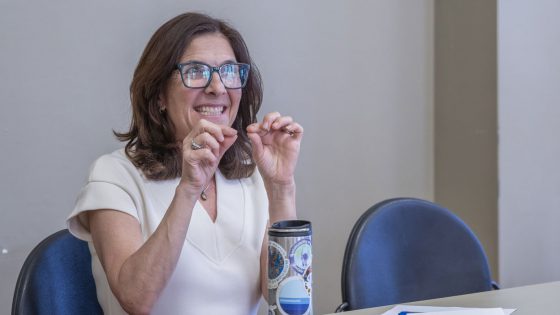
Juli Berwald discusses her career as a science writer. She is the author of three books, “Spineless: The Science of Jellyfish and the Art of Growing a Backbone,” “Life on the Rocks” and “The Shell Seeker.” (Photo by Derik Holtmann)
Later, she spoke in Benton Hall Room 303 to graduate students in the Department of Biology about the circuitous journey she took to her career as a scientist and writer – after starting college as a math major at Amherst College. She credited the first opportunity she had to go diving during an otherwise unhappy study abroad experience for exposing her to the wonder of the ocean.
Berwald, who went on to earn a PhD in ocean science at the University of Southern California, wrapped up her day at UMSL by leading a science writing workshop with a small group of biology doctoral students in the Harris Center conference room.
“I love meeting people who care about our planet and are working to understand it and make it a better place,” Berwald said. “It’s fun. I like being engaged with students. It’s fun to kind of share my mistakes, tell people not to make them.”
Berwald offered just as much about her experience that students should follow, particularly about her writing process and how she’s been so successful writing for a general audience. She said she kept her sister – a nonscientist – in mind as she wrote her first book, “Spineless: The Science of Jellyfish and the Art of Growing a Backbone.” In both “Spineless” and “Life on the Rocks,” she manages to marry science with memoir to reveal lessons from her own life experience.
Her latest release, “The Shell Seeker,” published in May, gives readers insight into how seashells have inspired people for generations, in art, music, architecture and elsewhere. The book also highlights 30 shells that one might encounter on the beaches of North America or in oceans elsewhere in the world.
Dunlap was happy students had a chance to engage with Berwald and learn more about another avenue they could explore in their scientific careers.
“In my upper division and graduate classes, I’ve offered students the option of writing a formal, traditional biology, scientific paper,” Dunlap said. “But I also give them the option of doing it as like a heavily resourced piece for something like The Atlantic. More students are taking us up on those opportunities.
“Just because you’re writing something for a scientific audience doesn’t make it somehow harder or more sophisticated.”
For students, the idea of branching out beyond the traditional academic environment can also feel like a necessity given how competitive the job market can be for faculty positions.
“There’s been an increasing premium and desire for students to develop alternative academia skills,” said Cait Stevenson, an undergraduate biology student who attended Berwald’s presentation and workshop and who also previously earned her PhD in history. “One of them is public writing and how can that be applicable in terms of actual copywriting, which is what I do. But also, things like developing high school curricula and how you can make that accessible, in an interesting way, to students. We all remember the mitochondria is the powerhouse of the cell, right? It’s that kind of catchy thing.”
Stevenson was just one of the students captivated by the chance to meet Berwald and learn about her career.