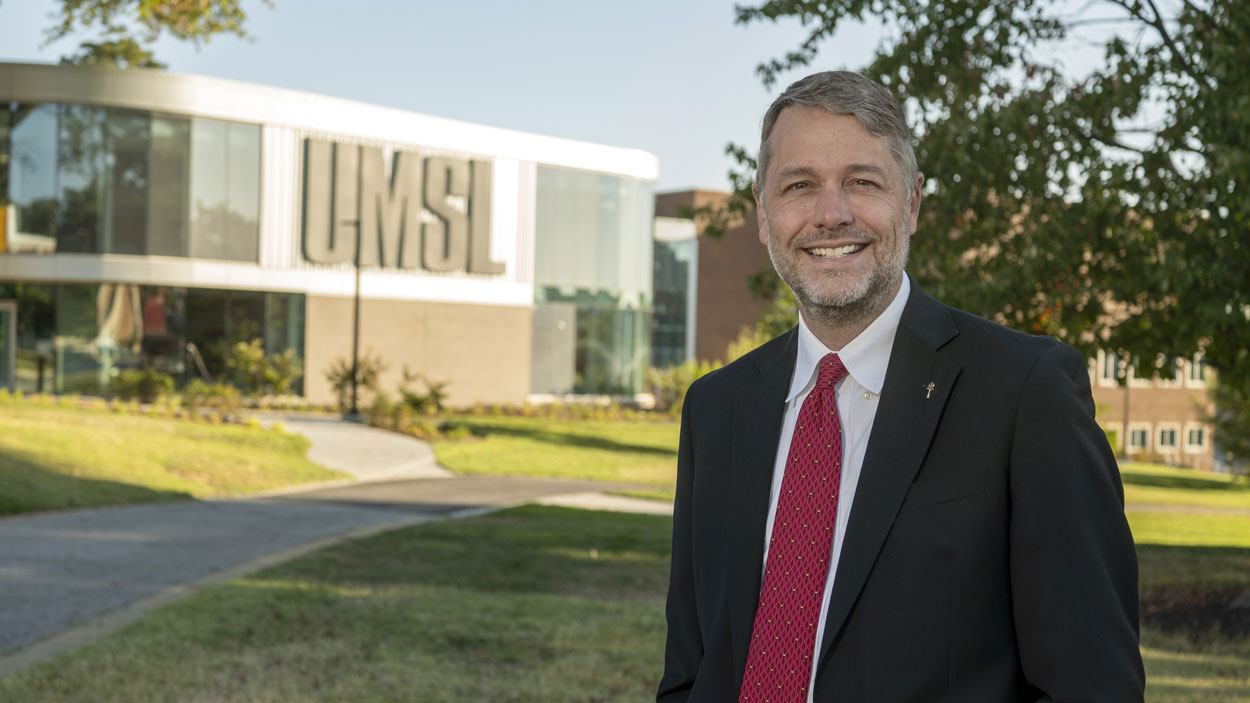
Alum Joe Blanner is the author of an upcoming book, “The Great Divorce and the Making of Modern St. Louis,” which will be published by the Missouri Historical Society with an expected release in October 2027. (Photo by Derik Holtmann)
Joe Blanner believes he was a college student studying public policy and administration at the University of Missouri–St. Louis the first time he learned about “The Great Divorce” – the 1876 vote that legally separated the City of St. Louis from St. Louis County and forever locked its borders into an area of roughly 66 square miles.
Having grown up in the St. Louis region and graduated from Eureka High School, Blanner, consciously or unconsciously, has lived with the fallout from that vote throughout his life. So too does everyone who calls this area home.
The split was a catalyst for a lot of other fragmentation throughout the region – with 88 municipalities, not to mention separate school districts, police departments and fire protection districts, in St. Louis County alone, all fighting for resources with the city and each other in what can often become a zero-sum game.
Blanner, who earned his bachelor’s degree at UMSL in 1998, has encountered the impact of those divisions in his professional life. He serves as an equity partner at the law firm McCarthy, Leonard, Kaemmerer, & Miller and has been active on civic boards such as the Regional Convention and Visitors Commission, the St. Louis Sports Commission, FOCUS St. Louis and Construction Forum.
“It doesn’t take very long to realize that we do have a lot of different jurisdictions, and a lot of people are not necessarily pulling in the same direction,” Blanner said. “If they were, we’d be a lot stronger as a region.”
Blanner, a former president of the UMSL Alumni Association and current member of the Chancellor’s Council, is authoring a book that explores the history behind it. “The Great Divorce and the Making of Modern St. Louis” delves into how it happened, its continuing impact and some of the as-yet unsuccessful attempts to undo it. Last month, Blanner announced that the Missouri Historical Society has agreed to publish the book with an expected release date in October 2027.
“I’m very grateful to them because they’re an incredibly well-respected organization and an institution in our state and in our city,” Blanner said. “It’s a huge honor to me that they’re even willing to consider my book. I think, for them, it’s a very timely topic. It’s a good thing for them to put out because they want to tell the story of St. Louis. This is such an important issue to the history of St. Louis.”
Blanner’s book is the product of a more than decade-long journey to learn more about it. He knows he’s an unlikely author. In fact, he had been researching the topic for several years before he ever thought about writing a book at all.
He points to an old journal article written by one of his wife’s ancestors, Truman Post Young, for starting him on his voyage of discovery.
“He was an assistant city counselor for the City of St. Louis, and in 1911, he wrote an article about ‘The Great Divorce’ for the American Political Science Association publication,” Blanner said. “I found a copy of it and read it, and I was fascinated by it because it was so contemporary. I thought it would be kind of interesting to connect me with the past and to write an update piece on it, because it was still an issue. The more I dug in, the more fascinating the whole thing became.”
Blanner started diving even more into the past, reading any relevant information he could get his hands on. He would get up at 5 a.m. and read. If he didn’t have any appointments over lunch, he would read. Then at night, after his kids went to bed, he would read some more.
There were frequently times where he’d cut out of work and visit the St. Louis room at the central branch of the St. Louis Public Library to get his hands on more source material. He also did some research at the St. Louis Mercantile Library on UMSL’s campus.
“It was definitely a sacrifice, particularly for my wife, who gave up a lot of time with me for me to work on this project,” he said.
It became clear early on he had more information than could fit in a single update to the original journal article, so he expanded his idea into a book. His manuscript contains roughly 1,800 footnotes, and even that represents only a fraction of what he uncovered in his research.
“I found all kinds of little side stories, which were very interesting, but it just got overly cumbersome,” Blanner said.
The book still explores the circumstances that led to the divorce, the contested election – marked by evidence of rampant voter fraud – that triggered it and the honeymoon period that existed in its aftermath, when city residents, in particular, were happy to see St. Louis pay off municipal debt and lower taxes.
In some ways, the city continued to thrive through the first half of the 20th century, reaching a population high of more than 800,000 residents in 1950. But suburbanization, spurred by cars, highways and favorable FHA and VA lending practices in the aftermath of World War II, led people away from the city center.
“They didn’t create a mechanism by which the city could continue to grow geographically, and so what you see is there are regions that were able to absorb their growth, offset decay and losses by new areas of development,” Blanner said. “We couldn’t do that. So, all we had was the decay, and we didn’t have the corresponding growth.”
Blanner said Young’s 1911 article was the earliest evidence he could find of someone lamenting the separation. But angst over the arrangement has continued to grow, all the way until today, as the book details.
It also examines several attempts to remarry the two entities, first coming in 1926. To date, all met resistance and ultimately failed, and Blanner offers some reasons why, including most recently with the Better Together plan that unraveled in 2019.
“Change is hard,” Blanner said. “I think a lot of the efforts to change the relationship have attempted to do too much, or they faced other hurdles. But any change that’s actually going to happen is going to have to learn from those lessons and be something incremental.”
Ultimately, he hopes sharing some of the history of the past 150 years can help improve regional collaboration going forward, and he’s been grateful for invitations he’s received to discuss the topic, including with the St. Louis Business Journal, Bar Association of Metropolitan St. Louis and the Association of Corporate Counsel.
“I really hope it will be useful,” Blanner said, “in shaping future conversations.”