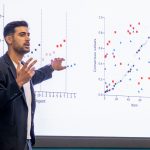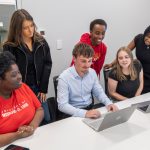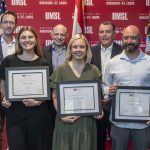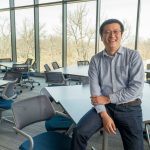
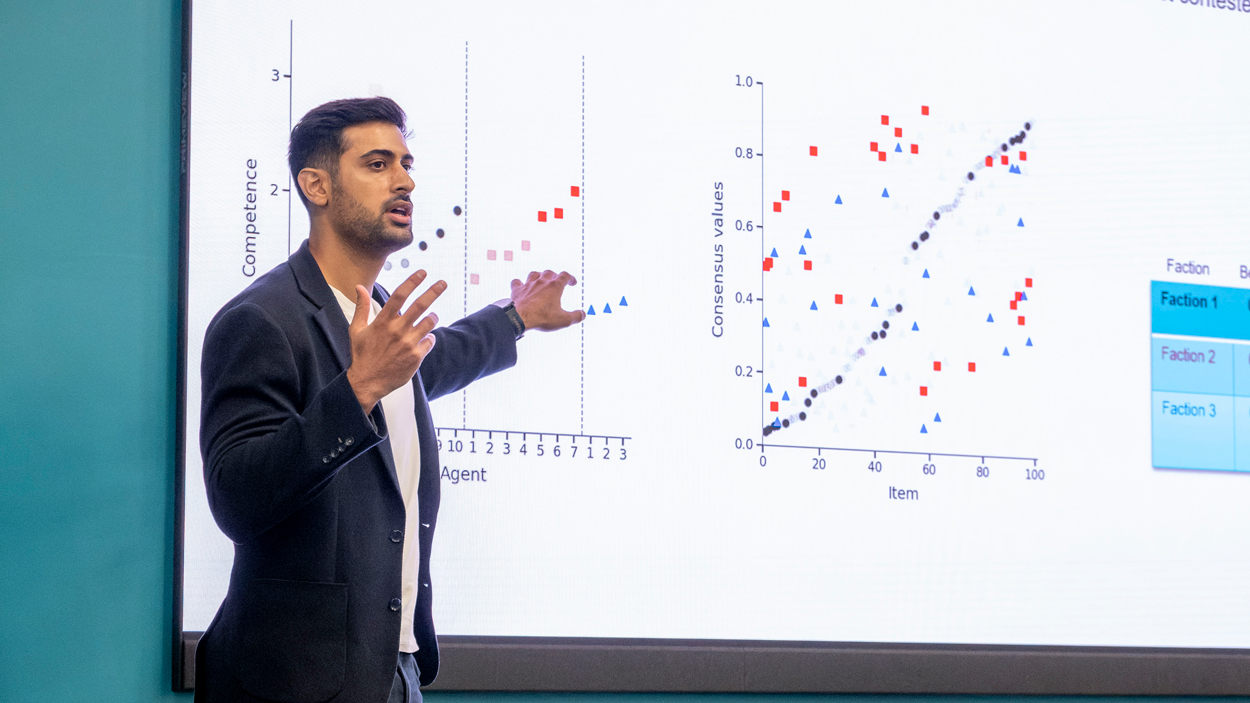
Necdet Gurkan, assistant professor in the Ed G. Smith College of Business, gives a presentation on his ongoing project titled “ConSense: A Psychometric Consensus Framework for Governing Belief Pluralism in LLM-Based Multi-Agent Systems” during the inaugural Information Systems and Technology Research Symposium. The day-long event, held Oct. 23 at the Entrepreneurship and Innovation Center, brought together researchers, faculty, students and industry practitioners from several regional universities to share emerging work in information systems, artificial intelligence, data analytics, cybersecurity, digital transformation and other technology-driven fields. (Photos by Derik Holtmann)
Researchers often have to travel long distances to share their work with fellow scholars. At a recent symposium hosted by the University of Missouri–St. Louis, they had an opportunity to present their research and exchange ideas with peers closer to home.
On Oct. 23, the Information Systems and Technology Research Symposium welcomed faculty from universities across the St. Louis region for a day of networking and discussion. Organized by IST Assistant Professors Damon Walker, Necdet Gurkan and Carol Kuai from UMSL’s Ed G. Smith College of Business, the event was designed to foster relationships among those working in information systems, artificial intelligence and related fields.
The idea began with a conversation over lunch between Walker and Gurkan, who saw an opportunity to bring together faculty from institutions throughout the metropolitan area. Although they sometimes cross paths at national conferences or connect through informal conversations, Gurkan said he recognized a need for more opportunities to exchange ideas and develop partnerships within the bi-state area.
“One of the reasons I wanted to come to the St. Louis area was there are so many great universities and so many great industry partners in the region,” said Gurkan, who joined the UMSL faculty in August 2024. “But when I got here, I quickly realized that there is a very limited communication across the institutions. I don’t know what my colleagues are doing at other colleges in our region. So, the idea was how we can get to know each other and start this collaboration.”
The UMSL faculty members initially hoped to attract about 10 participants to the symposium, held at the Entrepreneurship and Innovation Center. Instead, registration grew to roughly 60 to 70 people representing several institutions including Saint Louis University, Missouri University of Science and Technology and Southern Illinois University–Edwardsville, with more than 20 expressing interest in presenting. Organizers ultimately had to limit the number of presentations because of time constraints.
Walker said the response reinforced the need for a gathering where local faculty could learn from one another.
“Most of these events are kind of siloed out, or you have a national symposium or some type of conference that’s done nationally, and you will run into these same researchers in Pittsburgh, or New York, or other places around the world,” he said. “But knowing that these are your neighbors, why not collaborate prior to going to the national stage?”
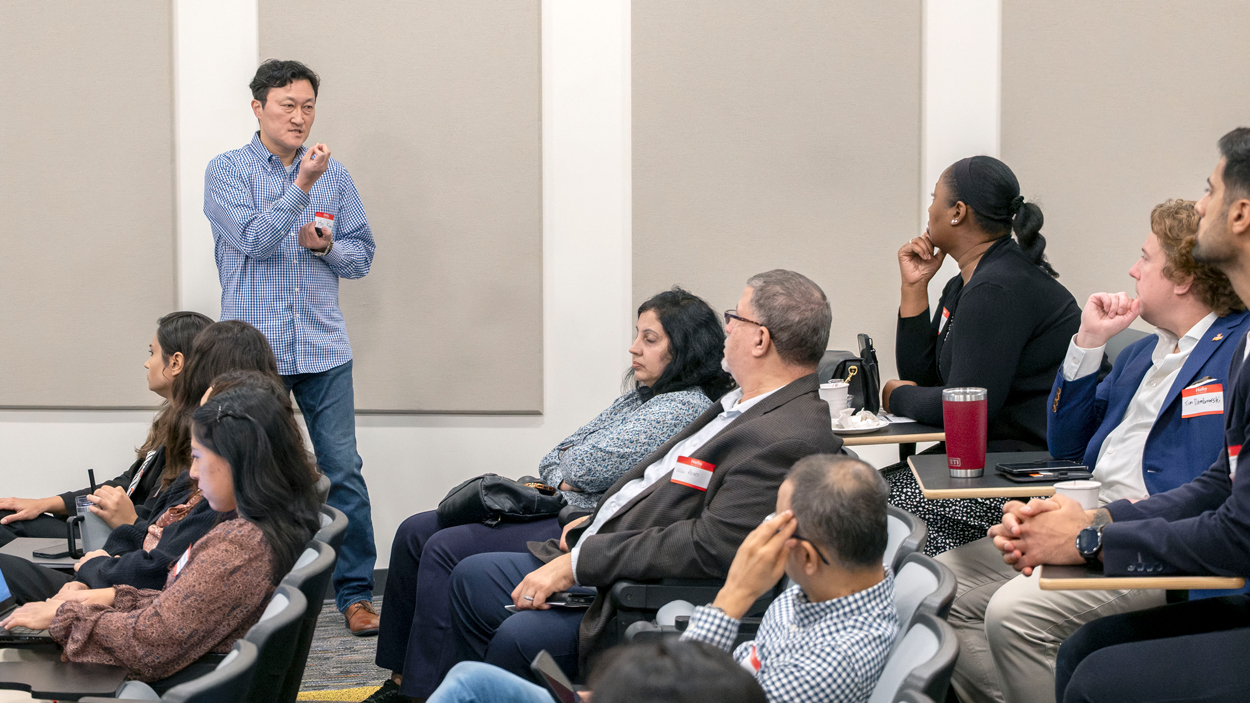
Ho Kim, UMSL associate professor of marketing and entrepreneurship, discusses his research with members of the audience during the Information Systems and Technology Research Symposium on Oct. 23 at the Entrepreneurship and Innovation Center.
For those presenting, the symposium offered more than a platform to share findings. It also gave them a chance to hear perspectives they might not encounter within their own departments or research teams.
Gurkan said presenting work in progress can help researchers, particularly those early in their careers, identify challenges and find new directions. During his presentation on an ongoing project titled “ConSense: A Psychometric Consensus Framework for Governing Belief Pluralism in LLM-Based Multi-Agent Systems,” Gurkan raised several questions he had encountered during his work and received suggestions from the audience.
“That’s why we want to do this, to get together and help each other out,” Gurkan said. “You get feelings from people’s faces or comments that can tell you whether you’re on the right path or not. There are a few things with my research that I’m struggling with, and there were some great comments from the crowd trying to help me resolve those problems.”
Deepika Gopukumar, an assistant professor in SLU’s Department of Operations and Information Technology Management, also valued the input of colleagues with different perspectives.
Her work includes research involving artificial intelligence and healthcare, as well as the use of large language models in research evaluation. Gopukumar said presenting at multiple events can help authors recognize perspectives they might otherwise overlook before submitting their work for publication.
“It’s good to present in as many places as possible to get diverse feedback,” she said.
Sandra Langeslag, an associate professor in UMSL’s School of Social Work, Psychological and Brain Sciences, collaborated with Gurkan on a project she presented at the symposium. She said preparing the presentation also helped her team organize its thinking as it worked through data analysis and prepared a paper for submission.
Their project, titled “Love, Emotions, and Cognition Associated with Romantic Love for Artificial Intelligence Companions,” also illustrated how connections made at previous gatherings can lead to new partnerships. Langeslag said an earlier Zoom meeting of UMSL faculty interested in artificial intelligence introduced her to Alice Lee-Yoon of the Department of Global Leadership and Management. That connection eventually led her to Gurkan, with whom she began working on the project.
“You never know who you will meet or what you will learn that down the line somehow proves helpful,” Langeslag said.
While individual participants benefited from exchanging ideas, organizers also envisioned a broader impact, potentially establishing the St. Louis region as a destination for information systems and technology research.
Walker said greater cooperation among local institutions could bring increased recognition and resources to the area’s academic community. Although universities inevitably compete for students and funding, he said that competition does not have to come at the expense of working together.
“If we can put a spotlight on St. Louis as an area where you can find great research, that brings those resources to the area,” Walker said.
The symposium also created opportunities for doctoral students and junior faculty members to connect with more established colleagues.
A junior scholar consortium followed the symposium, organized with support from Jintong Tang, a marketing professor and director of SLU’s Emerson Leadership Institute. The forum gave early-career faculty and doctoral students an additional opportunity to discuss professional challenges, learn from experienced colleagues and build relationships.
Gurkan said creating that sense of community is particularly important for those who can sometimes feel isolated while working independently on projects. He hopes those connections will help younger faculty members and doctoral students gain visibility while recognizing that the challenges they encounter are shared by others in the field.
“The senior scholar group, they are like rock stars in our field, and they can speak from their many years of experience to let us know that we are not alone with all of these struggles,” Gurkan said. “It’s OK to be stressed, it’s OK to struggle, it’s OK to get rejected. So, let’s kind of feel that all together.”
Given the response to the inaugural symposium, organizers hope the gathering will become a regular fixture for academics across the region. Walker initially envisioned an annual or semiannual event, but the strong turnout and interest in presenting have made him optimistic about its potential to expand.
“I am very confident that this can become a thing,” Walker said.