
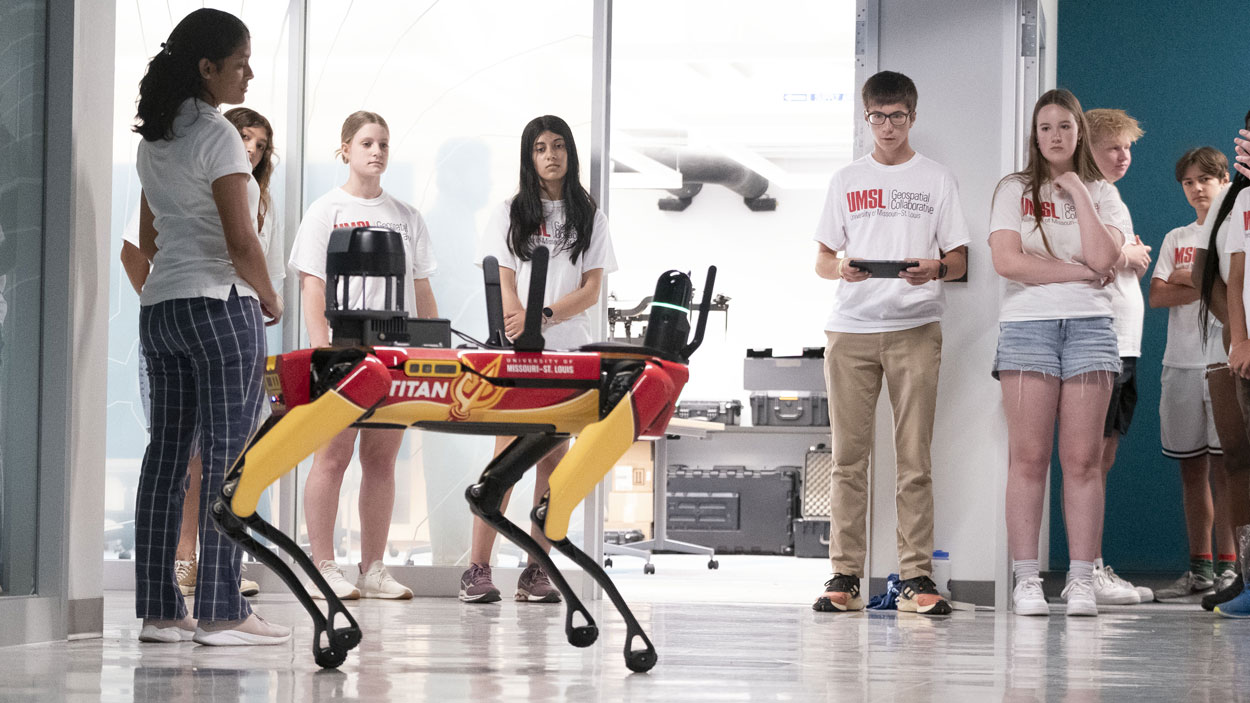
Area high school students take turns controlling Titan, UMSL’s robotic dog, at the UMSL Geospatial Summer Camp in June 2025. The popular camp introduces students to geospatial science and provides hands-on experience in various geospatial technologies as part of the university’s efforts to build a geospatial workforce development pipeline that stretches back to K-12 schools, supporting the region’s growing geospatial sector. (Photo by Derik Holtmann)
The University of Missouri–St. Louis announced the launch of a new Geospatial Workforce Development Pilot Program. The comprehensive initiative through UMSL’s Geospatial Collaborative is designed to accelerate education, training, certification and research in geospatial science and technology throughout the St. Louis region.
The program supports the mission of the National Geospatial-Intelligence Agency and strengthens the nation’s geospatial workforce at a pivotal moment for U.S. national security and economic competitiveness.
U.S. Senator Eric Schmitt introduced the National Geospatial Innovation Hub Advancement Act during the 118th Congress to strengthen America’s geospatial intelligence workforce and support the Department of Defense’s mission. The legislation was incorporated into the FY25 National Defense Authorization Act and signed into law, directing the Secretary of Defense to establish a five-year Geospatial Workforce Pilot Program focused on expanding and accelerating education, training, certification and research near National Geospatial-Intelligence Agency facilities. Through Senator Schmitt’s leadership, Congress authorized this pilot program and laid the foundation for federal investment to support its implementation.
“As threats to our national security evolve and demand for geospatial intelligence grows, we need to cultivate a skilled workforce that is ready to respond to the challenges of tomorrow,” Schmitt said. “I was proud to secure funding to launch this workforce development program to support the NGA’s critical mission, create new opportunities for Missourians in a cutting-edge industry and cement St. Louis as the national hub for geospatial technologies.”
Following that authorization, Congress provided $5 million in federal funding through the Department of Defense to support this initiative. That funding is now being deployed to launch the Geospatial Workforce Development Pilot Program at UMSL in partnership with NGA and T-REX.
“We are grateful to Senator Eric Schmitt for his leadership in supporting this geospatial workforce initiative,” UMSL Chancellor Kristin Sobolik said. “His commitment to national security and to advancing economic growth and workforce opportunity in St. Louis is helping position UMSL as a trusted partner to the National Geospatial-Intelligence Agency and will create new opportunities for students while strengthening America’s geospatial advantage.”
Meeting a Critical National Need
The launch of the program comes on the heels of the opening of Next NGA West, the $1.7 billion NGA campus in north St. Louis – the largest single federal investment in the region’s history. The new facility, which opened last September, is driving long-term growth in geospatial intelligence, advanced analytics and related technologies, while creating transformative career opportunities for local students and residents.
As threats to national security evolve, NGA requires a workforce skilled in emerging areas such as artificial intelligence, open-source data exploitation, visual analytics, human geography and geospatial intelligence fusion. At the same time, demand for geospatial expertise is rapidly expanding across the commercial sector, with the global geospatial analytics market projected to grow dramatically over the coming decade.
The UMSL Geospatial Collaborative
At the center of the initiative is the UMSL Geospatial Collaborative. Under the leadership of Executive Director Reda Amer, UMSL’s principal investigator for the Geospatial Workforce Development Pilot Program, the collaborative will serve as the regional convener, connecting K-12 schools with higher education institutions, industry, government agencies and nonprofit partners so that they can work together to build a workforce with the talent and skills needed to develop and deploy interactive geospatial tools. That is critical to help NGA and the many different related industries that exist in St. Louis to innovate and grow.
The funding is helping recruit and retain expert faculty and instructors as well as develop innovative curricula, certificates and degree programs in geospatial science. Undergraduate and graduate students will have opportunities to engage in cutting-edge geospatial research, often in collaboration with the Taylor Geospatial Institute, and resources are also being directed toward creating internships, co-ops and real-world projects with industry and government partners.
Together, these efforts will strengthen St. Louis’ position as a global hub for geospatial science and technology while ensuring a steady pipeline of talent for NGA, the Department of Defense and the broader geospatial economy.
A National Model for Workforce Development
The Geospatial Workforce Development Pilot Program aligns with national priorities to enhance domestic geospatial capabilities. With state-of-the-art facilities, including the Geospatial Advanced Technology Lab supported by Missouri’s MoExcels Workforce Initiative, the UMSL Geospatial Collaborative is poised to serve as a national model for geospatial workforce development.
“This initiative is about more than meeting today’s workforce needs,” Amer said. “It’s about securing America’s leadership in geospatial intelligence for decades to come – through education, innovation and collaboration.”
Media Coverage
St. Louis Business Journal