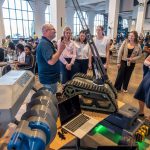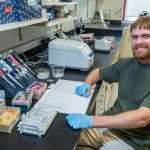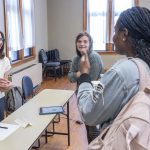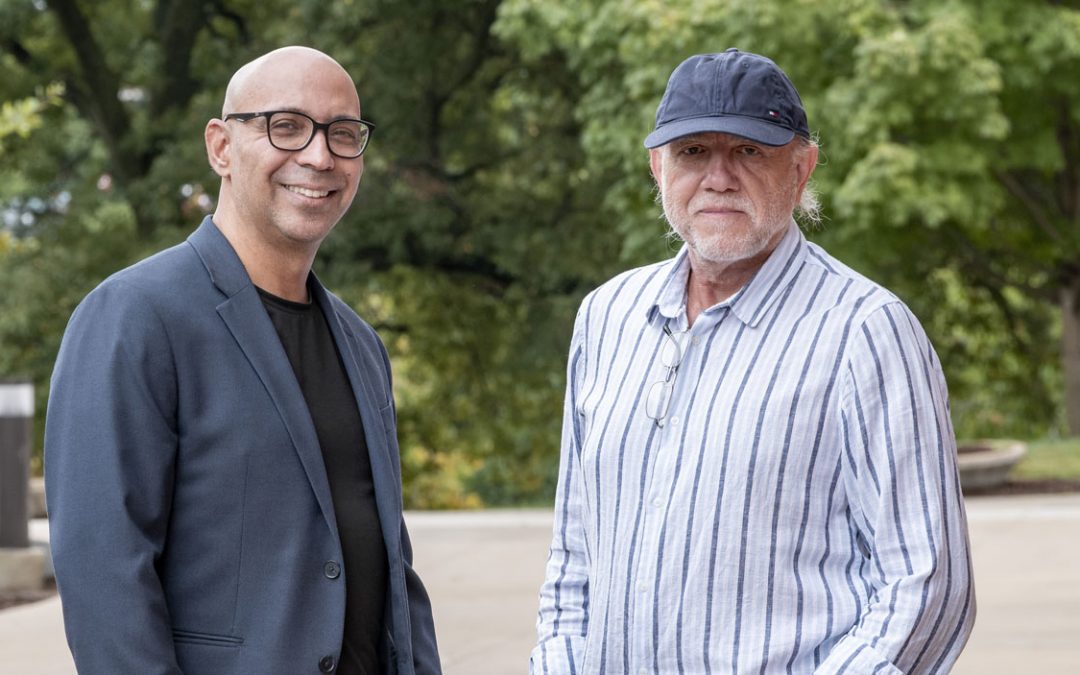
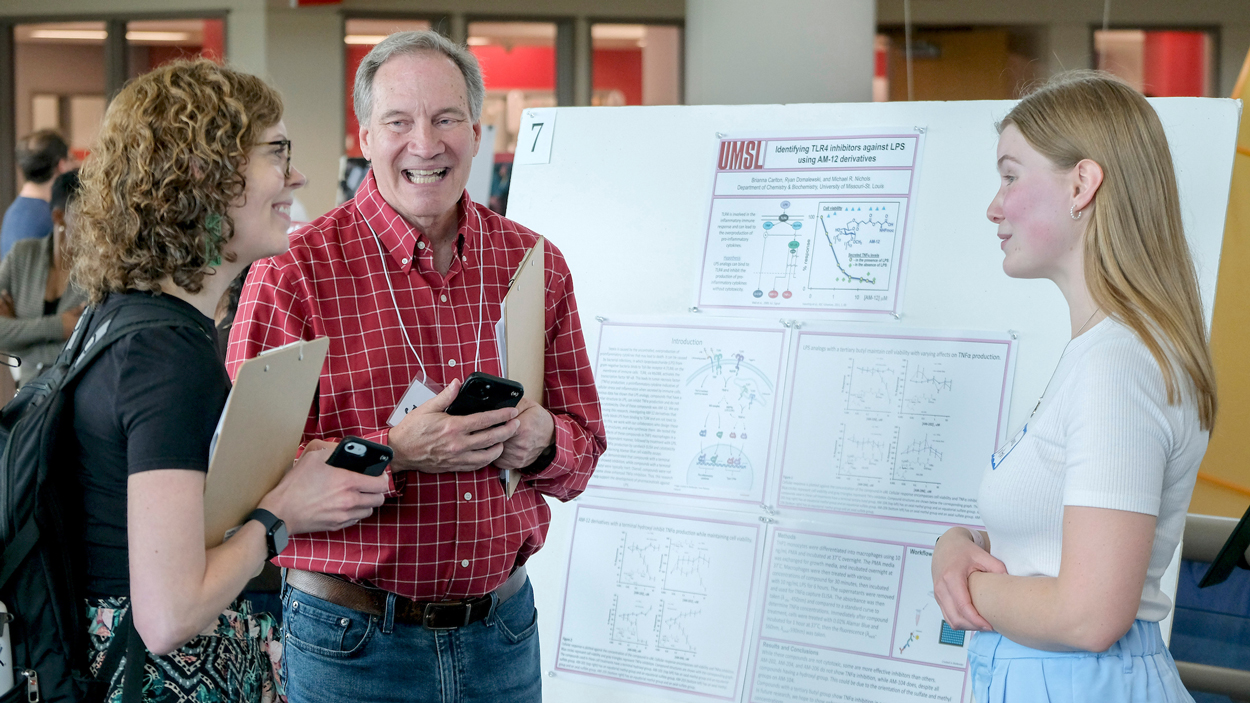
Associate Professor Carissa Philippi and Associate Professor Michael Griffin speak with Bree Carlton about her research project, “Identifyig TLR4 Inhibitors Against LPS Using AM-12 Derivatives” Friday morning during the Graduate Research Fair at the University of Missouri–St. Louis. Carlton won first place in the non-thesis category for her research. (Photos by Derik Holtmann)
Going into the Graduate Research Fair at the University of Missouri–St. Louis, Bree Carlton wasn’t thinking about the cash prizes awarded at the end of the exhibition.
Carlton, a master’s student in the accelerated chemistry and biochemistry program, was mostly concerned with showcasing her work identifying TLR4 inhibitors with Curators’ Distinguished Professor Michael Nichols.
“This project has some potential for pharmaceutical therapies for sepsis, which is really important,” Carlton said. “I’ve had really meaningful experiences in undergraduate and graduate research with the Nichols Lab, so I was excited to present here. I wasn’t really so worried about winning, but I’ve had a good time talking to people about the research I’ve been working on the last few years.”
That didn’t stop her from taking home first place in the non-thesis category. Carlton might have had an edge over the competition, though. She was regularly involved in research as an undergraduate and presented at the 2022 and 2024 Undergraduate Research Symposiums.
Friday morning, she was one of more than 45 students participating in the fair. The Graduate School sponsored the event, which is an opportunity for students from all degree programs to present their work, connect with peers and receive feedback from faculty members.
In a departure from previous years, the Graduate Research Fair was held in collaboration with the Undergraduate Research Symposium – a professional-style venue for undergraduates to gain experience presenting their original mentored investigations and creative inquiries – for a full day of conversation, inquiry and scholarship.
Projects from both events ran the gamut, including topics such as bumble bee foraging behavior, drone-enhanced medical delivery, parasocial love, soil bacterium and vigilante justice.
Graduate Research Fair
The day began at 9 a.m. with graduate poster presentations and judging on the third-floor rotunda and the Century Rooms in the Millennium Student Center.
Carlton happily took the time to explain her project to interested passersby. TLR4 is a transmembrane protein involved in the body’s inflammatory immune response. When a lipopolysaccharide, or LPS, binds to a TLR4 on the membrane of immune cells, it can cause the overproduction of proinflammatory proteins. That uncontrolled overproduction can then lead to sepsis, which can be deadly. Carlton tested butyl-group and hydroxyl-group compounds with the potential to help prevent that process, and the results were promising.
“We see that these groups with the hydroxyl are more effective inhibitors than the butyl group,” she explained. “Moving forward, we would probably continue with compounds that have this hydroxyl group.”
For the past year, Clover Vigus has been running experiments on the impact of environmental stressors on the growth of mutated genetic lines of the Arabidopsis thaliana plant, commonly known as thale cress or mouse-ear cress. Vigus, a biochemistry and biotechnology master’s student, noted that the research could have important real-world applications in the agricultural industry, particularly for crop protection.
“If we’re able to learn more about how these certain mutants respond to environmental stressors to have better root growth or worse root growth or better healing processes, you could use that to help grow stronger crops,” Vigus said. “Or you can use this on invasive species to break down their root growth and make it so they can’t heal as well.”
Rachael Carpenter, a political science master’s student and student recruitment specialist in the Pierre Laclede Honors College, designed a study to determine whether voters really “put their money where their mouth is.” Carpenter analyzed exit polling from the 2025 St. Louis mayoral election to examine how voters preferred to distribute the $280 million from the St. Louis Rams Settlement Plan.
“My project is actually about revealed versus stated preference, and how do we understand the difference, which is a way to say, ‘Do people really want money spent on stuff? Or do they just want to be upset about things?’” Carpenter said. “So, does your issue priority match what you want to put money into?”
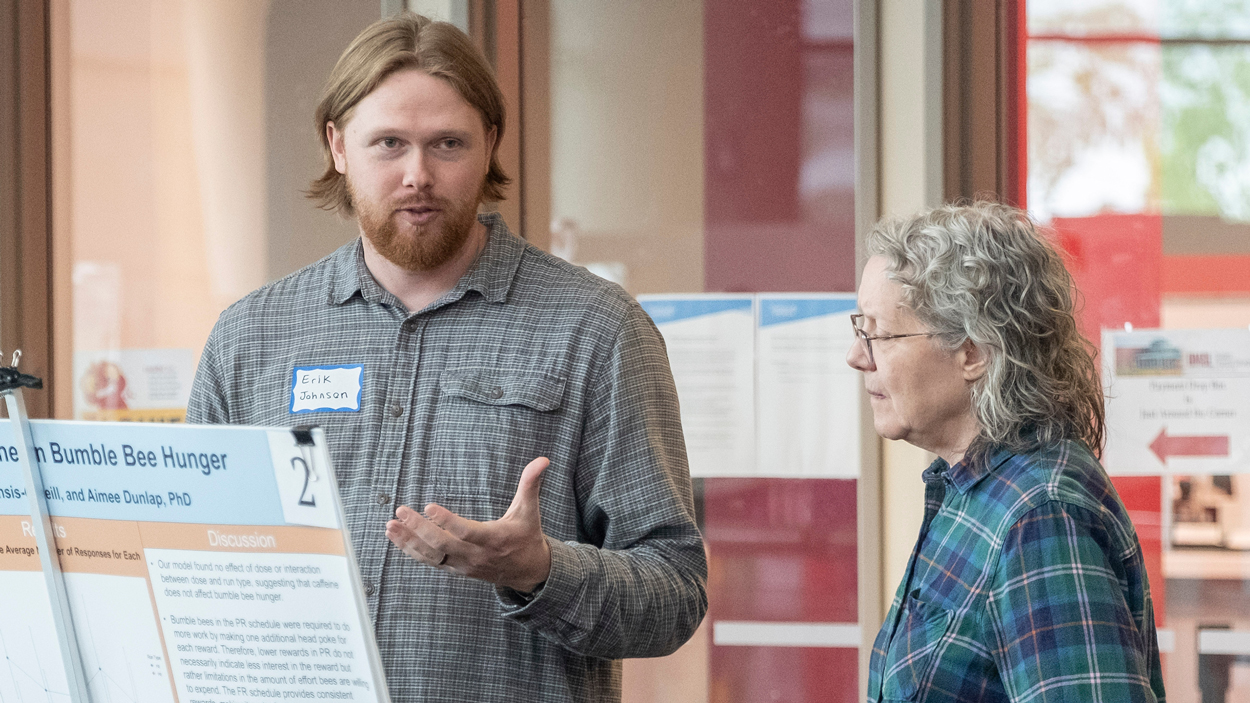
Erik Johnson, a biology doctoral student, discusses his research with Associate Professor Sharlee Climer. Johnson won first place in the math, computer science and natural science thesis contest.
She found a strong statistical relationship between stated issue priorities and funding allocation preferences when there is a clear and direct link between the two. For example, if a voter thinks crime is the most important issue facing St. Louis, that person typically will want to fund the police and emergency services.
“However, if it’s a little messier, if you’re worried about something like race relations, there’s not such a clear funding allocation preference,” Carpenter said.
Carpenter was motivated to participate Friday after previously presenting in the Undergraduate Research Symposium.
“That was a really great experience for me,” she said. “It really built up the skills that I needed when I wanted to go into graduate school and further.”
At noon, the judges presented monetary prizes to first-, second- and third-place winners in three categories: non-thesis; thesis in math, computer science and natural science; and thesis in social science, humanities, business and education.
Carlton won the non-thesis division. In the math, computer science and natural science contest, Erik Johnson, a biology doctoral student, won first place for “The Causation and Maintenance of Male Genital Antisymmetry in the Livebearer Xenophallus umbratilis.” Tabish Gul, a behavioral neuroscience doctoral student, won the social sciences category with his project, “From Stranger to Self: The Role of Familiarity in Modulating the N170 and N250r ERP Components.”
“I love my research,” Johnson said. “I think doing research here at the university is such a privilege, and to be able to present to a lot of awesome people and to have people interested in what I’m doing feels really great.”
Undergraduate Research Symposium
After the graduate student luncheon and award presentations, the Undergraduate Research Symposium got underway. More than 40 projects were presented by more than 65 students, who were mentored by 25 faculty members. Attendees were still able to circulate around the Century Rooms and rotunda to view poster presentations, but they were also able to sit in on oral presentations.
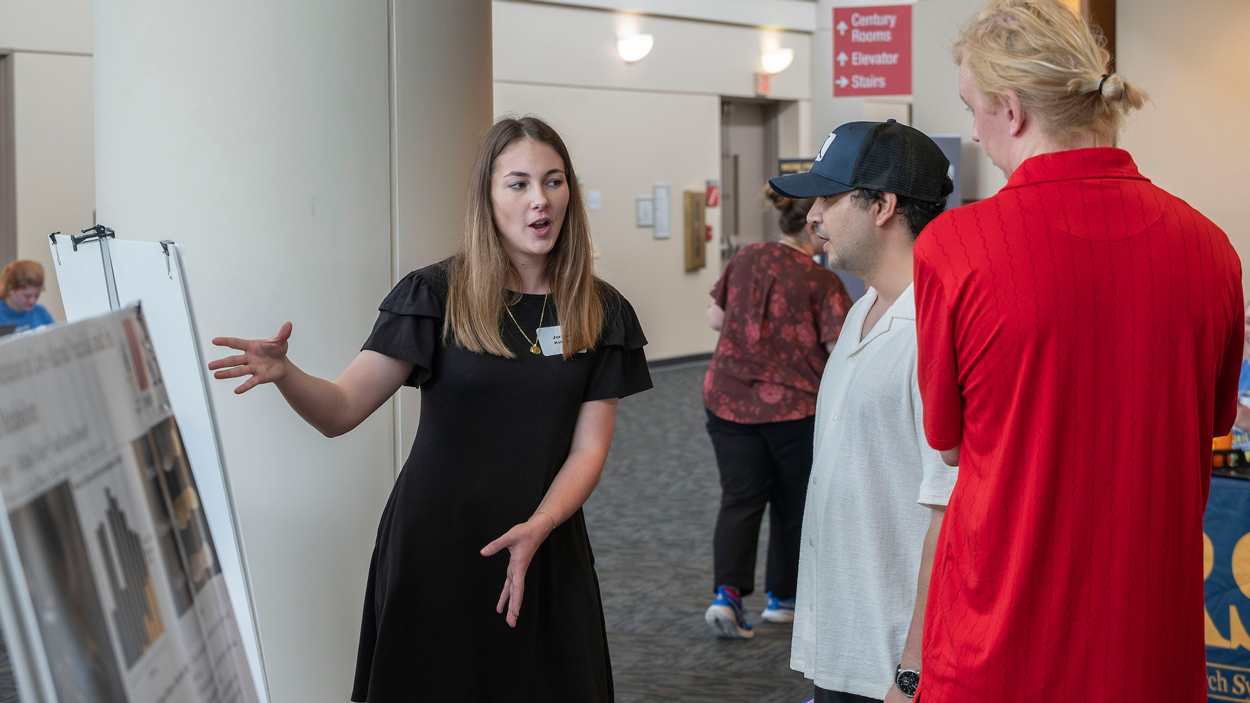
Jordan Kolinski, a senior biology major, talks about her research project titled “Tarantulas Can Use Black and White Cues in a Discrimination Learning Task” with graduate student Samir Kuinkel and junior biology major Kory Anthony-Petter.
Jordan Kolinski, a senior majoring in biology, developed a study on tarantulas after working with doctoral candidate Becky Hansis-O’Neill the past two years. Kolinski wanted to know if tarantulas can use visual cues to learn. She said tarantula vision is poorly understood, and that gap in the research compelled her to pursue the subject.
For the study, Kolinski set up a choice chamber with black paper on one side and white paper on the other. Each tarantula was assigned to learn either the black or white cue. When they went to the correct side, they were left alone for one minute. But if they went to the wrong side, vibration was applied until they moved to the correct side.
“Around the seventh trial, they ended up learning to go to the correct side first,” Kolinski said.
Karch Knipp, a sophomore majoring in biology, came to UMSL specifically for the numerous research opportunities available to undergraduates.
“When I looked into UMSL, I saw that it had the Whitney R. Harris World Ecology Center,” Knipp said. “I’m super into ecology, biology, evolutionary biology, all that kind of stuff. So, that was right up my alley.”
Before Knipp had even completed a full week of classes, he applied for and landed a position in Michi Tobler’s lab, which studies extremophile fishes. It wasn’t long before Tobler, the E. Desmond Lee Endowed Professor in Zoological Studies, and Soren Johnson, a doctoral candidate in Tobler’s lab, found research work for him.
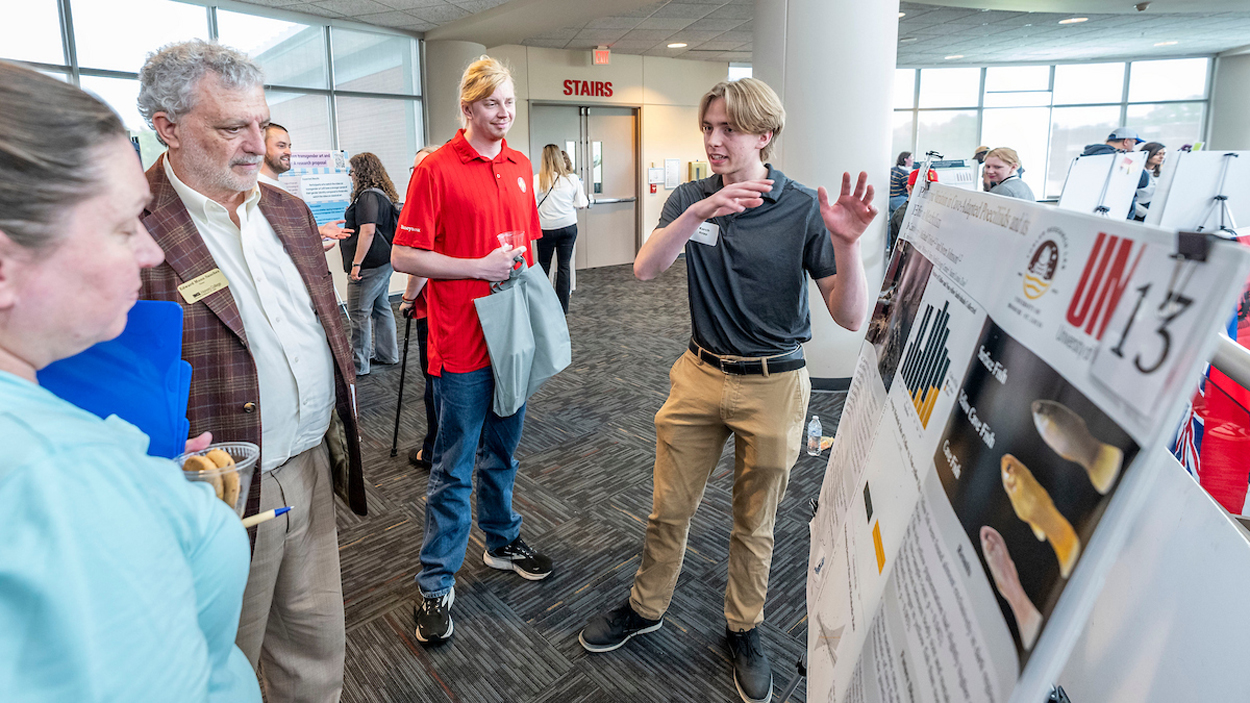
Karch Knipp, a sophomore majoring in biology, presents his research Friday afternoon during the Undergraduate Research Symposium.
Knipp’s research project explored the phenotypic variation between surface-dwelling and cave-adapted livebearer fish. Cave-adapted organisms typically lack pigment compared to their surface counterparts. Knipp explained that the lack of pigmentation lowers their metabolism, which is important in a low-energy environment. So, he became curious about a population of bright yellow livebearer fish found in caves.
“A very interesting result that I got was that the yellow pigmentation actually increased their metabolism, the opposite of what I expected,” he said. “A lot of literature has come out saying that this is likely due to what’s called recessive, monogenic inheritance.”
On the surface, a recessive trait such as bright yellow coloration is likely to get a fish spotted by predators and eaten. Knipp posited that there’s little light and no predators in the cave, so being yellow isn’t a survival hazard.
Overall, the students were proud to take part in the events and exhibit their work for the UMSL community.
“I’m super grateful to those who put this on,” Johnson said. “I think it’s great to have students come together and be able to share their work. We work really hard, and the times that we get to see each other’s work and show off what we’ve been working on are really valuable.”