
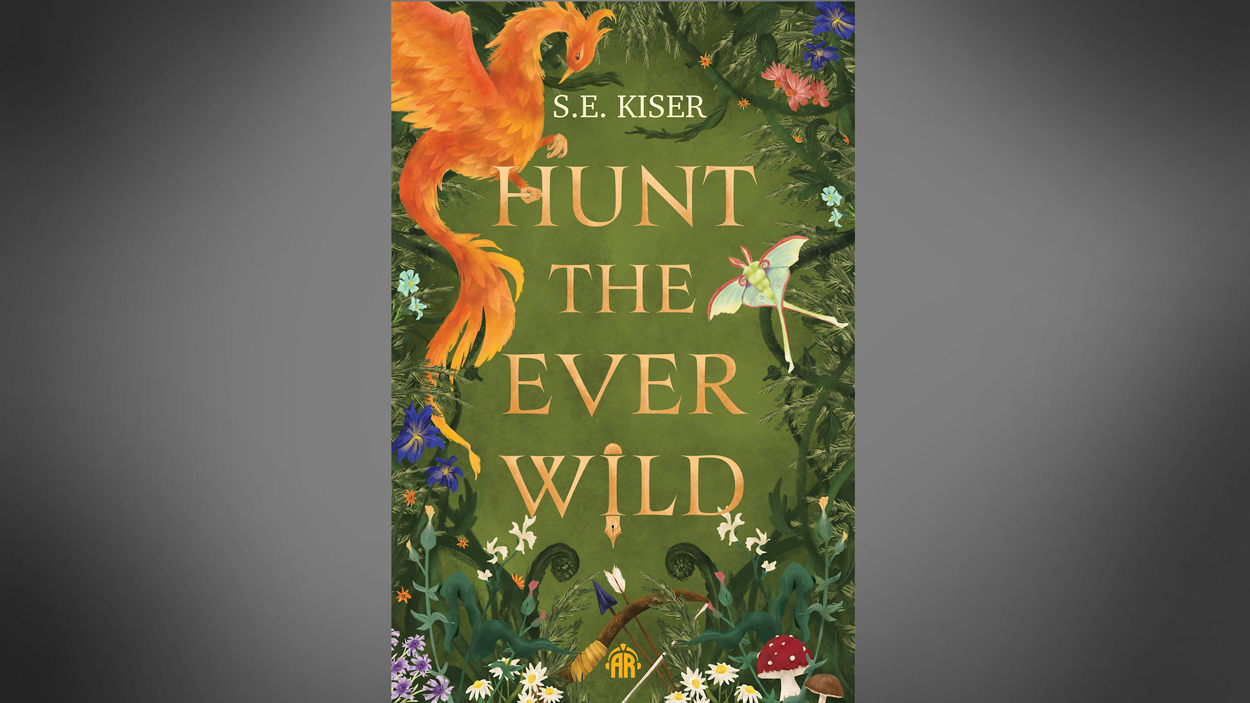
Sarah Kiser’s debut novel, “Hunt the Ever Wild,” will be published in June by Angry Robot. Kiser, who is pursuing an MFA at UMSL, gravitated toward working in gothic fantasy because the genre offers a unique fusion of the enchanting and the macabre. (Photo courtesy of Sarah Kiser)
Growing up in rural Bonne Terre, Missouri, Sarah Kiser didn’t have access to high-speed internet. However, Kiser never wanted for entertainment.
There was plenty to read.
“My parents read to me as far back as I can remember, and they always encouraged my reading habits and listened to the nonsense stories I would tell them,” Kiser said. “Once I knew how to read on my own, I would read everything I could get my hands on: chapter books, magazines, comics, newspapers, even encyclopedias.”
Kiser began writing stories at the age of 9 when the family finally bought a computer. It wasn’t long before Kiser imagined becoming an author. Now, many years and several attempts later, that childhood dream has come to fruition.
In June, Angry Robot will publish Kiser’s debut novel, “Hunt the Ever Wild,” a gothic fantasy about a wicked king’s hunt for a mythical phoenix that brings Sy, an indentured wizard, and Anya, a cagey hunter, together in the magical Lichtenwald forest. In addition to writing fiction, Kiser is pursuing an MFA at the University of Missouri–St. Louis and working with undergraduates at the UMSL Writing Center and in first-year composition courses.
Now that the novel has a release date, Kiser has been able to appreciate the culmination of three years of hard work and soak in how it feels to be a published author. Turns out, it’s many things at once.
“Brilliant. Incredible. Amazing. Showstopping. Spectacular,” Kiser said. “It is really and truly an absolute dream come true.”
That dream didn’t always seem so feasible, though. Throughout high school, Kiser was convinced it would be better to major in something “practical.” Ultimately, when it was time to apply to colleges, English prevailed over other career paths Kiser perceived as more pragmatic.
“I just loved books too much,” Kiser said. “My emphasis was in literature, not creative writing. I wanted to study the best writing under the people who know it best. In hindsight, I’m grateful to myself for following my gut.”
That instinct first led to Old Dominion University in Norfolk, Virginia, where Kiser earned a BA in English. After graduating, Kiser was somewhat uncertain about what to do next, but academia felt like a natural fit for an avid learner.
Kiser returned to Missouri and enrolled in the English MA program at UMSL. The university offered the flexibility and support Kiser needed as a first-generation, low-income student, and it was relatively close to Bonne Terre. The UMSL community also helped cement the decision.
“I love the people here,” Kiser said. “We come from all backgrounds, all cultures, all walks of life. I feel comfortable here.”
In the Department of English, Kiser has found knowledgeable, thoughtful faculty members who consistently work to foster students’ growth. Kathleen Nigro, retired associate teaching professor, was particularly impactful. Nigro’s “Feminism and Witchcraft” course was a watershed moment for Kiser.
“I can pinpoint that course specifically as one that helped put me on the path I’m on now,” Kiser said. “Dr. Nigro was one of the first professionals to tell me my writing was worth sharing, and her course introduced me to ecofeminism, which became a vital framework for my understanding of the world and consciously informs my fiction writing.”
Kiser’s education at UMSL has continued in the Creative Writing MFA program. It’s provided an opportunity to hone Kiser’s craft, connect with other writers and gain teaching experience. The MA and MFA programs also spurred a commitment to finish a novel. In 2021, Kiser splurged on a Scrivener license, promising that a completed work of fiction would come out of it.
Kiser fulfilled that pledge, completing an epic fantasy novel that went unpublished. It was the first of three novels Kiser authored before penning “Hunt the Ever Wild.” While countless hours at the keyboard went into successfully publishing a novel, Kiser said most of the story flowed easily during the writing process.
“I think Anya and Sy were so vivid and real in my mind I was able to let them take over whenever the plot began stalling,” Kiser said. “It felt less like telling the story what to do and more like letting the story tell itself to me, which is any writer’s dream. The most difficult part was nailing the ending, because there were quite a few plot threads and a lot of built-up tension to resolve. When the ending finally did come to me, I knew it was perfect. I’m extremely happy with how it turned out.”
Readers will no doubt be captivated by Sy and Anya’s journey. The prize for capturing the mythical phoenix would be enough for Sy to pay for his magical education and earn his freedom from the evil king. However, surviving the Lichtenwald forest is no easy feat, so Sy enlists Anya who has lived at the wood’s edge all her life. But Anya has her own motivations and seeks to lift a witch’s curse with the capture of the phoenix. Both parties are operating through deception and half-truths, and only one can claim the prize. But as Kiser puts it, “anything can happen in the wood.”
Kiser drew inspiration from authors such as Ursula K. Le Guin, Tanith Lee, Lois McMaster Bujold and Diana Wynne Jones. “Howl’s Moving Castle,” one of Jones’ most well-known works, was particularly influential. But echoes of the real-world can also be found in the pages of “Hunt the Ever Wild.” The novel touches on themes ranging from environmentalism to labor exploitation to love.
“I guess my way of imagining a better future begins with first being able to love someone else selflessly, which in turn begins with being able to truly love yourself,” Kiser said. “Being trans and nonbinary, I’m also very personally invested in the idea of a union of opposites. Many people believe the masculine and feminine are not only opposites, but fundamentally opposed, and our society supports that assumption. But reality is much more fluid and weird.”
Kiser gravitated toward working in gothic fantasy because the genre offers a unique fusion of opposites – the enchanting and the macabre. While fantasy provides a sense of imagination and escape, the gothic revels in darkness when necessary and gives readers a safe way to confront evil. Fantasy readers will be familiar with the general beats of the story, but Kiser worked to purposefully upend certain well-worn tropes.
“I adore fantasy, but I’m not interested in fantasy that supports the status quo,” Kiser said. “As one example, I can’t stand fantasy stories in which only certain ‘special’ people are capable of using magic.”
The concept of “magical blood” is a boring and potentially ugly way to conceptualize magic to Kiser. It’s more interesting as a form of knowledge that can be wielded by people from all walks of life with proper dedication.
Kiser is currently working on a new book and eventually hopes to revisit the unpublished first novel. But, for now, Kiser is grateful the stars aligned, and “Hunt the Ever Wild” will be in the hands of readers this summer. Ideally, the book will not only be a page-turning read but also motivation for others to chase their dreams and make change.
“Just because things are a certain way doesn’t mean they have to be,” Kiser said. “Everything made by humanity can be unmade by us, too. We can live in a more just society, but we have to make it. It won’t make itself.”
“Hunt the Ever Wild” will be available for purchase on June 23 and is available for preorder through Amazon, Barnes & Noble, Books A Million, Bookshop.org, Hudson Booksellers, Powell’s, Target and Walmart.