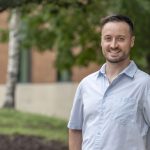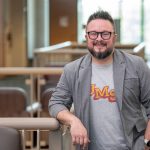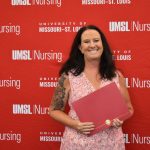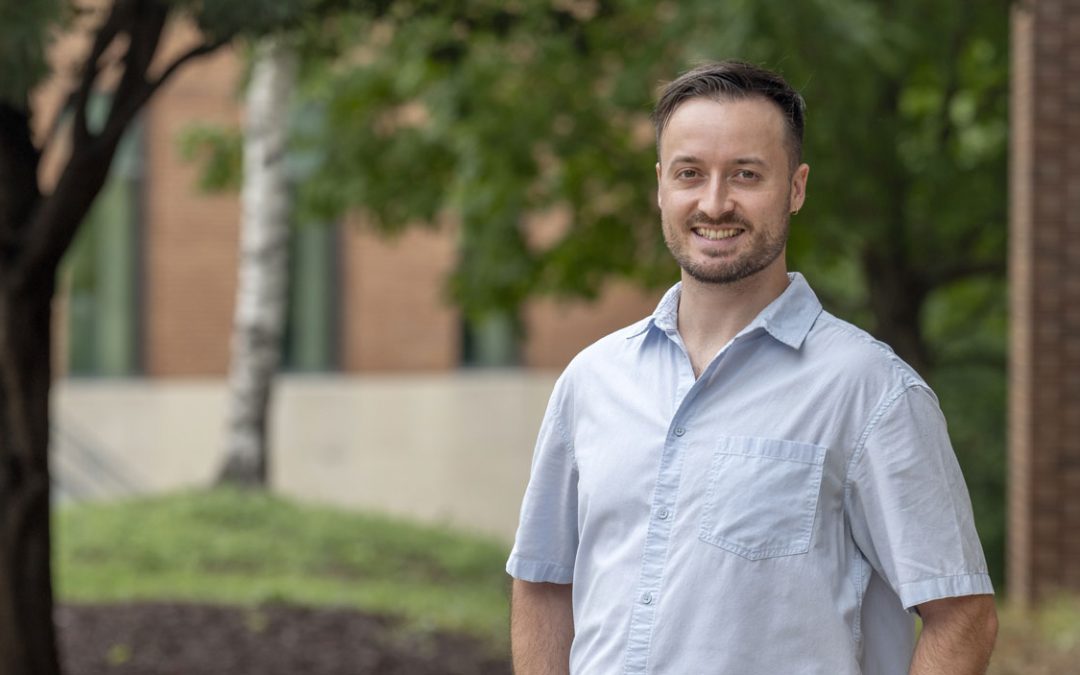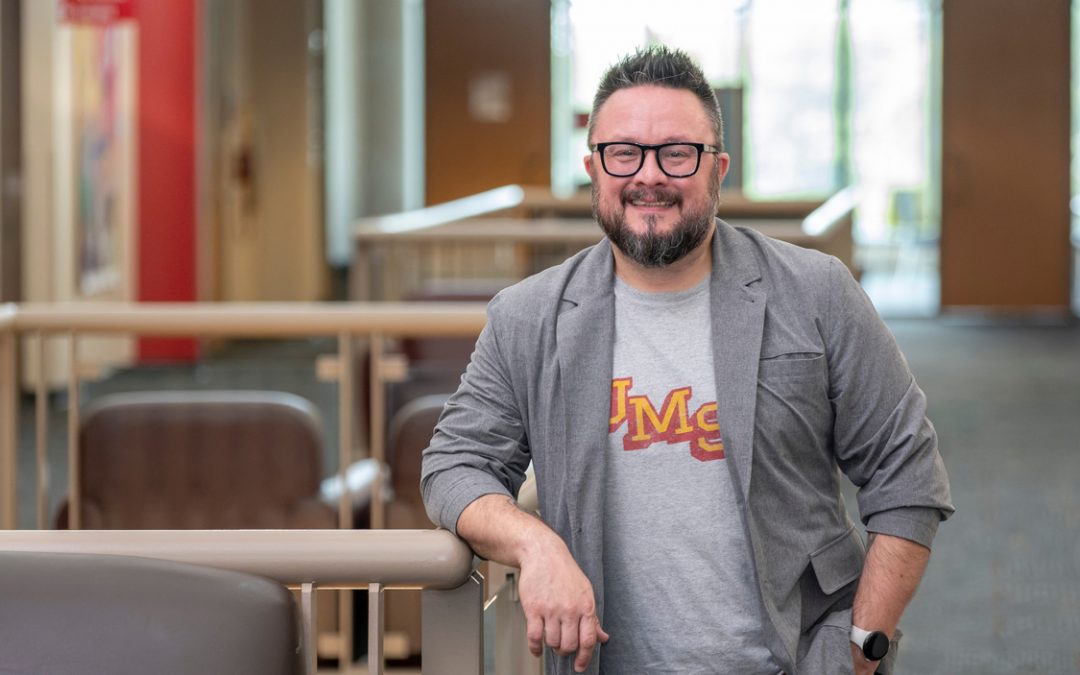
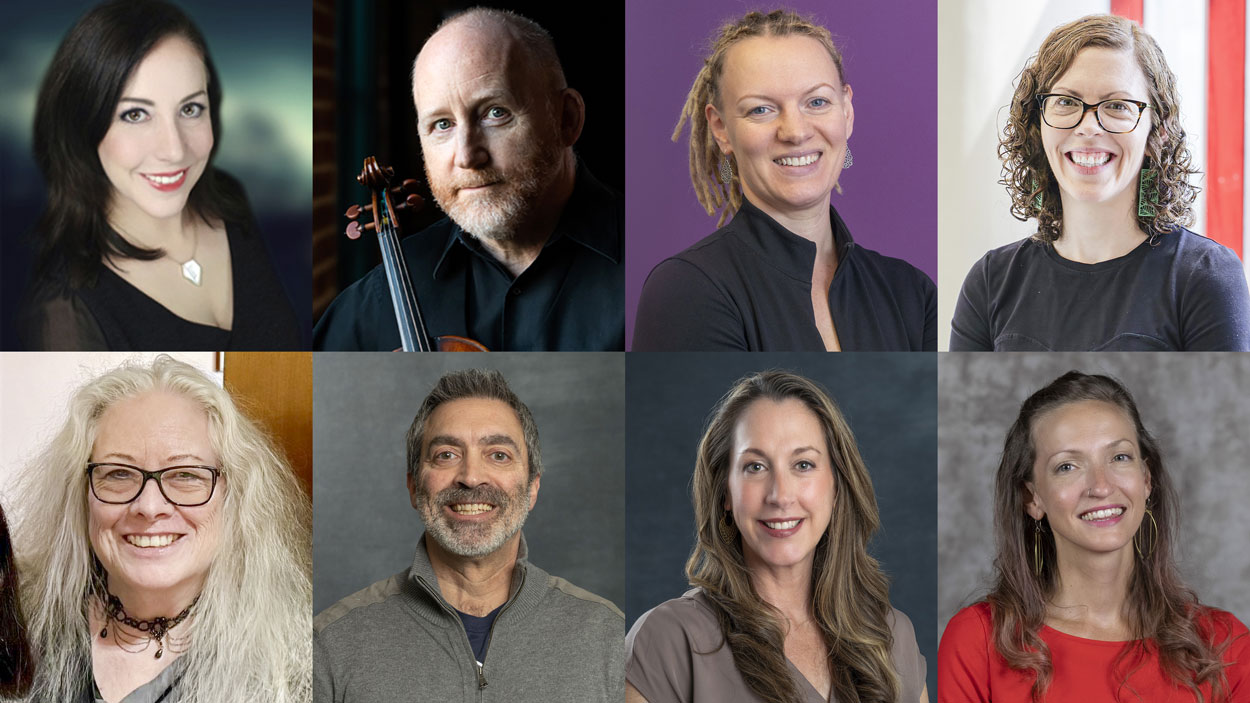
(Clockwise from top left) Stephanie Merritt, John McGrosso, Sandra Langeslag, Carissa Philippi, Annah Bender, Shannon Ahrndt, Marc Spingola and Laura Miller have been granted time to devote to research or course development during the fall or spring semester of the 2026-27 academic year. (Photo collage by Derik Holtmann)
The University of Missouri–St. Louis is granting sabbaticals or teaching releases to six tenure track and two nontenure track faculty members to expand their scholarship or enhance their curriculum during the upcoming academic year.
Associate Professor Annah Bender from the School of Social Work; Associate Professor Sandra Langeslag from the Department of Psychological Sciences; Professor John McGrosso from the Department of Music; Professor Stephanie Merritt from the Department of Global Leadership and Management; Laura Miller, the Eiichi Shibusawa-Seigo Arai Endowed Professor of Japanese Studies and Professor of History; and Carissa Philippi from the Department of Psychological Sciences will each spend either the fall or spring semester pursuing research work through the university’s sabbatical leave program.
Nontenure track faculty members Shannon Ahrndt, an associate teaching professor in the Department of Communication and Media, and Marc Spingola, a teaching professor in the Department of Biology, have also received teaching releases to allow them to enhance their teaching skills or work on curriculum or course development through UMSL’s Teaching Release Program for Nontenure Track Faculty. The program is meant to allow for professional development for experienced, non-tenure track faculty.
“Sabbaticals and teaching leaves give faculty the time and freedom to deepen their research, rethink their teaching and spark new ideas that strengthen both scholarship and the curriculum,” said Steven J. Berberich, provost and vice chancellor for academic affairs. “We’re glad to continue offering these opportunities to our outstanding UMSL faculty and look forward to the impact their work will have in the coming year.”
Under University of Missouri System policies, tenured faculty members are eligible to apply for a sabbatical leave after six or more years of service. There are similar requirements for nontenure track faculty members to be eligible for UMSL’s Teaching Release Program.
The application process for sabbaticals and teaching leaves during the 2027-28 academic year will open later this year with deadlines to apply next fall.
Learn more about how each of the faculty members plans to use their time away.
Sabbaticals
Annah Bender, School of Social Work: Bender plans to spend her fall semester sabbatical completing a co-authored book tentatively titled “Restoration and Accountability: Survivors of Intimate Partner Violence on Justice and Punishment.” The book, co-written with Assistant Professor Jill Delston from the Department of Philosophy, will showcase the results of a study Bender conducted with support from a $10,000 UMSL Research Award. She collected primary data in St. Louis and will integrate social work and philosophy as she and Delston explore a subject that remains pernicious as a societal problem and has been central to Bender’s research. They’ve already met with two publishers about the project and are hopeful they can complete a monograph in time for a spring 2027 publication date. Bender also plans to develop a proposal for a competitive R15 grant from the National Institutes of Health. Such a grant would allow her, as a principal investigator, to fund opportunities for students who are interested in social science research and create a training pipeline for undergraduates who may wish to pursue graduate education at UMSL as well as graduate students seeking research mentorship and support for their own work.
Sandra Langeslag, Department of Psychological Sciences: Langeslag has been researching romantic love for more than two decades and recently began studying parasocial love – i.e., people developing romantic feelings for media figures, such as celebrities and fictional characters – and AI love – i.e., people falling in love with artificial intelligence companions. During her spring sabbatical, she plans to write two manuscripts on parasocial love based on data that she is currently collecting. These manuscripts will describe the subjective feelings – including love feelings, pleasantness and arousal – and the brain’s response to the parasocial beloved. She also plans to apply for external funding to conduct studies on AI love. This work will provide research training for graduate and undergraduate students. In addition, Langeslag will engage in outreach to the public through the popular media to help people understand the experiences of parasocial love and AI love. One important concern with parasocial love and AI love is that they become substitutes for real-life interactions, love feelings for real-life people and real-life romantic relationships. Although the proposed research is fundamental research driven by curiosity, it has the potential to ultimately contribute to decreasing the negative effects of parasocial love and virtual AI love on individuals and society.
John McGrosso, Department of Music: McGrosso plans to use his fall sabbatical to complete a comprehensive instructional resource for violinists focused on orchestral “excerpts,” short but technically and musically demanding passages now widely used in both student and professional auditions. Students often lack access to expert guidance, unless they’re in major metropolitan areas receiving lessons from highly trained teachers. A former member of the St. Louis Symphony Orchestra and now a longtime member of the Arianna String Quartet, McGrosso aims to address this gap by offering detailed instruction on both technical challenges, such as rhythm, intonation and musical interpretation, including phrasing and stylistic nuance. The project will take multiple forms: a written guide, a series of YouTube performance videos and a companion website. A distinctive feature is the inclusion of newly created piano accompaniments, designed to help students better understand the full musical context and improve ensemble awareness. McGrosso also plans to record these 14 excerpts with the new accompaniments for online dissemination. The website will host materials and enable interactive learning through workshops and coaching, while also promoting UMSL’s music program nationally and beyond.
Stephanie Merritt, Department of Global Leadership and Management: During her upcoming fall sabbatical, Merritt will focus on advancing a portfolio of research projects in her field of management. Her focus is on how employees experience work and what enables long-term employee success, particularly as organizations navigate heightened uncertainty, evolving expectations and persistent changes both technological and social. Her work is grounded in a central concern with improving employee well-being and workforce sustainability. The sabbatical will provide dedicated time to deepen and integrate this line of research, which seeks to better understand how to simultaneously improve both individual and organizational outcomes. A primary emphasis of the sabbatical will be the advancement of several ongoing research projects addressing key issues such as job insecurity and employee turnover, safety leadership and ethical decision-making, and how individuals manage and negotiate their identities at work. Collectively, this body of work aims to contribute to theory and evidence on how workplaces can support employee well-being while also fostering resilience and career longevity within organizations.
Laura Miller, Department of History: Miller will use her fall sabbatical to conduct fieldwork in Japan for a book entitled “Kofun Mania.” Kofun are burial mounds and tombs that date from the late 3rd century to the early 7th century. She will be based in Nara, where the earliest and the greatest number of kofun are located. Her project will use linguistic, historical and anthropological perspectives to track how kofun are experiencing a recent explosion in public interest. She believes that kofun mania originates from two forces: efforts by communities to promote their unique histories and female history enthusiasts. People in Nara and Osaka want to counter Kyoto’s boast that it is “the ancient capital of Japan,” a claim that ignores their earlier capitals and kofun archaeological sites. Meanwhile, female history enthusiasts are the primary participants in kofun-related travel and consumption. After learning about female shamans and leaders buried in local kofun, they want to visit those sites and acquire kofun-related foods, goods and experiences.
Carissa Philippi, Department of Psychological Sciences: Philippi will use her fall sabbatical to focus on research projects related to advancing treatment for depression by investigating why some patients benefit from Transcranial Magnetic Stimulation – a noninvasive brain stimulation therapy – while others do not. The work will examine how patterns of brain activity and self-referential thinking, including rumination and negative self-focus, influence treatment outcomes. Through analysis of brain imaging data from clinical trials and collaboration with leading medical centers, Philippi aims to identify biological and behavioral markers that can predict patient response to TMS. The project will also include specialized training in newer, more efficient or accelerated forms of TMS capable of delivering therapeutic effects in significantly shorter treatment sessions. In addition to analyzing existing datasets, Philippi will conduct a pilot study involving patients with depression undergoing newer accelerated TMS treatment to assess changes in cognitive patterns and brain function over time. These findings will be used to develop a larger grant proposal focused on personalizing depression treatment by aligning patients with the interventions most likely to work for them. The overall goal is to make TMS more effective and targeted, ultimately improving outcomes for individuals with treatment-resistant depression while strengthening research collaborations and mental health innovation in the St. Louis community.
Teaching releases
Shannon Ahrndt, Department of Communication and Media: Ahrndt plans to use her teaching leave to make major changes to her online Intercultural Communication course. She also teaches an on-campus section of the course, which is unique in how it connects students in the class with a group of international students from the Department of Language and Cultural Studies five times each semester to engage in experiential intercultural communication. Ahrndt will use this teaching release to develop an updated curriculum for the class and establish a similar experiential learning opportunity to benefit her online students. She will work to develop relationships with international universities via Collaborative Online International Learning to establish a cross-cultural exchange.
Marc Spingola, Department of Biology: Spingola will use his teaching release next spring to comprehensively redesign two upper-level elective courses: Molecular Biology and Virology/Advanced Virology. Both courses enroll more than 30 students each year across several degree programs. For Molecular Biology, the redesign will allow him to update the textbook, incorporate modern research techniques, and emphasize data analysis, writing-intensive work and frequent assessments, all within an in-person format. For Virology, Spingola plans to redesign the course by implementing enhanced writing-intensive and AI-resilient assessments while preserving the fully online format that has drawn high student demand. He has been working closely with the Center for Teaching and Learning on his plans to redesign both courses so they will better prepare students for careers and advanced study.