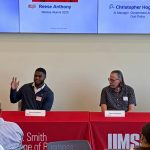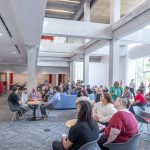
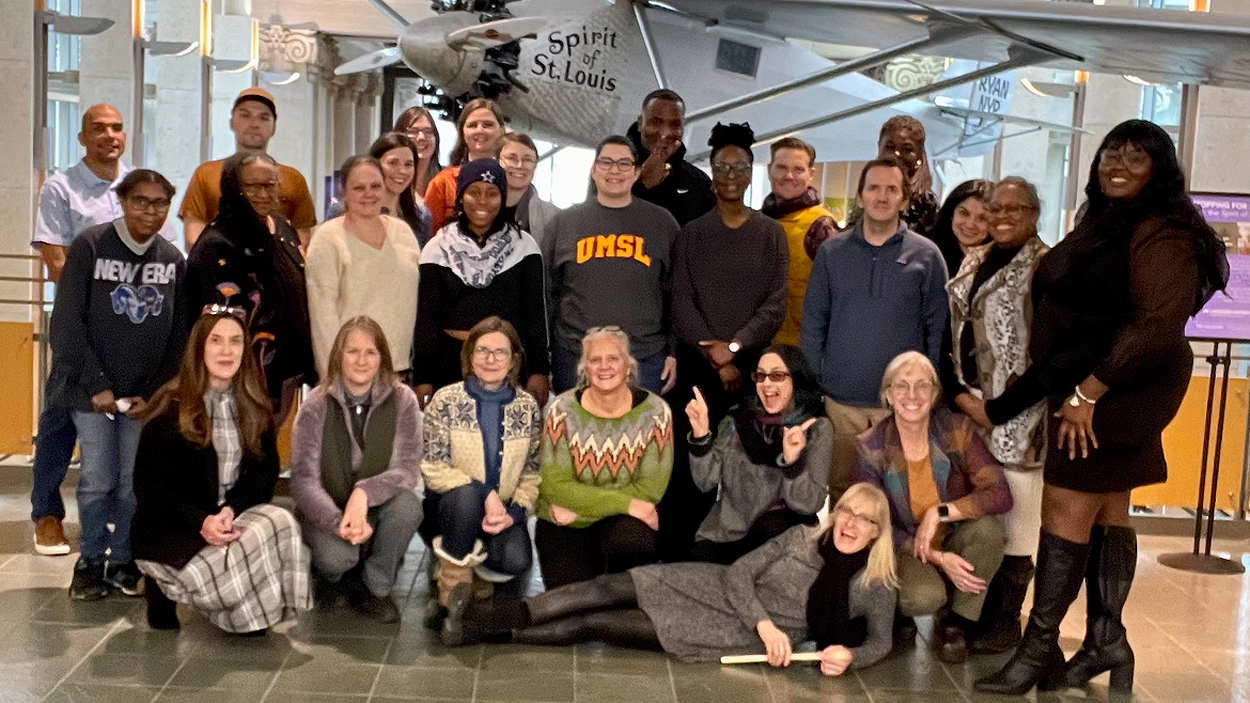
The third Heritage Leadership EdD cohort visits the Missouri History Museum in January 2023. In April, 10 of the 23 cohort members published original research in a special issue of the Journal of Interpretation Research. The cohort members and five faculty mentors published their research under a single IRB number, with the doctoral students listed as co-investigators who engaged in multiple, aligned projects. (Photos courtesy of Theresa Coble)
Students in the latest Heritage Leadership EdD cohort at the University of Missouri–St. Louis rose to the challenge when Theresa Coble announced that the Journal of Interpretation Research would publish a special issue on “interpreting contested heritage” in spring 2026.
If all went according to plan, that issue would include research related to their Heritage and the Human Spirit study.
Coble, the E. Desmond Lee Endowed Professor of Experiential and Family Education, leads the unique College of Education doctoral program, which is designed to be completed in three years and operates almost entirely online. The program focuses on interpretation – an educational discipline that helps people find meaning and facilitate connections at informal learning sites such as national parks, museums, zoos and historic places.
Completing a doctorate in three years is itself a feat. To some, publishing original research in one of the top academic journals in the field of interpretation might have been daunting. However, for cohort members Carol Fitzsimmons, Lotte Lent and Ajena Cason Rogers, that enterprising goal was a reason to join the program.
“I think that was the experiential education aspect of it that appealed,” said Fitzsimmons, senior program director of community development at Gateway Region YMCA. “We weren’t going to be writing a dissertation that just sits on the shelf. We were going to be doing something. We were going to have a dissertation, plus a journal article, plus a creative non-fiction chapter.”
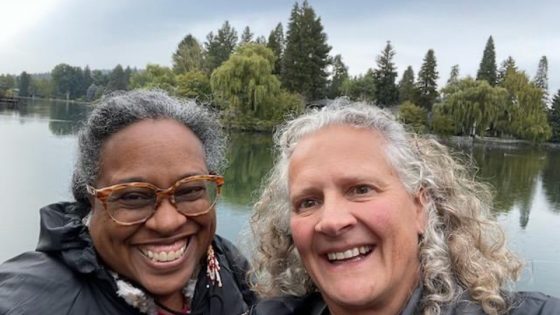
Ajena Cason Rogers and Carol Fitzsimmons visit Bend, Oregon, to conduct their doctoral research.
In April, years of hard work came to fruition when 10 members of the cohort, including Amanda Berlinski, Pamela Blair-Bruce, Jim Craig, Ryan Lindsay, Delia Lister, Ackesha Patrick and Heather Waterman, published five articles in a single issue of the Journal of Interpretation Research.
“I can’t tell you how thrilled I have been,” said Lent, interim director of the Museum Education Program at George Washington University. “I’ve sent it to all my friends. I was also inspired to present my research poster at the DC History Conference. It feels so good to have something out there that is meaningful and that has traction.”
The articles addressed contested heritage, a concept that refers to cultural, historical or natural assets whose meanings are subject to dispute between different groups. The topic aligned well with the Heritage Leadership program’s work, which examines the link between natural and cultural heritage, while also grappling with the difficult topics surrounding heritage sites such as bias, ethics and trauma.
The cohort members and faculty mentors published their research under a single IRB number, with the doctoral students listed as co-investigators who engaged in multiple aligned projects. Coble said it illustrated the collective impact a single program can make with a clear, coordinated vision.
“It can attract more attention than one-off articles,” Coble said. “The fact that heritage leadership alumni published six articles within a four-month period, and with five of the articles in a single special issue, I think that raises the profile of UMSL. We can call attention to an area of inquiry that we are focused on here, that UMSL is becoming known for.”
Craig, associate dean of the College of Arts and Sciences and chair of the Department of Sociology, published his EdD research findings in the Journal of Veterans Studies in January. He said the successful publication of multiple pieces of original research from a single cohort speaks to the value of the program.
“I think there’s a generalized assumption about EdD work – that it’s only about practice and not research-based,” Craig said. “That’s just a misunderstanding of the work that’s happening here. It is research. It’s deeply focused, and it adds knowledge to the greater community.”
College of Education Dean Marius Boboc concurred.
“I think it emphasizes the relevance and the contextual importance of the scholarship produced in the EdD program,” Boboc said. “It brings us together to look critically at our past, investigate the present moment and create a better future based on what budding scholars are telling us.”
On a personal level, Rogers, a supervisory National Park Service ranger at the Maggie L. Walker National Historic Site, said the experience led her to “learn a new language of writing.” Rogers has done much interpretive writing for exhibits with the NPS, but in the cohort, she honed her academic writing skills and found a way to effectively communicate with different audiences.
“I’ve been slipping my article slowly to friends,” she said. “I got feedback from a good friend who works with me at Maggie L. Walker, and he said, ‘This is great. It’s so accessible, and it’s something you can read, use and apply.’”
Rogers was also thrilled by the opportunity to work with former NPS Director Robert Stanton, who serves as a professor of practice working with the cohort. Likewise, Lent was excited to work with Coble, a nationally renowned leader in the field, and connect with professionals across the country from all walks of life.
The third Heritage Leadership cohort, which comprised a total of 23 doctoral students, also facilitated multidisciplinary connections across the UMSL campus. Craig was a critical link to the College of Arts and Sciences. Meanwhile, Lara Kelland, the E. Desmond Lee Endowed Professor in Museum Studies and Community History, came into the fold because Fitzsimmons simultaneously worked toward her master’s in museums, heritage and public history. Coble tapped Founders Professor Keith Miller and Associate Teaching Professor Chris Schott to work with the group, as well. Coble, Miller and Schott jointly authored an editorial that was published with the five research articles.
Schott, an English faculty member who has led the UMSL Writing Center for the past 13 years, said the experience has helped him improve the curricula for his technical and science writing courses. It’s also broadened his horizons as an academic.
“Most of my work is either administrative or in the classroom, so this has opened up a new part of my career,” he said. “None of this would have been put onto my plate without these kinds of relationships and collaborations. I’d just be working in my own little corner of the university. These collaborations are something that I think gives life blood to the university. It inserts some energy into the day-to-day hard work of education.”
Fitzsimmons, Lent and Rogers hope their research will provide insights and tools for others to effectively approach contested heritage sites. They know that the meanings and perceptions of certain places and historical events are not static. To engage with them meaningfully requires a willingness to hear different perspectives and an ongoing readiness to reflect on how the stories of these places have been told and how they might be better told.
“The goal is to create spaces where we can really listen to each other – understand and perceive the needs, interests and values across the things that might otherwise divide us,” Lent said, “and hopefully find the humanity in each other so we can come together more than be driven apart.”
In a country as large and diverse as the United States, with so many unique communities, with their own cultures, histories and traditions, their interpretation work is critical.
Fitzsimmons put it simply, “We’ve got to get it right.”