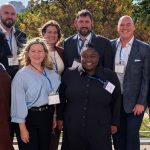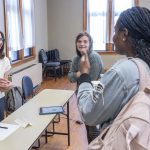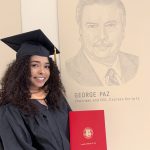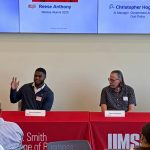
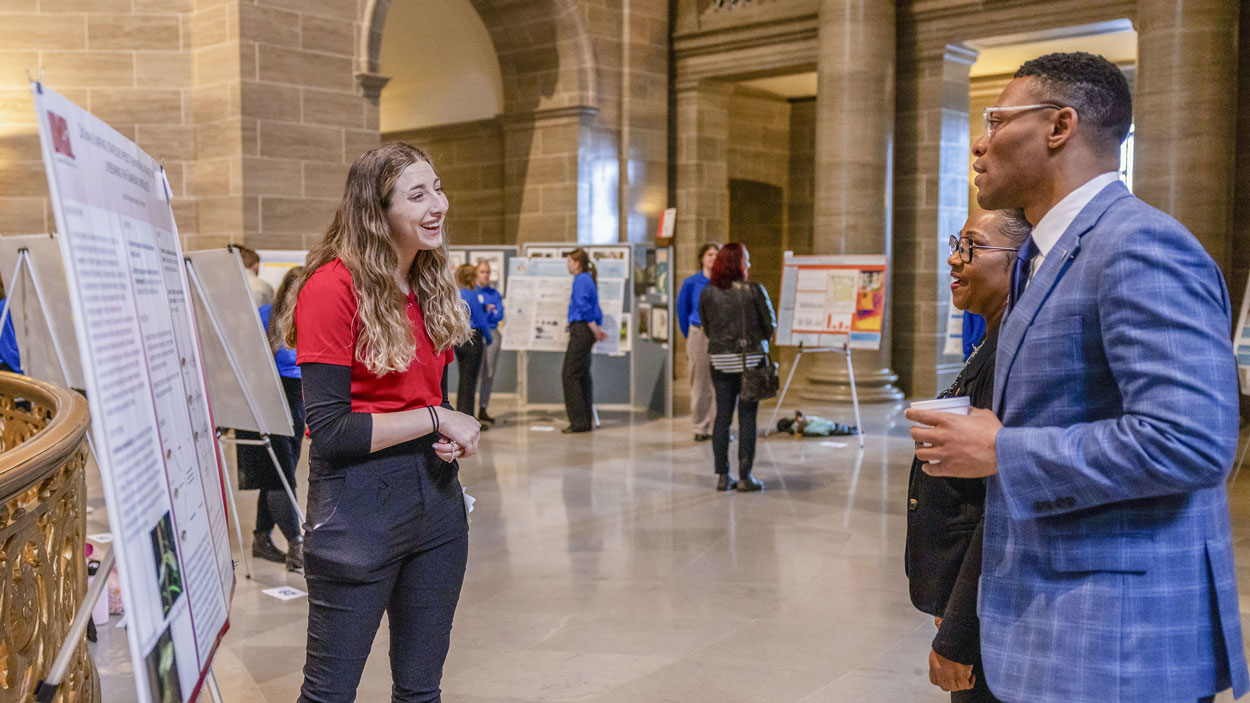
Biology major Zoe Ellis (at left) discusses her research on livebearing fish with Representative Marla Smith and Senator Brian Williams on March 12 at Undergraduate Research Day at the Missouri Capitol. (Photos by Abbie Nell Lankitus/University of Missouri)
Zoe Ellis has always felt a connection to the water, and she fell in love with the ocean during beach vacations growing up.
By her teenage years, particularly after watching the documentary “Blackfish,” she started to set her sights on becoming a marine biologist. But rather than focusing on aquatic mammals, she decided she wanted to work with coral reefs and study anthropogenic impacts – such as rising water temperatures and acidification – caused by human activity so that she might devise ways to help mitigate those issues.
Ellis, who grew up in Ballwin, headed for the coast after high school graduation in 2020 and enrolled at the College of the Florida Keys, a community college in Key West. She intended to spend two years in the marine environmental technology program there, then transfer to a four-year school in Miami to complete her bachelor’s degree. But when she was denied in-state tuition, she was forced to change course after completing her associate degree in 2022.
“I was freaking out,” she said. “I had no idea where I was going to go or what I was going to do.”
Ellis briefly returned home to St. Louis before heading to Papua New Guinea for nearly two months to spend time with a friend who had moved there. She came back and landed a job as a tank diver at a local Bass Pro Shops store to earn some money, but she felt no closer to figuring out her future.
Things started to change after the relatively last-minute decision to enroll at the University of Missouri–St. Louis just before the start of the fall semester in 2023. Ellis soon found a paying job as well as an undergraduate research role working with livebearer fish in Professor Michi Tobler’s lab.
Those opportunities working not only gave her lessons that complemented her coursework over the past three years as she completed her bachelor’s degree in biology, but they put her on the path to beginning a PhD program in biology at Saint Louis University this fall.
“Things kind of fell into place after the fish lab,” Ellis said.
Lessons in the lab
Ellis credits Associate Teaching Professor Meghann Humphries for helping connect her with Tobler, who at the time had just arrived in his dual appointment as the E. Desmond Lee Endowed Professor in Zoological Studies and senior scientist with the Saint Louis Zoo. She had gone to Humphries’ office hours one day early in her first semester and asked if she knew of any faculty members in the Department of Biology looking for undergraduate research help. She also told Humphries about her interests.
“Well, there’s this new guy that does fish stuff,” Ellis remembered Humphries telling her.
Tobler, whose lab studies different species of live-bearing fish with a focus on those living in extreme environments, recalled being impressed by Ellis’ background when she first reached out to him to inquire about potential work.
“She already had substantial research experience, including being a certified research diver in Florida, and she also had extensive experience with fish keeping and animal care through maintaining large aquariums for businesses around St. Louis,” Tobler said.
Ellis became the first undergraduate student hired in the lab, and Tobler said she made herself an “indispensable” part of its operations over the past three years as she took on some of the responsibility for feeding the fish and maintaining the rows of tanks that fill his space on the first floor of the Research Building.
“Zoe is extremely hard-working and genuinely passionate about aquatic ecosystems and animals,” Tobler said. “Her dog’s name is Minnow, which probably says a lot. She never misses an opportunity to participate in fieldwork and has also been involved in outreach activities, helping teach campus visitors about fish and aquatic biodiversity.”
Ellis has also worked alongside doctoral student Erik Johnson, who studies the evolution of asymmetric traits as well as how they influence behavior and how they are maintained broadly in live-bearing fish.
Over the past year, Ellis has even gotten the chance to explore some of her own research questions. With Johnson’s encouragement, she applied for and received an undergraduate grant from the Whitney R. Harris World Ecology Center to support a study looking at whether different mating strategies predict laterality – think handedness – in a metallic-looking live-bearing fish with the scientific name Girardinus metallicus that is native to Cuba.
“There are two different types of males – one that has black coloration on the ventral side and one that has plain coloration,” Ellis said. “But the males with the black coloration seem to behave differently in the mating process. The idea is, if you have that coloration, then you’re going to want to show off to the ladies, so you’ll have a propensity to go one way or the other while swimming.
“It’s been a good experience, just to work with experimental design, data collection and data analysis.”
This spring, Ellis presented her work alongside several of her lab mates at the University of Missouri System’s Undergraduate Research Day at the Capitol in March and again at UMSL’s Undergraduate Research Symposium in late April.
Ready for the next step
Ellis’ time in the lab has only been part of what has shaped her UMSL experience.
“I really like the program, and I love all of the professors in that department,” she said.
She’s packed her semesters with coursework – taking as many as 20 credit hours in one semester – to allow her to finish in three years, but she’s found plenty of classes that have captivated her.
“Once you get through your core, there are a lot of choices,” Ellis said.
Courses on animal behavior and herpetology as well as one on zoo and aquarium sciences stood out as some of her favorites. In her final semester, she took a course taught by Tobler on storytelling and conservation, in which she was tasked with communicating with different audiences about conservation topics. In one project, she recorded a podcast episode about carp.
After all her experiences at UMSL, Ellis was open to continue working with freshwater fish rather than marine life in general or coral in particular. Long term, she aspires to serve as a conservation director at either a zoo or an aquarium or as a professor, and she’d love a job like Tobler’s that allows her to pair both.
Ellis has known for a while that earning a PhD would be an important step toward achieving her career goals, and her coursework at UMSL – combined with her work in the lab – has left her well prepared. But funding challenges across the country made the application process a little nerve-wracking.
She felt a mix of joy and relief in February when she learned she’d been accepted into the doctoral program at SLU. She’ll be working with Professor Jason Knouft, who also serves as the director of the Freshwater Policy Institute at the National Great Rivers Research and Education Center.
Knouft’s lab integrates different data sources with hydrologic modeling techniques in an effort to predict potential impacts of environmental change on water resources and subsequent effects on various aspects of human and environmental systems. It also examines the potential of climate adaptation strategies to produce increased freshwater system resilience.
“His work is really well aligned with what I want to do,” Ellis said. “I’ll be more on the fish ecology side of things, but he does a ton of conservation work.”
It doesn’t matter than none of this exactly matches the plan Ellis had laid out for herself six years ago. She’s just excited to get started.