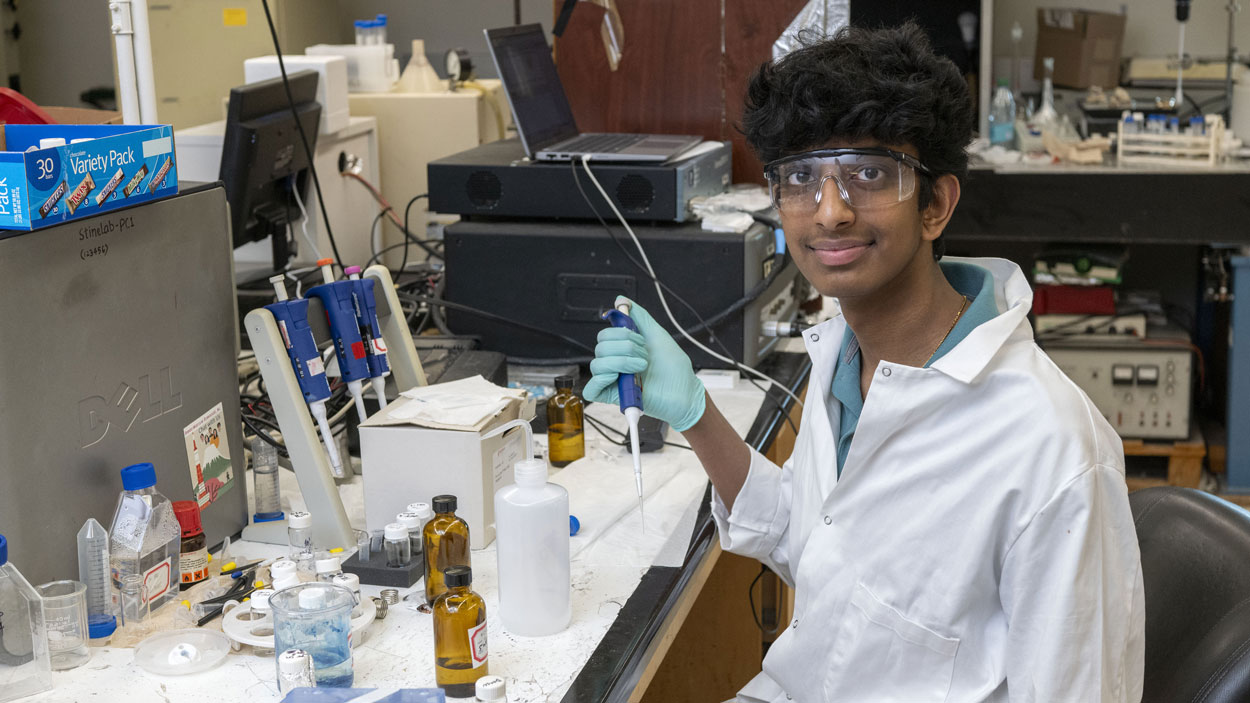
Marquette High School student Ayush Vasireddy has been conducting research using hierarchical bimodal nanoporous gold, or hb-NPG, to detect traces of Bisphenol F, or BPF, in water samples under the guidance of Professor Keith Stine and doctoral candidate Taiwo Adeniji since early 2025. He was recently recognized with four awards at the 76th annual Regeneron International Science and Engineering Fair. (Photos by Derik Holtmann)
Ayush Vasireddy peered down through his safety goggles as he lifted his pipette filled with water and got ready to a release a drop onto an electrode strip in a second-floor laboratory in the William L. Clay Center for Nanoscience at the University of Missouri–St. Louis.
The Marquette High School rising senior had already prepared the end of the strip with hierarchical bimodal nanoporous gold, or hb-NPG, and was now set to use it to test the water sample.
He was looking to see if it contained traces of Bisphenol F, or BPF, an industrial chemical that’s been used increasingly in products such as plastics, adhesives, baby bottles and sippy cups.
“It’s a contaminant of emerging concern,” Vasireddy said.
It can wind up polluting the water in lakes and rivers, and too much exposure to the endocrine-disrupting chemical can interfere with a body’s natural hormones, leading to developmental, reproductive, neurological and cardiovascular effects.
For the past year and half, Vasireddy has been working with his mentor, doctoral candidate Taiwo Adeniji, under the supervision of Professor Keith Stine, chair of the Department of Chemistry and Biochemistry, to develop a more effective means of testing for BPF. They developed the hb-NPG, which with its network of pores, provides a high surface-area-to-volume ratio and enhances conductivity and protein absorption, making it useful as a sensor for contaminants.
Adeniji said it’s been especially effective at detecting BPF.
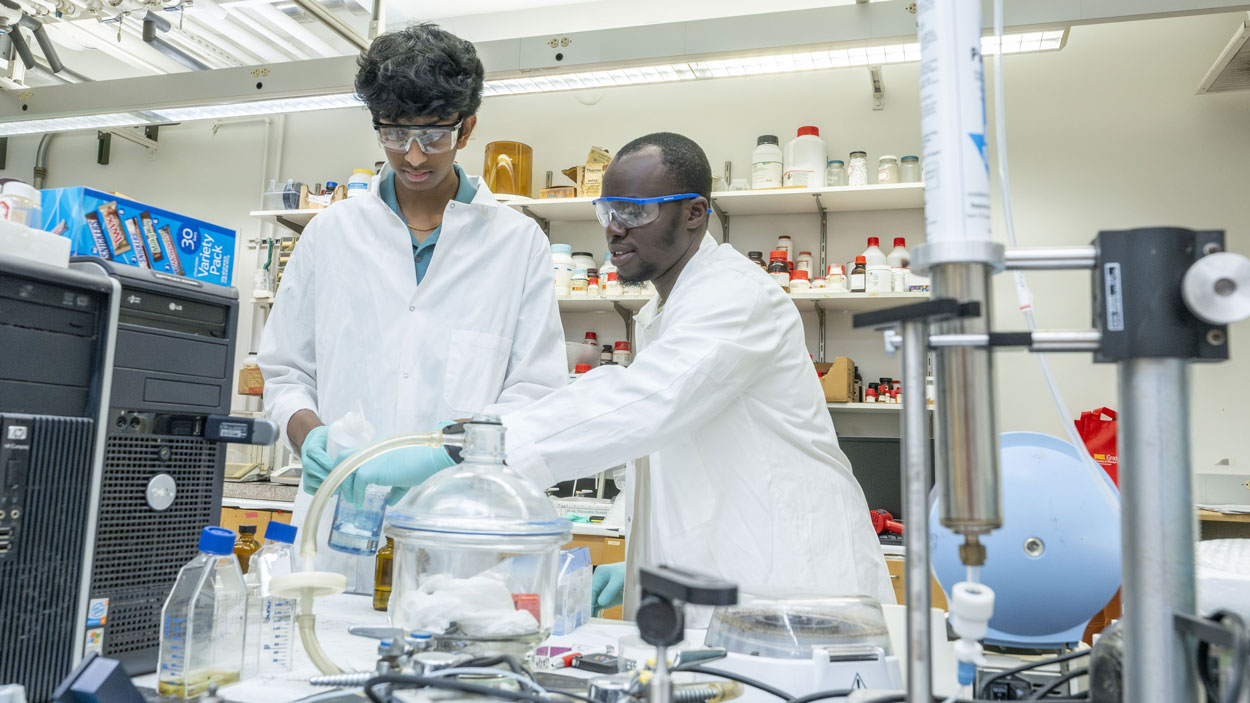
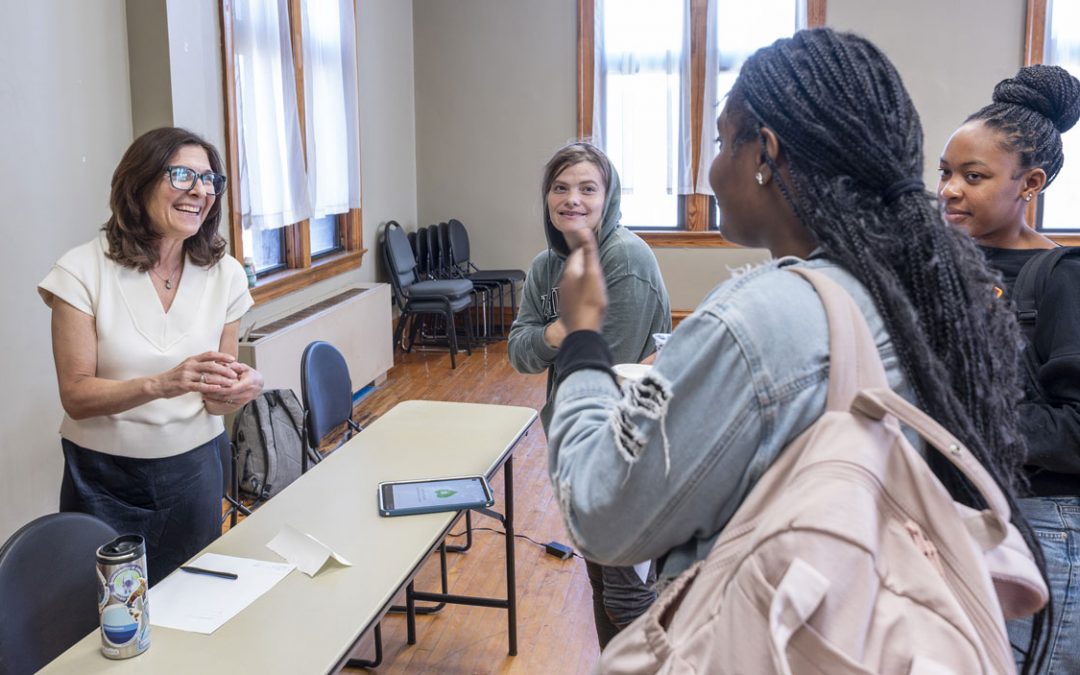
Doctoral candidate Taiwo Adeniji (at right) has helped mentor Marquette rising senior Ayush Vasireddy since he joined the lab of Professor Keith Stine in early 2025.
“I think it’s a very novel approach,” Vasireddy said, “and it’s very exciting to make a new structure and then get data that actually shows promising results.”
The research has the potential to influence policy. Testing water samples from lakes, rivers, seas or oceans for the presence of contaminants can provide evidence of the need to regulate their future use.
Vasireddy entered his work in the 76th annual Regeneron International Science and Engineering Fair, the world’s largest international pre-college science competition, which brought more than 1,700 young scientists and engineers from around the globe to Arizona last month for a week of events at the Phoenix Convention Center. He came away with four awards – a second-place award in the chemistry category and special awards from Arizona State University, the International Precious Metals Institute and the YM American Academy. The awards came with more than $5,000 in prize money plus the promise of a scholarship to ASU should he choose to enroll there.
The success was greater than he ever imagined.
“I was very happy to be at ISEF itself,” said Vasireddy, who won a regional competition to qualify. “I thought that was already an accomplishment in itself. To win a prize, I was very excited because months of work actually got me to a tangible result.”
Vasireddy began working in Stine’s lab in early 2025. He followed in the footsteps of former Marquette High School student Alice Liu, now a student at the Massachusetts Institute of Technology. Both were inspired by science teacher Cathy Farrar, whom Vasireddy had for both biology and a science research class.
Farrar encouraged him to reach out to Stine and inquire about potential research opportunities. Stine, in turn, connected him with Adeniji, a native of Nigeria who began pursuing his PhD as a member of Stine’s lab at UMSL in 2022.
“It’s been a great opportunity for me to mentor someone,” Adeniji said. “Obviously, he doesn’t really have the skill from high school, so he had to train a little bit in the use of the instruments in our lab and some other things, especially lab safety. But he has learned pretty quickly and has been an excellent student so far.”
Adeniji has been impressed with his dedication. He said he regularly receives text messages from Vasireddy with ideas or questions related to the work.
Vasireddy, for his part, has picked up knowledge he never could’ve received in a high school classroom.
“I think I was definitely a newbie at the beginning,” Vasireddy said. “I didn’t know anything about electrochemistry, nothing about that. I knew some basics about the research process, but I think I’ve learned a lot over my past year. I learned how to better my research process – like the methods, the background, and how to effectively do literature review, and then results – and then look at future work limitations and conclusions.”
The experience has reinforced Vasireddy’s interest in studying chemistry in college.
Vasireddy doesn’t have to finalize any of those plans until next spring. In the meantime, he’s spending the summer continuing his research in Stine’s lab alongside Adeniji.
For the next phase of their project, they’re hoping to take a similar approach toward the detection of so-called forever chemicals or PFAS, which have been used since the 1940s to make products resistant to heat, oil, stains and water but do not break down in the environment or the human body. They’re also aiming to make their approach portable so that they can test water samples in the field rather than having to collect them and bring them back to the lab.
“It’s been very interesting to do such a research project like this,” Vasireddy said. “Not only did I refine my research process, but then I’ve also learned a lot about chemistry and electrochemistry in specific.”