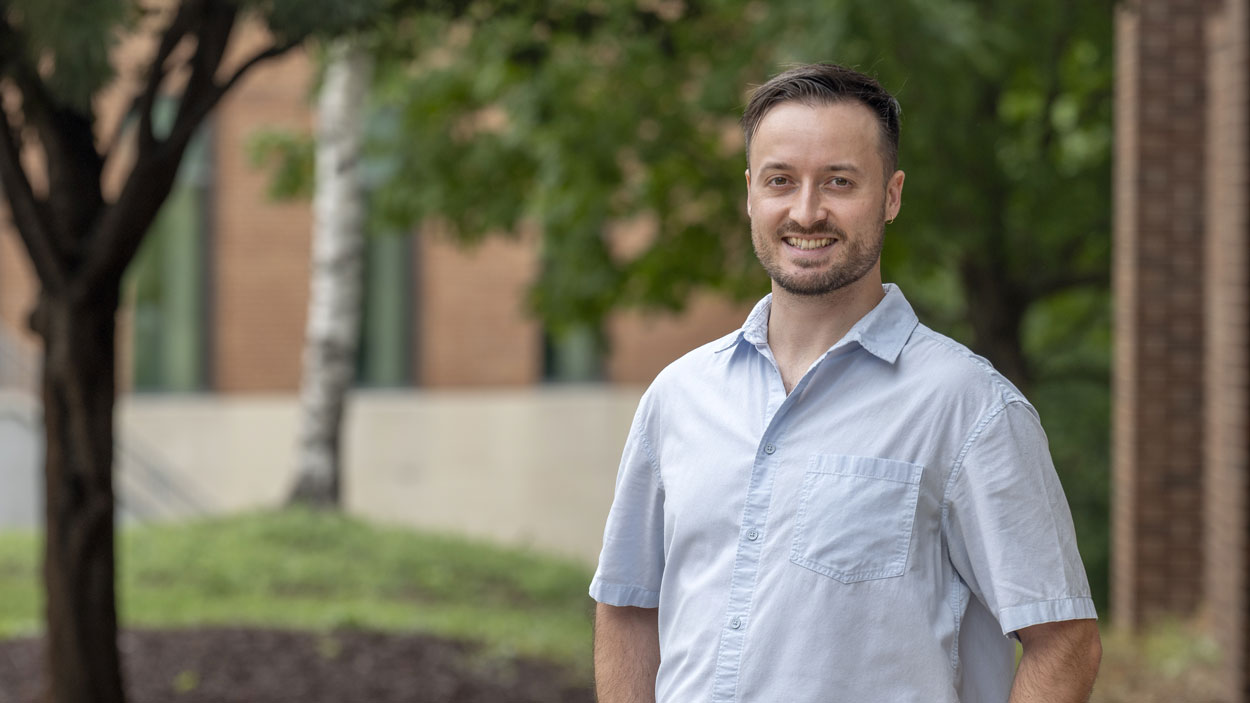
Austen Klein is pursuing a certificate in geographic information systems while majoring in history and minoring in political science. (Photo by Derik Holtmann)
Austen Klein won’t graduate from the University of Missouri–St. Louis until May, but he’s been getting a head start on building his career.
Klein, a senior majoring in history with a minor in political science, has also been pursuing an undergraduate certificate in geographic information systems, which are computer systems used to create, store, manage and analyze data linked to specific locations on a map.
This summer and fall, he’s had a chance to apply some of the skills he’s been learning while working as an intern at T-Kartor, an international geospatial technology and cartography company with an office in St. Louis. The opportunity came about through the Geospatial Workforce Development Program.
“It’s the first real work experience that I have had in this field, and it’s defied my expectations,” Klein said. “We work with satellite imagery. It’s very hands-on. You are working. You’re not getting coffee, except maybe for yourself. I’m kind of surprised how much hustle is involved, and it’s set a very strong expectation for what I might want to be doing in the next two or three years, which I think is great.”
Through the Geospatial Workforce Development Program, UMSL has engaged industry partners, including T-Kartor, to create opportunities for students to learn about and engage with emerging geospatial technologies and ultimately apply their education toward careers in a fast-growing sector of the global economy – one already estimated to generate nearly $5 billion in economic impact for the St. Louis region.
Klein knew little about geospatial technology or its growing importance to the regional economy when he arrived at UMSL in 2022. He certainly never considered it to be a career option.
The truth is Klein wasn’t sure exactly what he should study when he first started taking classes, almost a decade after his graduation from Webster Groves High School. He had earned an associate degree in guitar performance at Musicians Institute in Los Angeles, but it had been seven years since he had been in a classroom.
Klein had spent most of the intervening time working different jobs in the restaurant industry. Recently married and getting ready to start a family – he has a daughter who is now 2 – he just knew he wanted to unlock more career opportunities by pursuing a bachelor’s degree.
He ultimately decided to major in history.
“I didn’t want to go back to school for something I knew I wouldn’t like, even if I knew I could make money,” he said. “I just imagined the thing I would enjoy the most. Even when I was doing music, I was always reading books or studying musical history. So, I think a lot of it was pretty natural.”
Klein figured he might eventually decide to become a history teacher, but a flyer he spotted in the history department lounge during a coffee hour started leading him in a different direction. The flyer advertised UMSL’s new GIS certificate program shortly after it launched in 2023.
“I don’t know why I looked at it,” Klein said. “I think because it had a map or a globe on it. I was just kind of curious, ‘What is that?’ I think it spoke to me.”
He’d been thinking about ways to enrich his academic work toward his degree, and as he started to read about GIS applications, he recognized how it might apply to his studies. His own mind tended to think geographically as he thought about important historical events and characters, and he figured learning about geospatial tools might help him better convey historical facts and relationships to others.
“It just seemed to make sense in the moment, and it still makes sense,” he said.
Over time, Klein has come to see GIS not just as a tool but as a pursuit unto itself, with applications across interests and industries.
The GIS certificate program attracts students from different backgrounds and with different academic and career aspirations because the tools are so useful and have become embedded in so many different things.
“It kind of becomes this portal that everyone can use, despite their backgrounds, because it’s a visual form that makes sense to anyone that might be using it,” he said. “Most people might be using a GIS, but they’re just asking for directions on an app, and so to them, it’s just an app. But that means it’s working. Maybe it doesn’t need to be brought up to the surface all the time, but it is there.”
Klein didn’t have a background in computer science or data science, so he’s needed some technical training. But the GIS program has helped him start developing the skills he needs working with proprietary software such as ArcGIS as well as open source software such as OpenStreetMap.
He’s also gotten involved in the UMSL chapter of YouthMappers, a student organization that uses digital geospatial technology and open mapping tools to address global development, humanitarian and environmental challenges. He currently serves as the group’s president.
Klein was eager to take some of the things he’s learned at UMSL and apply them to a job setting. He spent four days a week at T-Kartor over the summer and has kept up working about 24 hours a week there this fall while balancing coursework.
“It’s all been enlightening,” he said. “We’re treated with a level of respect like other employees, and we’re supposed to rise to that expectation, which is great for an internship.”
Klein has nearly completed all of his coursework for his history degree and political science minor. But he expects to spend the spring semester doing another internship to meet the final requirement for his GIS certificate.
He is excited about the possibilities that await after graduation.
“I fully expect to work in the geospatial field afterward,” Klein said. “I knew that this was going to be a growing industry. That was my assumption, and so far, I still think that. It’s a small community still, but it’s a great time to get in.”