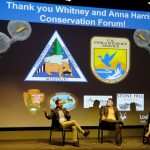
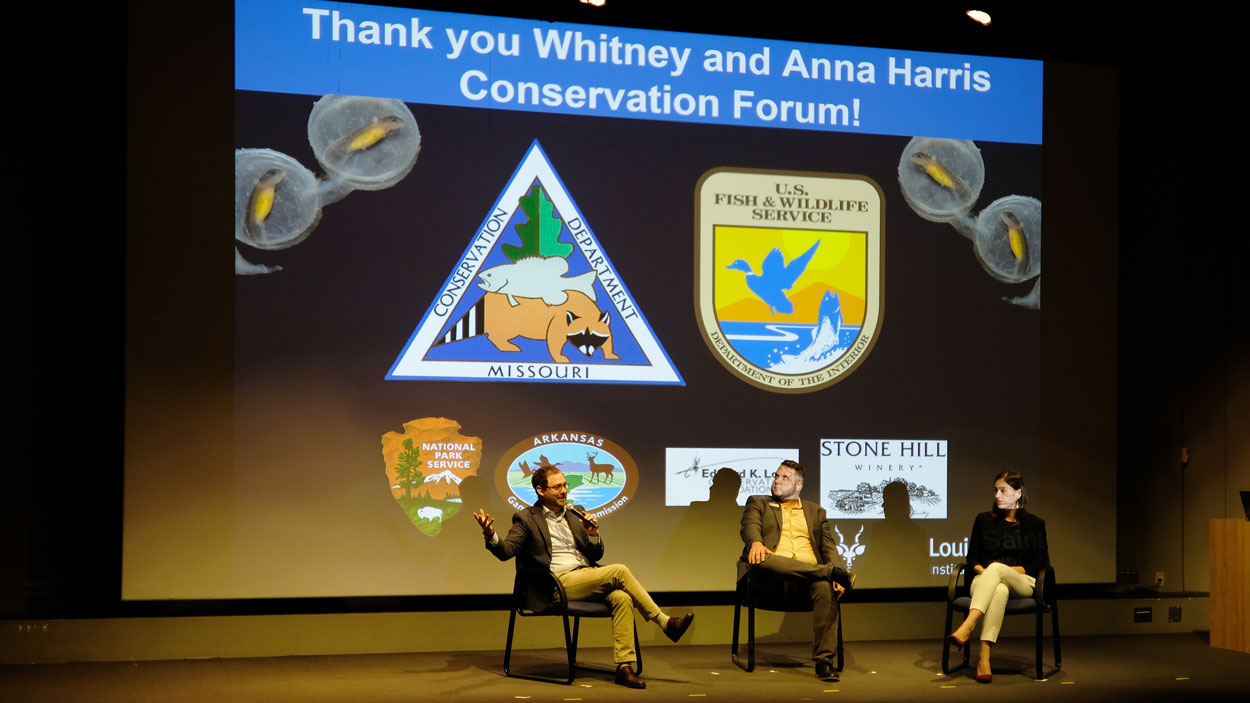
Pacific Bird Conservation Executive Director John Bender, a recent PhD graduate from UMSL’s Department of Biology, responds to a question from the Audience during the Whitney and Anna Harris Conservation Forum Thursday in The Living World at the Saint Louis Zoo. Bender joined fellow presenters Justin Elden from the Saint Louis Zoo and Laura Toro from the Missouri Botanical Garden during a Q&A at the end of the forum. (Photos by Steve Walentik)
Since its inception, the Whitney and Anna Harris Conservation Forum has served as a venue for members of the public to hear from leading experts about some of the biggest conservation challenges, both locally and around the globe.
In recent years, the forum, hosted each fall by the Whitney R. Harris World Ecology Center at the University of Missouri–St. Louis, has highlighted topics such as combatting negative health effects from urban heat islands, mitigating injustice connected to pollution and selective enforcement of environmental laws, and dealing with mosquitoes and other pests in ecologically responsible ways.
The 30th annual forum provided an opportunity to celebrate a few proactive efforts showing positive results at restoring fragile ecosystems in an event titled “Bringing Them Back: Successes and Challenges in Species Reintroduction.”
“Whether it’s a species or a group of species or an entire forest, for conservation biologists the headwinds are strong,” Harris Center Director Aimee Dunlap said as she welcomed an audience of about 150 attendees to the Anheuser-Busch Theater in The Living World Thursday evening at the Saint Louis Zoo. “Anthropogenic effects have changed the world around us in so many ways, from disappearing and degraded habitats to the effects of introduced organisms and diseases to changing temperatures and weather patterns. So, in picking our topic for this 30th conservation forum, we wanted to focus on both the successes and some of the challenges in putting natural communities back together.”
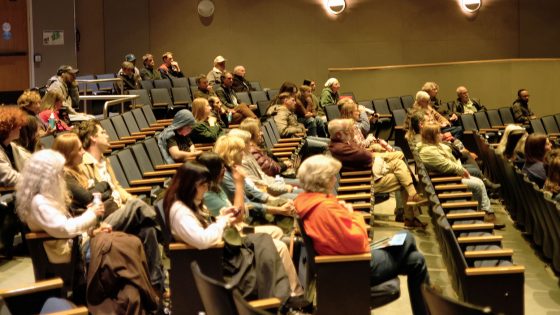
The Whitney and Anna Harris Conservation Forum drew students, faculty and staff members from UMSL as well as people from the wider St. Louis community.
Attendees heard from three speakers over the course of the evening: John Bender, who recently earned his PhD in UMSL’s Department of Biology and serves as the executive director of Pacific Bird Conservation; Laura Toro, a scientist in the Center for Conservation and Sustainable Development and the lead organizer of the Monitoring Restoration Effectiveness working group at the Missouri Botanical Garden; and Justin Elden, the curator of herpetology and aquatics at the Saint Louis Zoo overseeing the Charles H. Hoessle Herpetarium and its amphibian and reptile breeding programs.
Bender has spent more than a decade working in the Mariana Islands alongside local agencies, conservation organizations and research partners with an eye on preserving and recovering native bird species.
“Islands are at the leading forefront of some of the major conservation problems that we’re dealing with today,” Bender said. “Unfortunately, they’re at the leading edge of extinctions. So, while islands only make up about 5% of the world’s landmass, they’ve been at the forefront of about 61% of extinctions since the 16th century, and on top of that, 86% of those extinctions were due to introduced predators and invasive species.
“So, we have these really pristine and unique, incredible ecosystems with species and plants found nowhere else in the world, but they’re also very fragile. They’re very vulnerable to disturbance, and unfortunately, the system that I work in, the Marianas, is one of the leading cases for that.”
Bender talked about the island of Guam, which has seen its native bird population eradicated by the accidental introduction of brown tree snakes that arrived in cargo shipments from New Guinea shortly after World War II. The loss of the birds has also harmed the plant population as they were important germinators.
Pacific Bird Conservation has been at the forefront of restoration efforts, work in concert with the Saint Louis Zoo that earned his team the Association of Zoos and Aquariums’ 2025 North American Conservation Award. Bender described the work of choosing which birds to introduce to an ecosystem like assembling a fantasy football team. It requires an understanding of what role each will play in the environment.
He also stressed the importance of controlling the predator population, transporting birds safely when translocating them and engaging with the local community to support and sustain those efforts.
Toro shared a similar story of working to restore tropical dry forests in her native Colombia, which are under increasing pressure from agricultural uses and climate change.
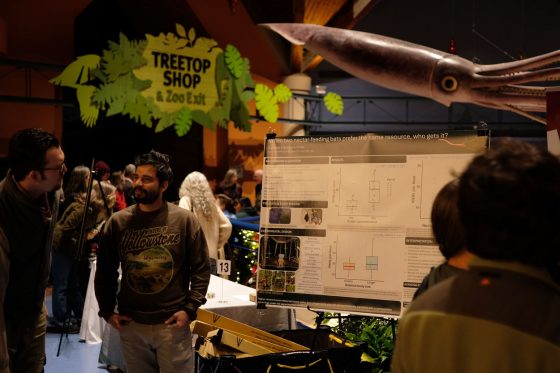
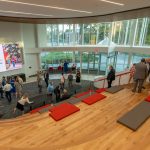
UMSL doctoral student Raj Prasai discusses his research on nectar-feeding bats in the lobby of The Living World at the Saint Louis Zoo before the Whitney and Anna Harris Conservation Forum. He was one of several UMSL students giving poster presentations before the forum.
She described the life cycle of those efforts – from planning to implementation to evaluation. The planning phase included botanical explorations and ecological studies of thriving forests to learn about the ecosystems. In the implementation phase, Toro and her colleagues have experimented by planting some 4,000 trees and have tested different fertilizer and water treatments. They’ve also been diligent about monitoring to understand the most successful and cost-effective ways to revive forest growth.
“Now we know what works and what doesn’t work,” Toro said. “So how can we implement this?”
She also stressed the importance of translating the lessons they have learned through their work for a general audience of practitioners who can put that knowledge into practice.
Elden was the event’s final speaker and detailed the Saint Louis Zoo’s efforts to breed and return Ozark hellbenders to Missouri streams.
The fully aquatic salamanders, which inspired UMSL mascot Louie the Triton, have genetic ancestors that trace their roots back millions of years. They depend on clean, oxygen-rich, fast-flowing rivers but have seen their population under threat by habitat degradation. In the early 2000s, Ozark hellbenders had declined by more than 70%, with fewer than 600 estimated in the wild.
Elden noted that in 2004, it was projected that Ozark hellbenders would face extinction within 30 years without intervention. But the zoo, in partnership with the Missouri Department of Conservation, established the Wildcare Institute Ron and Karen Goellner Center for Hellbender Conservation to try to change that.
A group of four full-time zookeepers work to breed Ozark hellbenders and prepare them for release into the wild. They have a facility in the basement of the zoo’s herpetarium with four climate-controlled laboratories, three artificial breeding streams, 17 rack systems, and capacity for more than 4,000 hellbenders.
The zoo began successfully breeding Ozark hellbenders in 2011 and first started reintroducing them to the wild in 2018. To date, it has hatched over 17,000 eggs and released more than 12,000 animals to the wild, where they have had a 60% survival rate over their first three years. There also is now evidence that zoo-born hellbenders have reproduced in the wild in Missouri and Arkansas.
It’s taken the same understanding of the environment that Bender and Toro described and years of careful implementation and evaluation, but it’s paying off.
“We’re buying time here for this species,” Elden said. “This effort is not done. We still have a lot of work to do, but we’ve made some great progress. And we estimate that we bought this species about 30 years of survivorship, when 20 years ago we thought that they were going to be extinct within 30 years. So, we’re heading in the right direction, and I’m optimistic that through this work, we will be able to rebound these populations with time and with effort back to their 1970s era of abundance.”