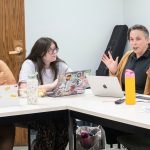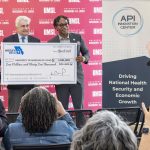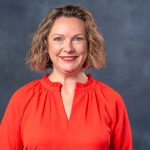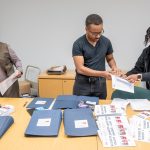
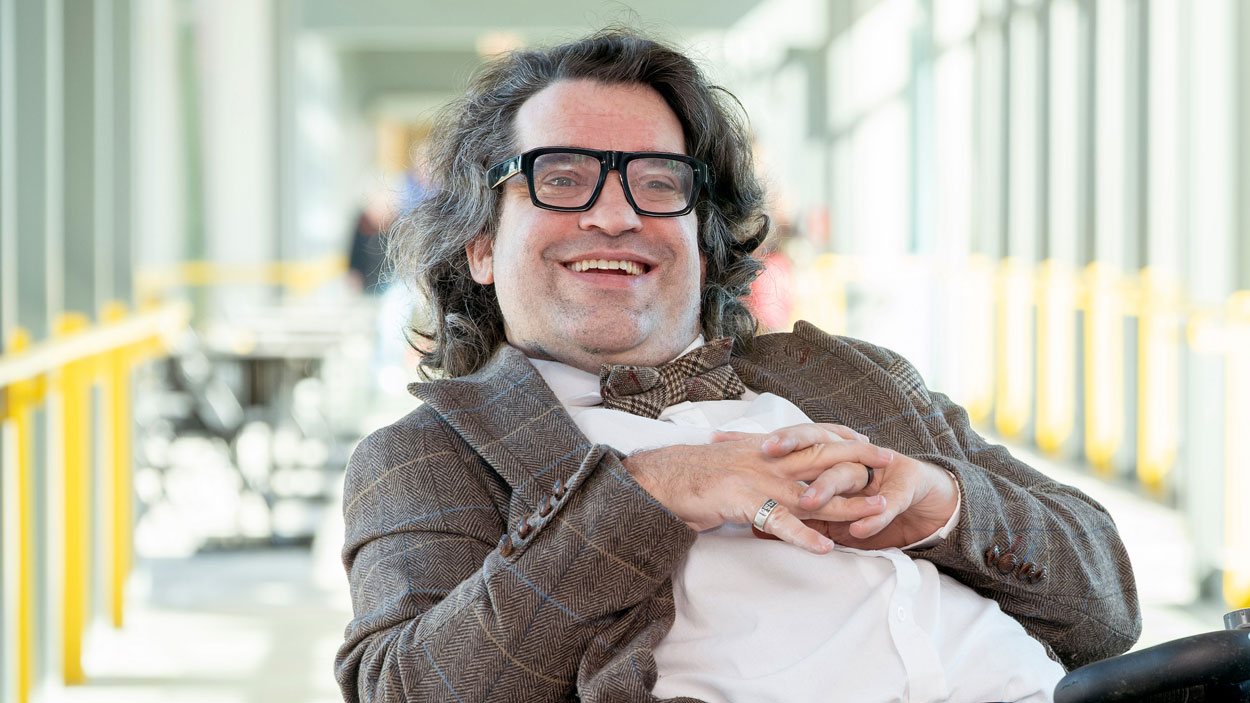
Chris Worth won the American Association on Intellectual and Developmental Disabilities’ 2026 Student Award last month. The award recognizes Worth’s advocacy for people with intellectual and developmental disabilities and his PhD research at UMSL. (Photo by Derik Holtmann)
Chris Worth was born at the age of 11.
Not literally, of course, but in Worth’s mind, that’s when his life truly began. As a disabled person, he was fully institutionalized before that time. His access to formal education was restricted during a critical time for development, and he couldn’t read or write as an 11-year-old.
That changed when he was adopted by a caring, forward-thinking family from West Virginia. At first, his father likened his adoption to taking in a wildcat, but that wildness indicated an underlying zeal that has served Worth well in adulthood.
“That wildness that I had, and then the strictness that had to happen to bring me up to speed, was really hard,” Worth explained. “It was like being born again in 1989 when I was adopted. It was hard, but one of the best things that ever happened to me.”
Since that time, Worth has succeeded in the face of numerous challenges. He’s earned several college degrees and is currently working toward his PhD in the College of Education at the University of Missouri–St. Louis. As a graduate research associate at UMSL, he was part of a team that won the Chancellor’s Award for Excellence in Collaborative Research and Creativity. Besides his academic work, he has served as a tireless advocate and community organizer for disability rights with Paraquad in St. Louis.
Recently, Worth added one more accomplishment to his impressive resume. In January, the American Association on Intellectual and Developmental Disabilities granted him its 2026 Student Award. The organization’s annual awards recognize individuals and groups who have made outstanding contributions to advocacy and education for people with intellectual and developmental disabilities.
“I plan to stay in academia, so it feels really good to get that recognition,” Worth said. “It’s amazing to be a person with a disability who has faced a lot of obstacles to get to this point even. For that organization, one of the oldest in the country doing the kind of research and advocacy they do, to award this, it’s a pretty big deal.”
Colleagues at the University of Missouri–Kansas City and the American Institutes for Research nominated Worth for the award. He has worked with George Gotto and Sheli Reynolds, the director and associate director of the UMKC Institute for Human Development, respectively, to help develop LifeCourse Nexus.
The innovative program is designed to help people with intellectual and developmental disabilities establish a positive vision for the life they wish to lead, and it offers online educational resources to bring those goals to fruition.
Worth is also the co-principal investigator on My ROAD at the American Institutes for Research. The project aims to embed “dignity of risk” into postsecondary education programs for individuals with intellectual and developmental disabilities. In practice, it means creating environments where risk-taking is encouraged and supported as a learning opportunity. Robert Perske, an author and advocate, originally developed the concept, arguing that self-determination and the right to take reasonable risks is essential for personal growth and self-esteem.
“He said everyone, no matter what our perception of their ability is, should be allowed to take risks,” Worth said. “Risk shapes who we are in some way. By denying people that opportunity, you’re actually keeping them from being fully engaged in the world.”
At UMSL, Worth’s doctoral research has focused on dignity of risk and how it affects people with disabilities. He’s conducted in-depth interviews with individuals between the ages of 18 and 31 for a qualitative study titled, “Journey of Becoming: Risk and the Story of Self in Adults with Intellectual, Developmental, and Learning Disabilities. A Phenomenological Case Study Employing Narrative Inquiry.” Thus far, he’s found that most of his subjects recognize some amount of risk is beneficial and independence is needed to really experience risk.
Worth was drawn to the subject because, in his estimation, his “whole life has been a risk.” Though he noted he had the advantage of an extraordinary support system as he navigated coming into his own after institutionalization.
“I had really progressive special ed teachers who saw something in me,” he said. “My parents saw something in me. The system, my paperwork pointed in one direction, right? My stubbornness pointed in the other direction.”
His parents and teachers refused to let Worth settle, and he began imagining a life in higher education. After earning his GED and taking the ACT at a specialized rehabilitation center, Worth enrolled at Marshall University in Huntington, West Virginia.
The experience was transformative. Worth learned to advocate for himself, and he also became involved with community organizing for the first time. As an undergraduate, he studied visual arts, although he told his family he was majoring in art education.
“The act of drawing was very much a part of my life because I didn’t have access to reading and writing until much later,” Worth said. “But I really loved the idea that art could be a language, and that’s what I learned through my time at Marshall. Art can be a thing that a culture uses to better itself, stretch itself.”
Eventually, Worth earned a master’s in studio art at Marshall. After graduating with his second degree, Worth decided to stretch himself and leave West Virginia. He was attracted to St. Louis because he had read about Max Starkloff and his work to establish Paraquad, one of the first independent-living organizations in the country.
Colleen Starkloff, Max’s wife, hired Worth at Starkloff Disability Institute. Later, Worth went to work for Paraquad as its first community organizer and was later elevated to manager of a team. It was at that point where he met April Regester, associate professor of inclusive education at UMSL, and after several years of being connected, Regester invited him to speak on a keynote panel at a TASH conference in St. Louis.
Over breakfast with Regester at the TASH conference, Worth brought up his desire to add a PhD to his toolbox. Sometime later, Regester encouraged him to further his education at UMSL, first in the MEd program and then as a doctoral candidate.
“The fact that I’ve been able to be in these different kind of arenas, national and statewide as a young PhD researcher, speaks a lot to my training here at UMSL,” Worth said.
Worth hopes his journey will inspire others to pursue higher education and chase their dreams. He knows firsthand that the risk is worth the reward.
“I fell in love with what a college setting could do,” he said. “It opened my mind in a lot of ways. I had some really great professors who took me under their wing, and on the college campus, I got my first challenge and my first push toward being who I am today.”