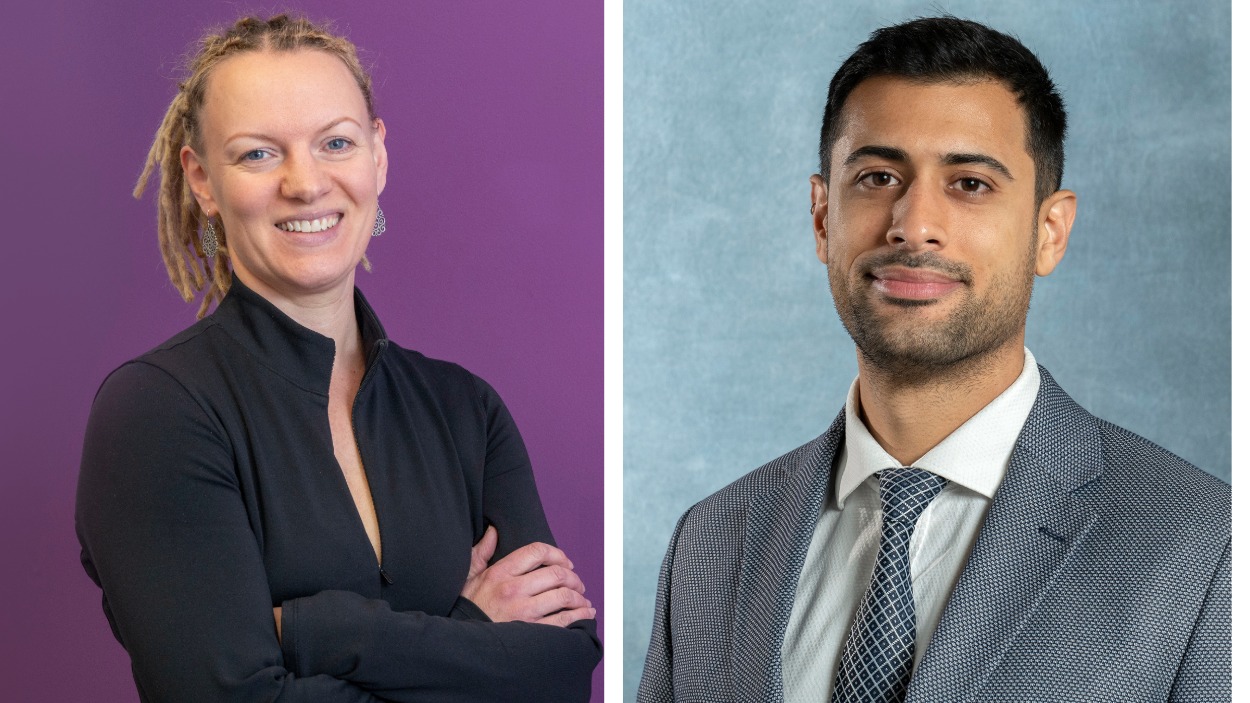
Sandra Langeslag, an associate professor in the Department of Psychological Sciences, and Necdet Gürkan, an assistant professor in information systems and technology in the Ed G. Smith College of Business, are teaming up to study the phenomenon of people falling in love with AI. (Photos by Derik Holtmann)
As AI use becomes commonplace in many households, a growing number of users are relying on the technology for emotional companionship. Nearly 1 in 5 high schoolers say they or someone they know has had a romantic relationship with artificial intelligence, while a third of adults have had a romantic relationship with AI.
But what are the potential ramifications of such relationships? Two faculty members at the University of Missouri–St. Louis are teaming up for an interdisciplinary study to find out.
Sandra Langeslag, an associate professor in the Department of Psychological Sciences, and Necdet Gürkan, an assistant professor in in the Department of Information Systems and Technology in the Ed G. Smith College of Business, have received a $100,000 grant to study the phenomenon of people falling in love with AI. Funded by OpenAI, the creator of ChatGPT, the research specifically examines the emotional and cognitive effects of experiencing romantic feelings for AI companions and aims to determine the effectiveness of love regulation strategies for increasing and decreasing love feelings as well as brain reactivity to AI companions.
As part of OpenAI’s mental health initiative, the grant required a multi-disciplinary team including a mental health expert (in this case, Langeslag) and an information technology expert (Gürkan). Langeslag, who has been studying how love impacts memory and attention for nearly 20 years, was interested to see if what she’s learned so far about romantic love applies to AI companions and how the two types of love differ. She notes that the research so far suggests that falling in love with an AI companion can have both positive effects, such as providing social support, and negative effects, such as higher depressive symptoms.
“There’s obviously not a whole lot of work on it yet because it’s such a new phenomenon,” she said. “But one previous study has shown that about a fifth of the people that are in love with an AI companion actually prefer that over being in a romantic relationship with a human and that, to me, sounds worrying. That leads to all sorts of questions. Are people going to use it to replace interacting with people or having romantic relationships with people? Is that a problem, especially if these are young people? What if adolescents start doing that, and they never learn to have a relationship with a human? What is that going to do to our society? Every Friday night, is everyone going to sit behind the computer instead of going out to the bar or the movies?”
Gürkan, meanwhile, has a background in information systems and technology, with experience in experimental design using various AI tools. His research focuses on socio-technical systems, including how people interact with AI and how AI presents biases in our daily lives. For this study in particular, he’s interested in learning more about how socio-technical systems are embedded within society and how they impact the way we think and act. Like Langeslag, he notes that AI is a bit of a dual-edged sword, as it has both positive and negative impacts on its users. On one hand, users who are not quite ready to go into a real-life dating scene can use tools such as AI dating simulators to practice conversations and boost confidence. But there can be devastating consequences when users form connections with AI bots that get updated with new safeguards, and the users feel as though they’ve lost a loved one.
To evaluate the impact of developing romantic feelings for AI companions, Langeslag and Gürkan plan to conduct two studies. The first is an online survey of people who are currently in love with an AI companion. The survey will ask participants questions such as how they feel, how they think, if they want to be more or less in love with their AI companion and if they have a real-life companion.
The second study will be a lab study that measures participants’ brain activation as it responds to photos of their AI companion, their real-life companion (if they have one), a friend and a stranger. The research will examine how participants’ brains react, specifically looking at how strongly it responds to the AI companion. It will also evaluate strategies to try and make participants more or less in love with their AI companion and examine how those strategies change their brain activation.
Langeslag hopes their research will provide insights that can help improve both AI development and public understanding of love regulation.
“This is such a new phenomenon, and it has all sorts of potential, good and bad,” she said. “As a scientist, I really want to learn more about it and understand what’s going on. Is it good or bad for people? Are there certain ways in which we can make it better for people? Can we increase the positive effects of it and decrease the negative effects? I think it’s really important for us to gather more information about this, and then ultimately, once we know more, developers that are working on creating AI platforms, software, apps and whatnot can use that information to make it safer for people to use.”
Gürkan is also excited about the potential for their findings to influence OpenAI’s development, noting that this topic bridges academic research with real-world applications.
“Most of the time in academia, when we do research, we don’t know whether it will translate to the real world,” Gürkan said. “We hope that some people will read our papers and understand our results and apply them in the real world. Here, we have a very, very unique opportunity in that our findings will translate to the real world. We are going to report this to OpenAI, and they will actually develop or fine-tune their AI tools.”