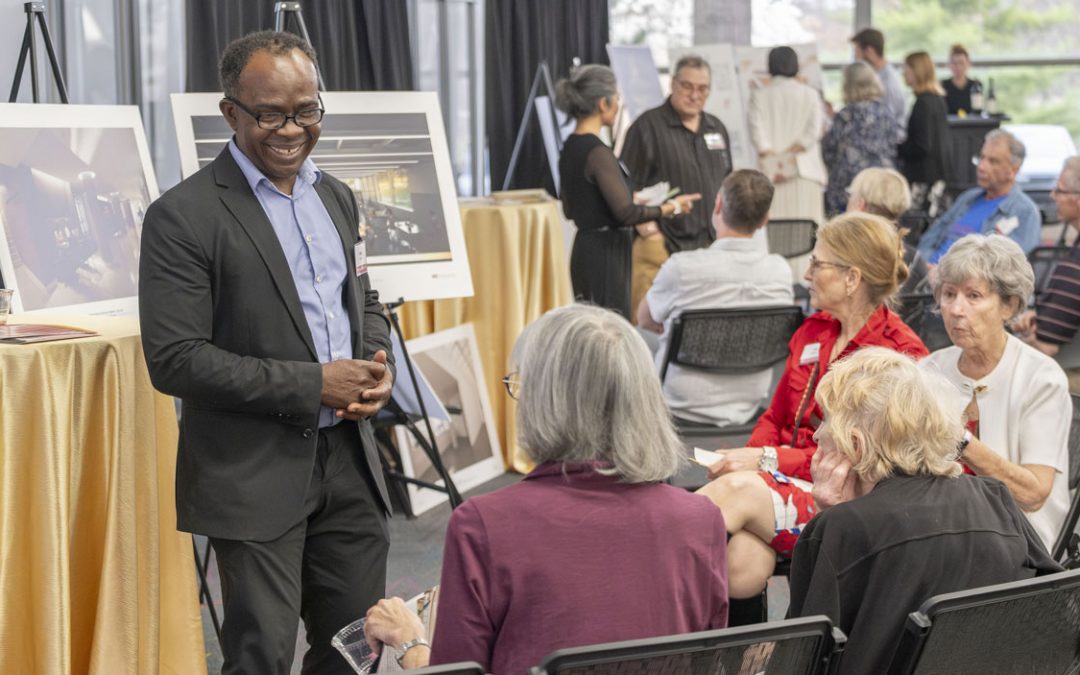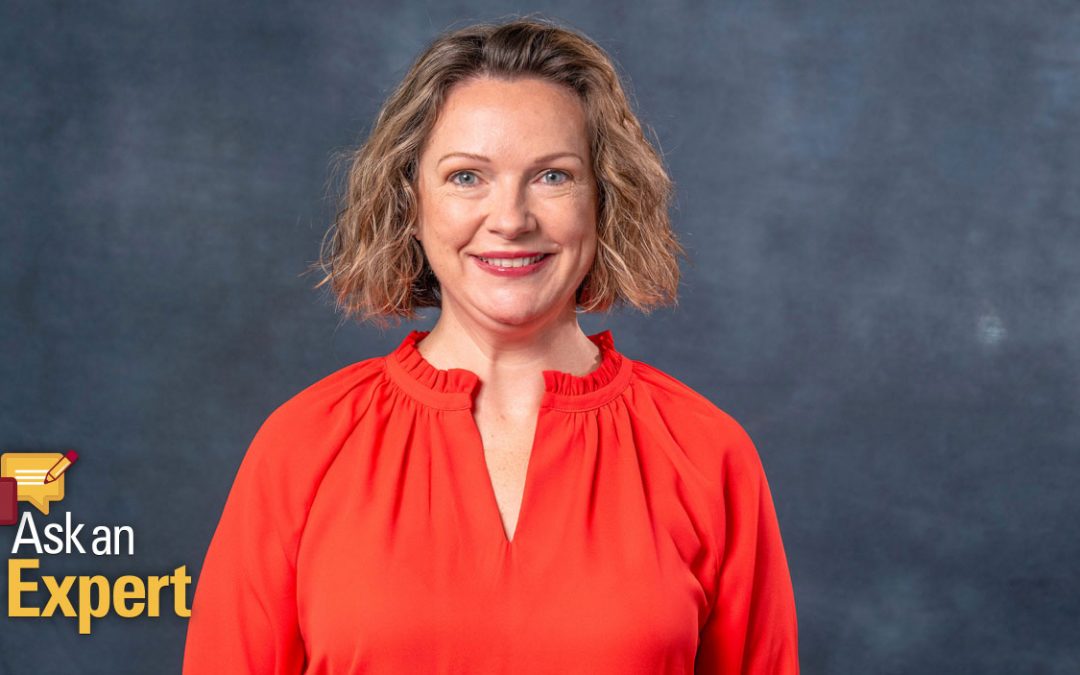

Dr. Tareq Nabhan, an associate clinical professor in the College of Optometry, has a passion for humanitarian work that began during his time as an optometry student at UMSL. (Photo by Derik Holtmann)
About a year ago, Dr. Tareq Nabhan gave a talk for Volunteer Optometric Services to Humanity International, a nonprofit organization focused on delivering vision care to those in need across the globe. He asked the 200-person audience to raise their hands if they had previously done humanitarian work in Latin America. Nearly every hand went up. Next, he asked who had done work in Africa, and many hands were raised again. But when he asked who had done work in the Middle East, only one hand went up.
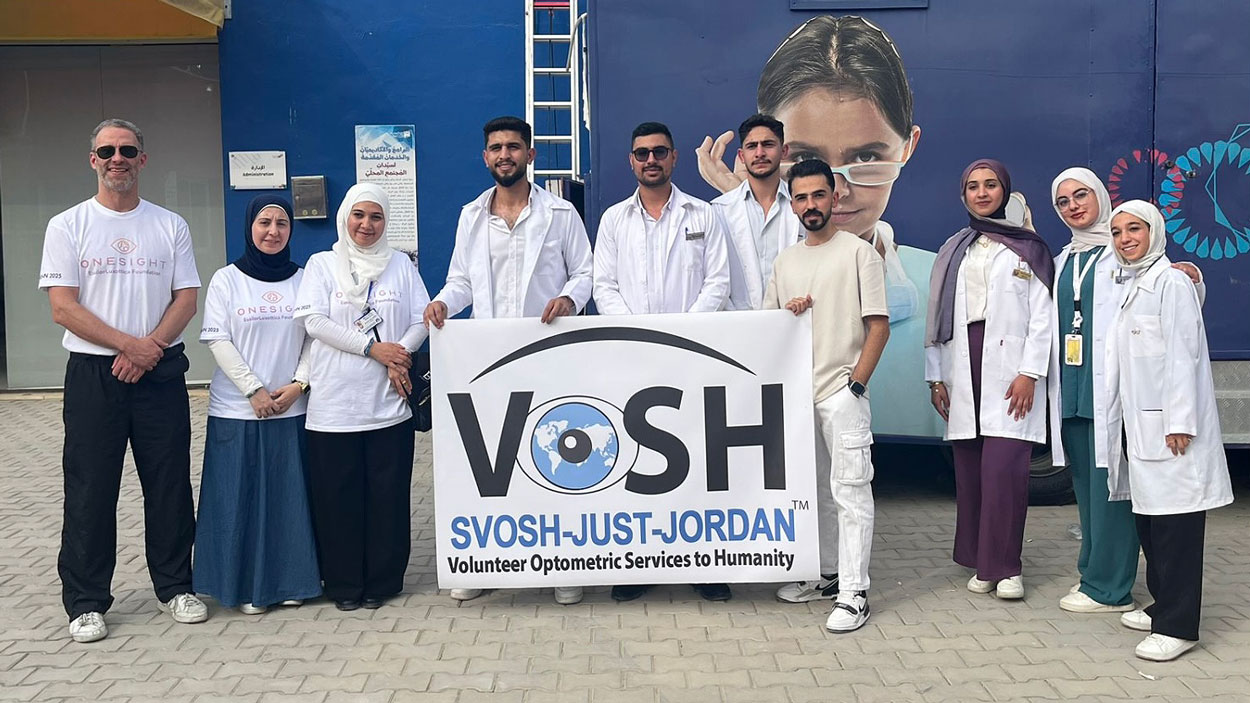
Dr. Tareq Nabhan recently helped establish a new chapter of Student Volunteer Optometric Services to Humanity at the Jordan University of Science and Technology and also hosted a charitable eye clinic with the students. (Photo courtesy of Dr. Tareq Nabhan)
Nabhan, an associate clinical professor in the College of Optometry at the University of Missouri–St. Louis, was disappointed but also motivated. Over the past few years, he’s been looking for ways to do more optometry work in the Eastern Mediterranean region where he grew up. In 2019, he participated in a humanitarian clinic in Jordan, and as a board member for VOSH/International, he recently helped establish two new chapters of Student Volunteer Optometric Services to Humanity – which boasts nearly 140 chapters at universities across the world – at the Jordan University of Science and Technology and at An-Najah National University.
Working with the OneSight EssilorLuxottica Foundation, the Princess Alia Foundation and students at JUST, Nabhan and other members of VOSH/I set up a charitable eye clinic last fall. Over the course of four days, the clinic provided over 1,000 people with comprehensive eye exams and, if needed, a pair of glasses or sunglasses.
“My goal is to improve the vision, not just of our patients, but to improve the vision of the providers,” Nabhan said. “When international teams go into a foreign country, they learn really quickly that the people they’re serving are humans. There’s often a political effort to dehumanize people, but when people go and see it for themselves, they realize these are people just like us. They want to work. They want to provide for their children, send them off to good schools, see them be successful, have opportunity and have freedom to do those things. Everyone comes away being better as people, no question. And I think that’s why I love to see students, either domestically or internationally, be engaged in these efforts.”
In addition to the charitable clinic, Nabhan also had the opportunity to lecture to students at JUST about democratizing healthcare through technology and giving back through humanitarian efforts through SVOSH – two topics he is extremely passionate about. While UMSL students didn’t travel to Jordan with Nabhan this time, he feels students can still learn from his experience overseas, and he hopes it might be possible to bring some of them with him in the future.
Nabhan also gave three continuing education talks at the annual Saudi Society of Optometry conference in Riyadh, Saudi Arabia. (Photo courtesy of Dr. Tareq Nabhan)
“When we see people who come from different regions or different races or identities, they are at different risks for different conditions,” Nabhan said. “We’re better clinicians by understanding the risk factors that different populations face, and so by getting involved in these things, I think our students get to see even more what it’s like to care for patients who come with different risk factors. Anytime I can expose our students, whether directly or indirectly, to what it’s like to be a global optometrist, they appreciate the scope of practice that they have and they become more well-rounded clinicians because they get to see differential diagnoses that they would not have otherwise considered. I think that’s critical if we’re going to be successful, not just in our communities, but for global optometry, we need to bring a global perspective into the classroom and the clinic. Our patients in St. Louis have globalized, and so must our thinking and understanding.”
On the same trip, Nabhan also gave three continuing education talks at the annual Saudi Society of Optometry conference in Riyadh, Saudi Arabia. His talks at the leading event for vision care in the Middle East focused on teleretina, emerging AI technology in eye care and humanitarian values. In addition to his humanitarian efforts in Jordan and his speaking engagements in Riyadh, he was also able to travel to Mecca and perform Umrah, a religious observation of prayer at the Kabaa, Islam’s holiest site.
Nabhan has long been a passionate advocate for international exposure for optometry students and clinicians. As a fourth-year student in the College of Optometry in 2012, he was able to travel to Bethlehem and Jerusalem for an eight-week externship. He considers the experience to have been some of the best clinical training that he could have received, having had the opportunity to learn directly from the authors of “The Massachusetts Eye and Ear Infirmary Illustrated Manual of Ophthalmology,” a textbook still used in the college.
“When I came back as a student, I remember saying I’d like for my classmates and those after me to have this opportunity,” Nabhan said. “There was interest, but it just didn’t work out. But you live with this for a while, and when I became faculty, I was looking for ways to see if I could internationalize our work and bring different voices to the table, different experiences to our curriculum. I think that diversity of thought and experience just makes us better people. Those international experiences as faculty translate to the classroom for our students, and then in the future, as clinicians making a difference in their communities and in the world.”