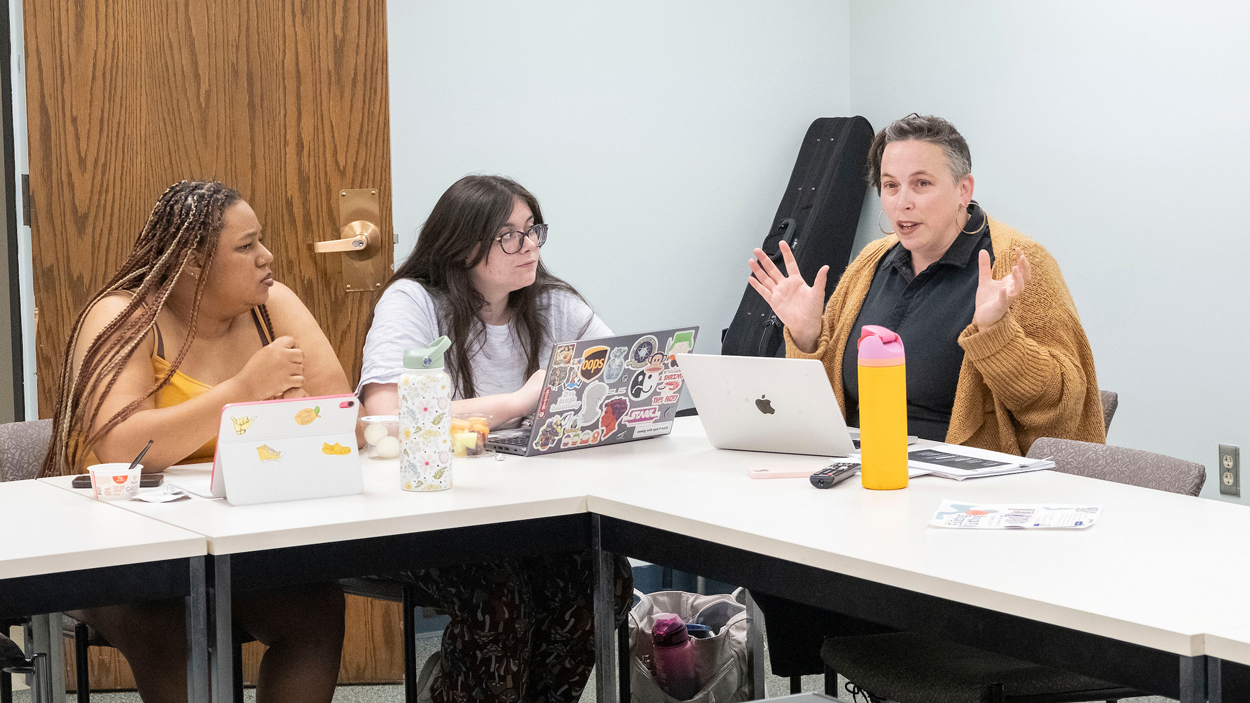
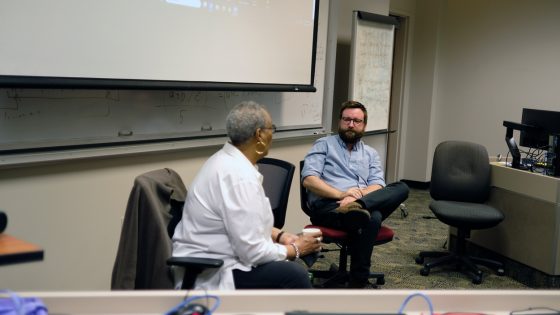
Associate Professor Lauren Obermark (right) leads a discussion in her English 2400 course. Obermark and Assistant Teaching Professor Lauren Terbrock-Elmestad launched the Writers Talk Writing series during the 2024-25 academic year with the support of a College of Arts and Sciences Course Enrichment Grant. Since spring 2025, Obermark and Terbrock-Elmestad have organized two events a semester. (Photo by Derik Holtmann)
For much of her life, Vivian Gibson didn’t consider herself a writer.
That’s likely news to the scores of people who have read Gibson’s bestselling memoir, “The Last Children of Mill Creek.” The book details Gibson’s childhood in Mill Creek Valley, a racially segregated, working-class St. Louis neighborhood that was razed in 1959. Gibson started writing vignettes about her memories growing up in the community during a writing workshop after retiring at age 66.
As an author, Gibson discussed her path to becoming a writer and publishing her memoir to with students during last month’s Writers Talk Writing panel at the University of Missouri–St. Louis.
“With me, I didn’t want to write a book,” she said. “I was just writing stories for my kids and my nieces and nephews because my parents died before they were born. There were other people saying, ‘This is a book. This is interesting. People want to know this.’”
The panel discussion was sponsored by UMSL’s English Writing Program, and Gibson was joined by fellow authors Devin O’Shea, a former adjunct professor at UMSL, and Sarah Kiser, a current UMSL MFA student. The theme of the hourlong conversation was, “Writing for Change,” and the trio explored how people can effect change through the written word.
“We hope that Writers Talk Writing makes a bit of space and time for us to come together to consider and celebrate what writing can do, even when writing feels difficult or scary,” said Lauren Obermark, an associate professor of English who moderated the panel.
March’s event was the latest gathering in an ongoing series that explores the role of writers in today’s world. More than 35 UMSL students joined the panel to listen, learn and discuss the authors’ writing practices, processes and purposes.
Obermark, who also serves as a co-administrator of the English Writing Program, and Lauren Terbrock-Elmestad, fellow co-administrator of the program and assistant teaching professor of English, launched the Writers Talk Writing series during the 2024-25 academic year with the support of a College of Arts and Sciences Course Enrichment Grant.
The grant is aimed at augmenting existing courses, especially those that reach first-year and transfer students. The pair initially applied for it to expand the impact of English 1100, the required first-year writing course at UMSL, and 3000-level writing courses, which are a graduation requirement for transfer students.
Authors Vivian Gibson and Devin O’Shea catch up before last month’s Writers Talk Writing event. Gibson, O’Shea and Sarah Kiser, author and MFA student, spoke about writing for change during the hourlong panel discussion. (Photo by Burk Krohe)
“It feels really important in the writing classes to help students see how they will need to write outside the classroom,” Obermark said. “Writing is always going to be with them – in other classes, personally, professionally. We think one of the best ways to drive that home is to listen to other writers, to other people, talk about how they use writing.”
Since spring 2025, Obermark and Terbrock-Elmestad have organized two events a semester, which are generally scheduled during high-traffic English classes. The series will pick up again in the fall, and students in all writing courses are encouraged to attend the “on-campus field trips.”
At first, the pair brought in other UMSL faculty members as panelists to speak about their current writing projects. Since then, the series has evolved. October’s “Writing is Scary” installment marked the first themed event. English faculty members Chris Schott and Shane Seeley, and adjunct instructor Owen Smith spoke about how fear, horror and existential dread have affected their writing.
February’s “Writing at Work” event focused on writing in professional settings and featured two guest speakers from outside of the university: Evie Hemphill, programs director at St. Louis BWorks, and Kat Riddler, business senior project advisor at Evernorth Health Services and UMSL Alumni Association president.
“Some of my students were there, and they were discussing how they appreciated seeing two ends of the spectrum in terms of professional writing,” Terbrock-Elmestad said. “There’s this nonprofit, more grassroots writing – grants, community outreach and things like that – and then on the other end, there’s very corporate, professional writing – inter-departmental and project management communication that’s happening.”
One of the most valuable aspects of the series for students is the window into the writing processes of professionals. Many are surprised to learn that even published authors and communication professionals still have trouble getting started or keeping momentum as they write.
“When we hear people talk about writing, they often talk about their finished product,” Terbrock-Elmestad said. “They rarely talk about their writing process, their practices or their habits. We wanted to make sure that the students got to hear other people, other writers, talk about the fact that it’s not just about presenting their final product. There are a lot of other things that go into that process.”
Obermark said it’s been helpful for students to hear tricks like getting started with rough ideas in a notes app or dictating voice memos and then transcribing the audio recordings. It’s also been enlightening for students to learn that writing is hard work at any level.
“We all get stuck,” Obermark said. “We all write stuff that we throw out. All of that is very normal. It’s labor intensive, but that is some of the joy that you start to take in your writing – that you get to grapple with it. That’s always something that stands out from the events.”
Gibson, Kiser and O’Shea touched on their writing habits but also their perceptions of how their work creates change. Kiser’s novel, “Hunt the Ever Wild,” is a work of gothic fantasy, but it’s also a commentary on American society. The book’s main character, Sy, indentured himself to the crown to pay for his magical education, and because of that debt, he’s forced to carry out nefarious acts for the king.
“When I start writing a work of fiction, I usually have something I really care about that I want more people to understand better,” Kiser said. “Sometimes it’s a problem that I would like to see change be made around. I do think that fiction can have strong themes and messaging in it, so I’m aware of that as I’m drafting and as I write.”
An inherent part of writing is ruffling feathers, but feedback can often be positive and quite moving, as well.
“People write to writers,” said Gibson, recalling feedback on his own book. “I didn’t know that. People emailed me these heartfelt messages about how the book impacted them, how it related to them, how they had a similar story.”
Junior English majors Lillian Weatherly and Ryan Winzen thoroughly enjoyed the conversation, and they left energized with the intent to dedicate more time honing their craft as writers.
“I was so excited that I got to experience this,” Weatherly said. “I think that I devote so much of my time to not writing because I’m so busy as a college student. I don’t put writing at the forefront sometimes, and I think I would like to. I’d like to put it first because I love writing.”
Obermark and Terbrock-Elmestad said that’s ultimately the goal of the series.
“We want students to leave these events thinking, ‘I am a writer,’ and to feel empowered,” Obermark said. “These are writers. You’re a writer. This is a community of writing. This campus has a culture of writing that we’re all in together.”