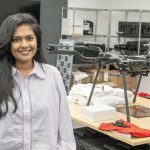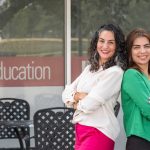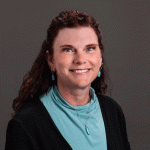
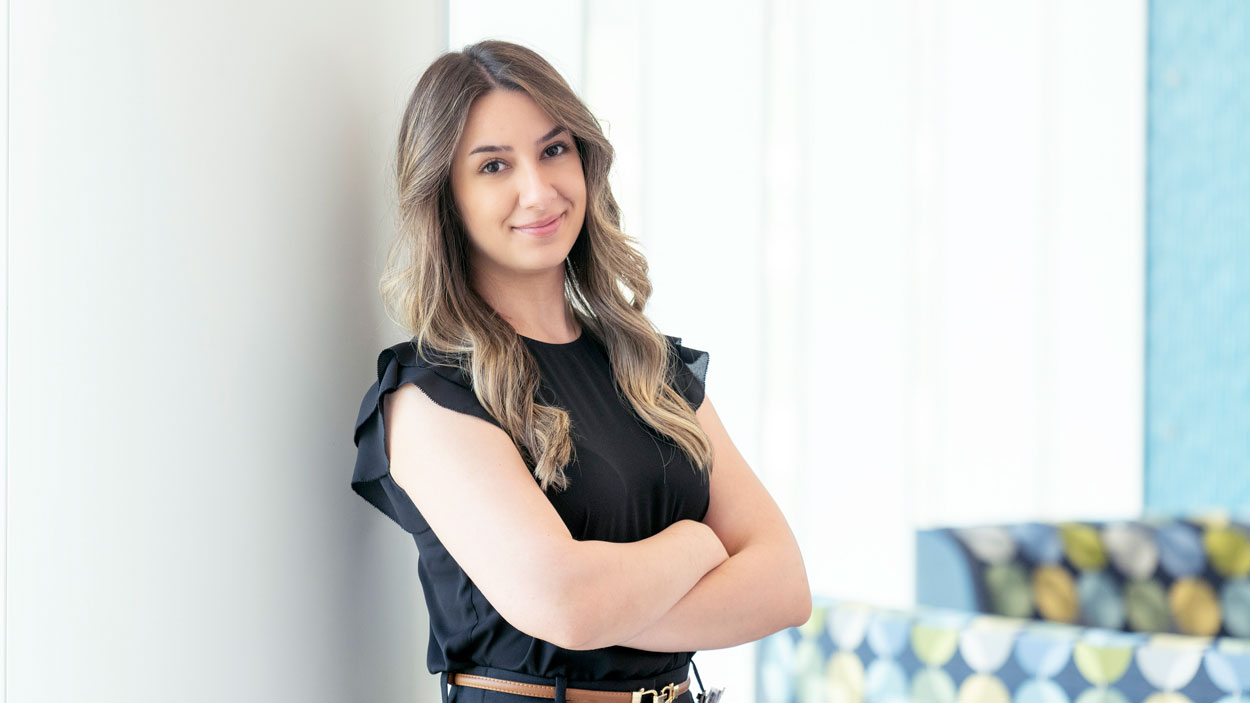
Sama Alhalabi, who graduates from the College of Optometry this May, has accepted a job working as a medical optometrist at Quantum Vision Centers, which operates several locations in southern Illinois. (Photo by Derik Holtmann)
Shortly after immigrating to the United States from Iraq with her family in 2012, Sama Alhalabi started thinking about what she wanted to do with her life.
She had long known she wanted to pursue a career in healthcare, as she liked science and wanted to help people. During her senior year of high school, she realized she had never had an eye exam before and started wondering what it would be like. Once optometry occurred to her as a career path, she started learning more about the field and took her first job working as an optician and doctor’s assistant at Crown Vision Center right after graduating high school. From there, she said, things were pretty clear.
“I think vision is the most important sense as it allows us to feel and see so much,” Alhalabi said. “I wanted to do optometry because I wanted to bridge that barrier where people think that it is a privilege to get an eye exam, but access to eyecare should be seen as a standard part of healthcare. Everybody should have an eye exam. Everybody should make sure that their eyes are healthy and they see well. Many people don’t seek care simply because they are unaware of its importance or lack access. I want to make sure that people have more access and be that role model for others that want to consider this path.”
After high school, Alhalabi enrolled at the University of Missouri–St. Louis, which she said was the most affordable, accessible option for her as a first-generation immigrant living with her parents. She earned her bachelor’s in biology from UMSL in 2021 and was heavily involved in the Pre-Optometry Club, which helped her gain exposure to the industry and learn more about what attending UMSL’s College of Optometry would look like. Witnessing the culture in the College of Optometry – notably its small class sizes, in which students are able to build close relationships with both fellow students and faculty – reaffirmed her decision to stay at UMSL for another four years.
“I was so sold because the culture was so friendly, and everybody just wanted to support one another,” Alhalabi said. “Everybody really knew each other and wanted the best for each other. Starting at UMSL, from my first year to where I am right now, it’s been nothing but consistent support from faculty and preceptors – everybody around you just wants the best for you. I’ve been blessed to experience that during such a challenging journey in optometry.”
During her time in the College of Optometry, Alhalabi enjoyed building relationships with her fellow students – who regularly celebrated the end of midterms at Sushi Ai – and the college’s experienced faculty members. She was particularly impacted by Dr. Kathleen Boland, who taught clinical skills and recently retired from UMSL after 23 years.
Alhalabi was also involved in UMSL’s chapter of Student Volunteer Optometric Services to Humanity, which sends students to schools, Native American reservations and refugee resettlement institutions across the country to conduct vision screenings. After first joining as a member, she decided to get more involved with the organization as treasurer, managing finances and helping to coordinate meetings. While she was not able to participate in any SVOSH trips during optometry school, she has since scheduled a volunteer trip for the summer following graduation and plans to use that time to give back through service.
“We all can contribute a little bit in our community, and a little goes a long way,” Alhalabi said. “These small things can mean the world to other people. My time can really help give people more access to eyecare, and I want to contribute some of my time to that.”
Alhalabi’s rotations allowed her get exposure to different modalities and affirm what she wants to do moving forward. Her first rotation at Koetting Eye Center in May 2025, for instance, allowed her to practice contact lens care and redefine her skills. From there, she went on to Envision Eye Specialists, where she was able to shadow surgeons, followed by SLUCare, where she witnessed the close collaboration between ophthalmology and optometry firsthand. Her favorite rotation, by far, has been at Family Care Health Centers’s Carondelet location, where she was able to see just how powerful community-centered healthcare can be.
“Even small moments spent explaining something basic often seemed to have a real impact,” Alhalabi said. “That really made me appreciate the field that I chose, because it can be so rewarding, and we don’t really realize how privileged we are to know what we know and how we can change someone’s life just from sitting down and explaining what things mean to them, rather than just telling them this is what they have.”
Alhalabi is glad for her varied rotation experiences, as she wasn’t exactly sure of what type of setting she’d like to practice. Her rotations helped redefine what she does and doesn’t enjoy, and her exposure to ocular disease throughout her training and education inspired her to continue to care for diseased eyes. After graduating this May, she’ll be working as a medical optometrist at Quantum Vision Centers, which operates several locations in southern Illinois. In this role, she’ll be working alongside the clinic’s ophthalmologists to treat patients with glaucoma, macular degeneration and cataracts.
Alhalabi admits it’s a little intimidating to start working as a provider, as there’s a lot of responsibility in her hands, but she feels confident in the education and training she received from the College of Optometry. In addition to the foundational classroom instruction and clinical experience, she’s learned more about social determinants of health and common barriers to healthcare, such as a lack of transportation, that have made her a more empathetic, well-rounded clinician. She thinks of ocular disease almost like a puzzle and enjoys being able to figure things out for her patients and help them navigate their eyecare.
“Patient care is huge for me, and a lot of disease and medical optometry involves educating the patient on what’s going on and making sure they understand when to come see you,” she said. “A lot of it stems from having that relationship with patients where they trust you with their eyes, and I want to be able to provide that reassurance and care for somebody so that I can take care of their eyes accordingly. I’m excited to take part in such a rewarding field and be able to provide care for patients. Vision is such a sacred sense, and I want to be able to help preserve that as much as I can.”