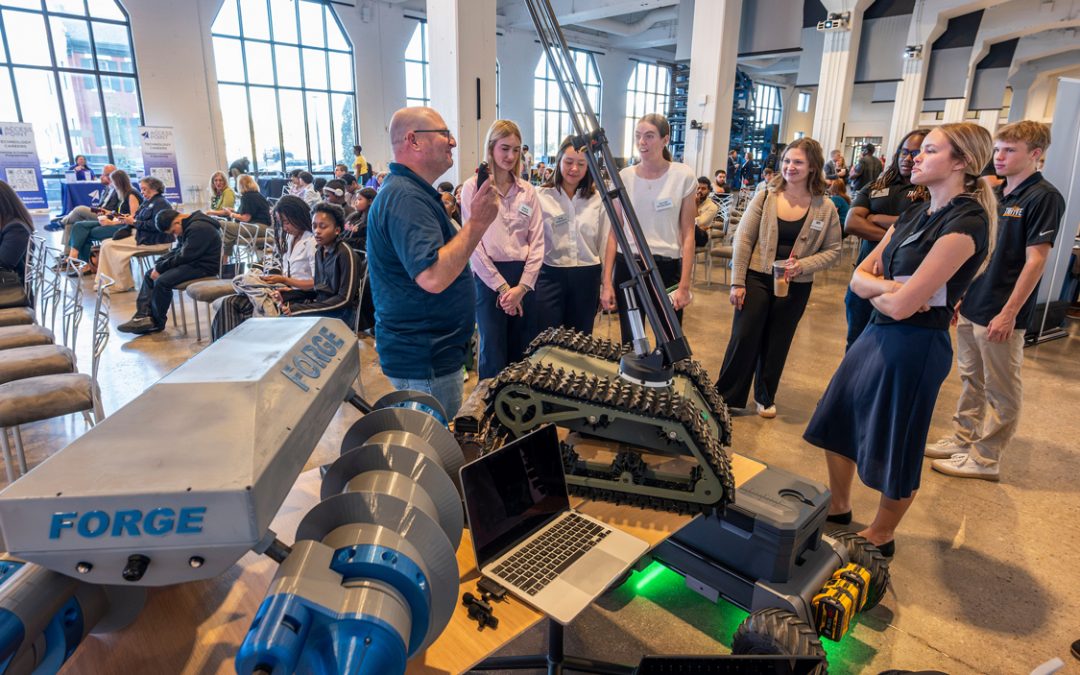
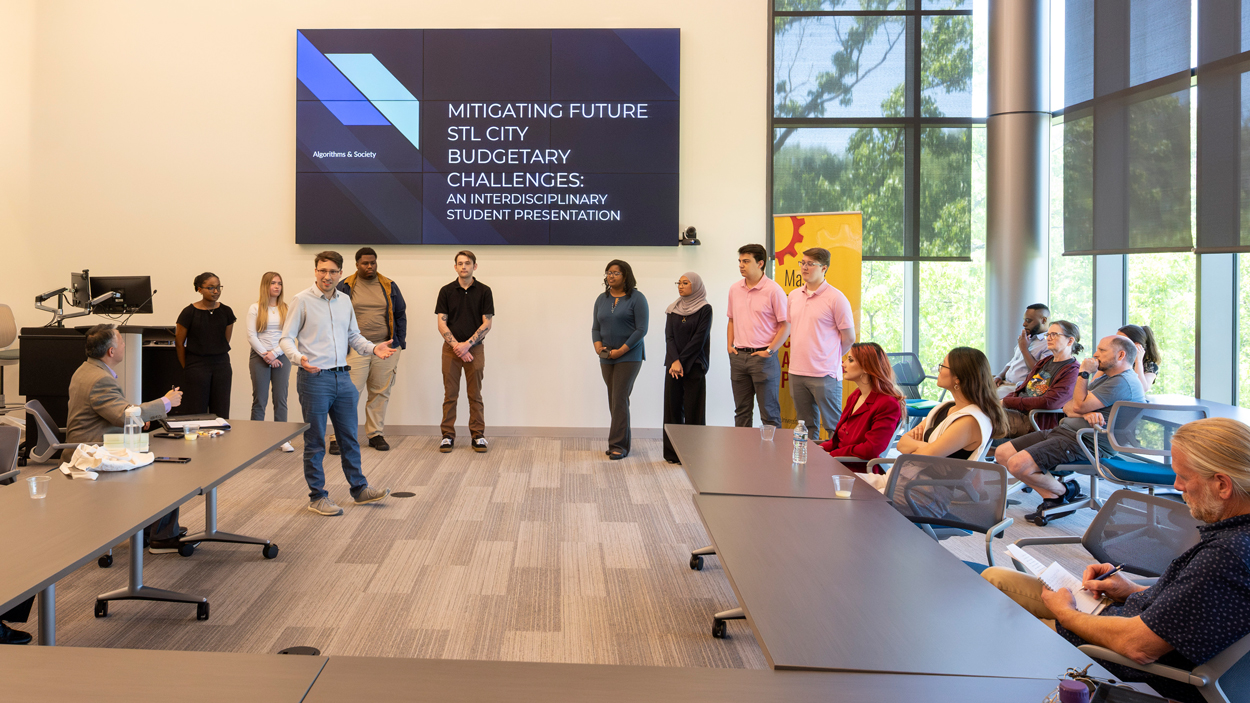
Professor Brian Adler (left) addresses the crowd in front of the students from his Algorithms & Society class in the Pierre Laclede Honors College, discussing the presentation of findings from an interdisciplinary project that also involved students from the Ed G. Smith College of Business and the College of Arts and Sciences. In a room at Anheuser-Busch Hall that included officials from the City of St. Louis, the students analyzed the potential benefits of a program to help St. Louis address budgetary challenges. (Photos by Derik Holtmann)
University of Missouri–St. Louis students from the Ed G. Smith College of Business, the Pierre Laclede Honors College and the College of Arts and Sciences spent the past few months working on a unique cross-campus collaboration that examined ways to help ease the financial strain on municipal services in St. Louis.
For the project, the students explored the challenge caused by nonprofit organizations that own tax-exempt property and therefore do not contribute to property tax revenue. They invited a group of officials from the City of St. Louis to a presentation May 12 at Anheuser-Busch Hall, where they showed off the results of their semester-long interdisciplinary work.
By the time the final group connected the research, data and recommendations highlighted throughout the afternoon, city leaders appeared convinced they were looking at more than a classroom exercise. City Assessor Shawn Ordway and Chief Operating Officer Ben Jonsson closed the event by urging the students to apply for upcoming openings, turning the presentation’s conclusion into something that felt a lot like a recruiting pitch.
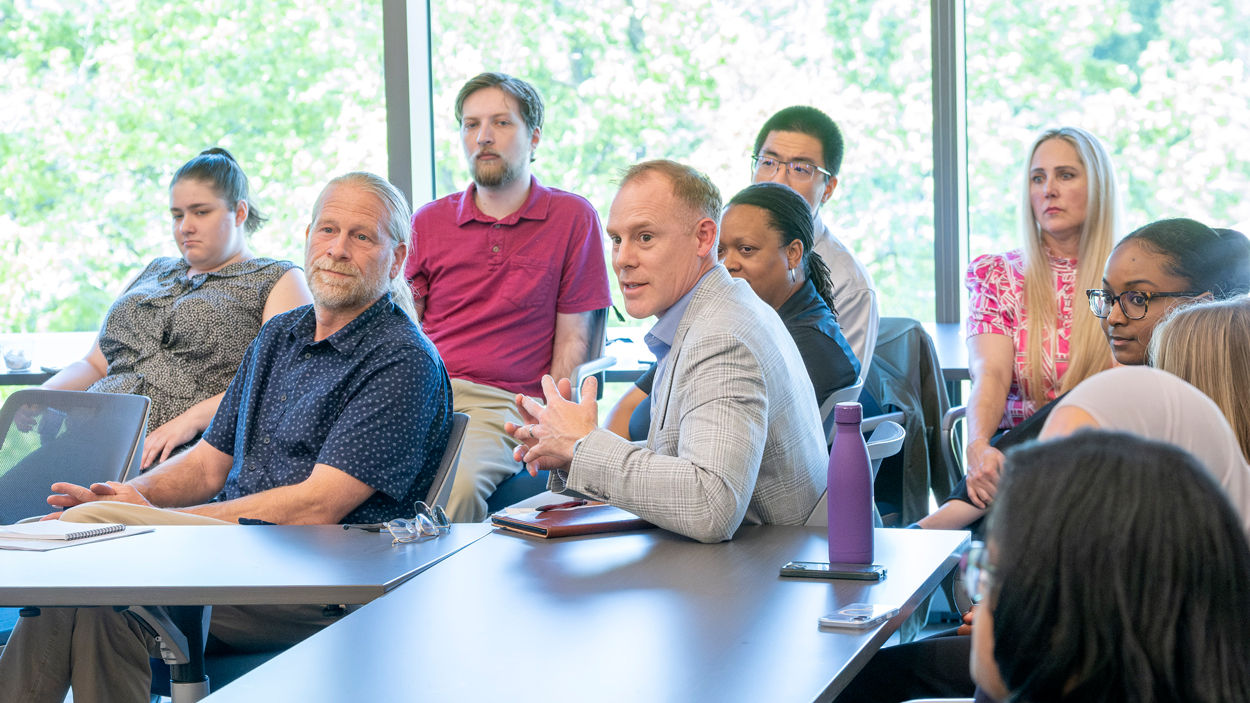
Ben Jonsson, Chief Operating Officer for St. Louis Mayor Cara Spencer, welcomed the “creative energy” that UMSL students brought to a project that explored ways for the City of St. Louis to address a challenging budgetary issue.
“It was very satisfying. The city assessor said, ‘Hey, there’s a lot of spots open,’” said Cade Sutterer, a junior in the Department of Criminology and Criminal Justice. “That’s really cool to hear, to know that what I’m doing is going to be used in the real world.”
Titled “Mitigating Future STL City Budgetary Challenges,” the tri-pronged group research analyzed the potential use of Payments in Lieu of Taxes (PILOT) to offset the fiscal burden of regular maintenance afforded to property owners who contribute no tax dollars to the city’s budget. Over nearly two hours, each class highlighted its findings, with a pair of graduate students in the Department of Supply Chain and Analytics recommending that St. Louis strongly consider utilizing UMSL’s model to implement PILOT as a structured, fair and data-driven way to address budgetary concerns.
“It’s exciting to be around young people who are committed to the city, to the region, to its success, and leveraging their considerable talents and brain power to help us solve some real, significant challenges that we face,” Jonsson said. “It was inspiring to see the creative energy that they bring to bear.”
The first group, which was comprised of 10 sociology seniors from Assistant Teaching Professor Brian Adler’s Applied Social Research class, provided analysis of content gathered from qualitative methods such as interviews, surveys and questionnaires regarding the use of PILOT in Boston, Providence and Baltimore. An octet of Honors College students from Algorithms & Society, also taught by Adler, used machine learning to predict the assessed value of tax-exempt parcels in St. Louis. Then Ini Abejide and Tanzina Bashir, the duo from Supply Chain Modeling with Professor Haitao Li, chair of the Department of Supply Chain and Analytics, took all of the information, along with a mountain of data supplied by Ordway, and used optimization modeling to conclude that PILOT, while not “the final answer,” could be a useful tool in the effort to reduce the city’s budgetary burden.
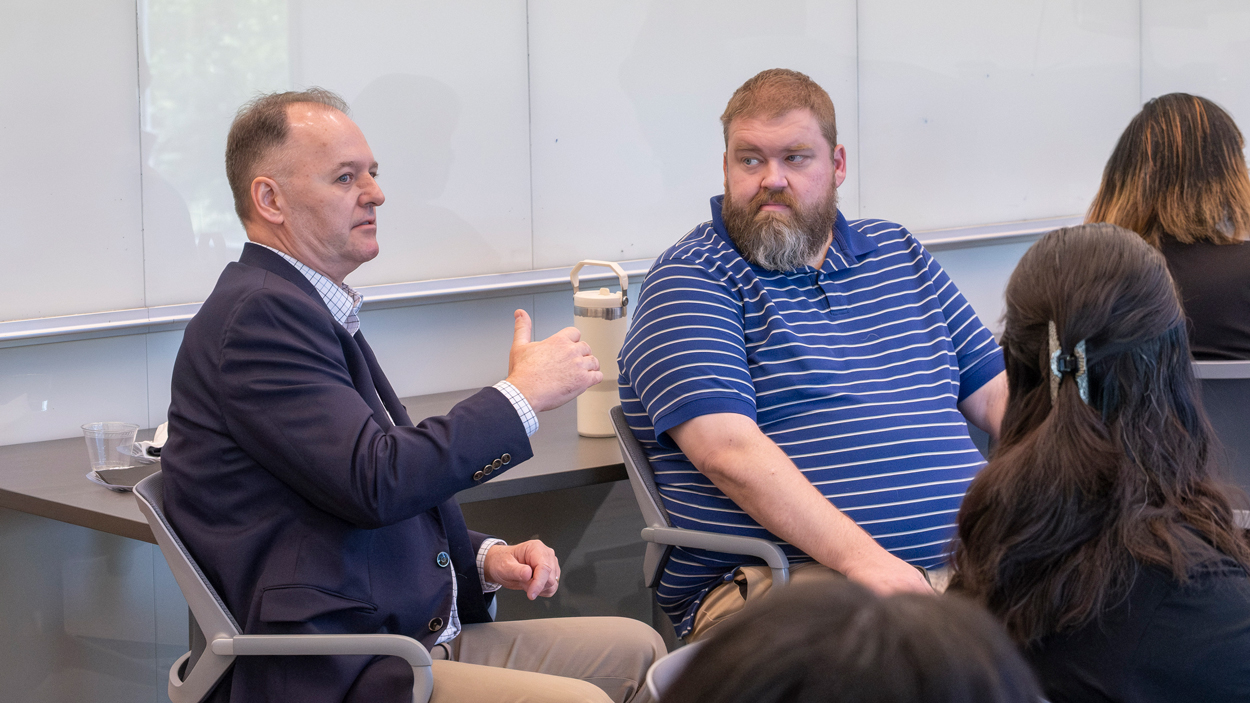
St. Louis City Assessor Shawn Ordway (left) said he was impressed by the “eye-opening” presentation by students from the Ed G. Smith College of Business, the Pierre Laclede Honors College and the College of Arts and Sciences, who collaborated to analyze the viability of a Payment in Lieu of Taxes program for the City of St. Louis.
“I was telling one of my cohorts after the presentations today, I feel like I need to go back to school again,” Ordway said. “But it was eye-opening from the standpoint of using the latest technologies, and I think the students did a superb job with the research and the depths they went to get the best data that they could.”
The city officials said that type of information and analysis is invaluable in determining the viability of a program like PILOT for St. Louis, but realistically, the city does not have the resources available to perform an in-depth dive into such a complex topic, which highlights how a partnership with UMSL could be helpful for the city’s approach to data-driven decision-making. Li stressed that a big piece of the puzzle is the state-of-the-art statistical and analytical software that UMSL provides for its students.
“The tools that they’re putting together, that they demonstrated in their presentations, can really energize how we address some of these underlying challenges in a way that’s creative and that is informed by a substantial body of research right here at UMSL,” Jonsson said.
Li said UMSL, as the only public research institution in the St. Louis area, has a unique responsibility to help the entire region address whatever challenges and opportunities that may come along. It’s why Li is hopeful that this semester’s project and the collaborative work with the St. Louis assessor’s office opens the door to future collaborations. Li said he and Adler will be sure to follow up with the city officials to see what could happen next.
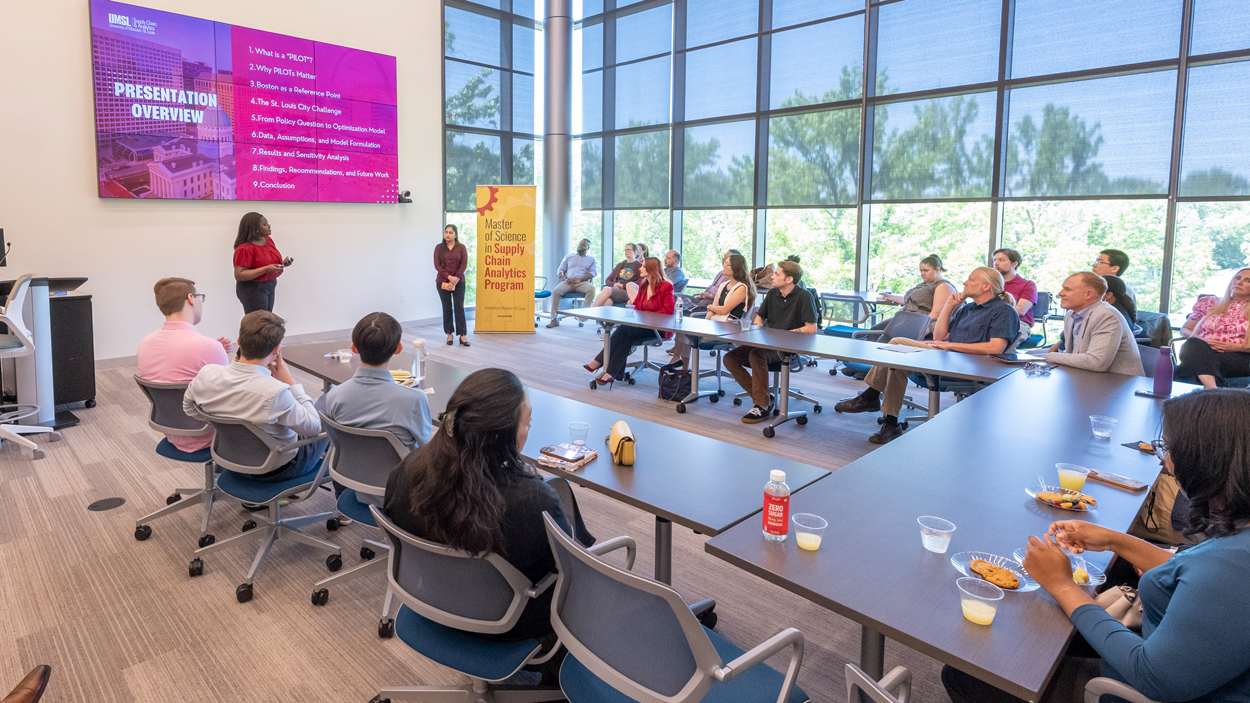
Ini Abejide and Tanzina Bashir, graduate students in Professor Haitao Li’s Supply Chain Modeling class, presented the conclusions of an interdisciplinary class project that recommends the City of St. Louis explore Payments in Lieu of Taxes.
“This is only a starting point, right?” Li said. “A starting point that just demonstrates the capability and capacity of UMSL talents. We can make a difference.”
For the students, the opportunity to work on issues that impact the government of a large metropolitan city can make a difference in their lives by showing them how their UMSL education works in the real world.
“I was working toward something that was really tangible and was going to be able to help the city out and be able to present it to the city, and I knew that we were working toward that all semester,” said senior Will Barkofske, a student in both of Adler’s classes. “It really was an extra motivating factor that you don’t get in certain classes, and seeing it come to fruition like that with the business school and the supply chain analytics class was really fortunate and really rewarding at the end of it all.”
The sociology class consisted of Barkofske, Jada Aleem, Meko Burr, Ashton Carter, Kerrin Giles, Sarah Cummings, Elaine Finn, Abbey Freyling, Peyton Pearce and Jonathan Wygal. Students in the Honors College course included Barkofske, Sutterer, Carter, Morgan Daniels, Darien Mayers, Andrea Pettigrew, Katie Powell and Anisah Zulkifli.