
Michael Cosmopoulos was among 10 faculty members across the University of Missouri System promoted to Curators’ Distinguished Professor or Curators’ Distinguished Teaching Professor. (Photo courtesy of Michael Cosmopoulos)
Michael Cosmopoulos has earned international attention and acclaim for his work digging – often quite literally – into the history and culture of Ancient Greece.
The longtime professor of archaeology and the Hellenic Government-Karakas Family Foundation Professor in Greek Studies at the University of Missouri–St. Louis has been featured on the pages of The New York Times, among many other publications, and spotlighted on the National Geographic Channel. He’s been elected to the Royal Society of Canada and both the European and American Academies of Arts and Sciences. Two years ago, he was inducted into the famed Academy of Athens, joining the ranks of the “Immortals” as the Chair of Bronze Age Archaeology.
Cosmopoulos is now taking on a new title: Curators’ Distinguished Professor.
This week, the University of Missouri Board of Curators appointed Cosmopoulos and nine other faculty members from across the University of Missouri System to serve as either Curators’ Distinguished Professor or Curators’ Distinguished Teaching Professor, the system’s highest faculty ranks.
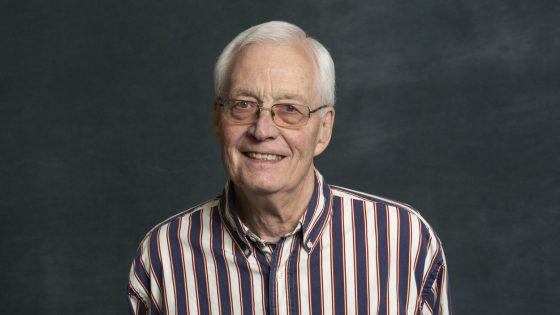
Charles Granger has received the title of Curators’ Distinguished Professor Emeritus following his retirement after a 55-year career in biology and education at UMSL. (Photo by Derik Holtmann)
The Board of Curators also honored recently retired UMSL faculty member Charles Granger with the title of Curators’ Distinguished Professor Emeritus after a 55-year career serving both in the Department of Biology in the College of Arts and Sciences and the Department of Educator Preparation and Leadership in the College of Education.
“The board grants these awards to outstanding scholars, researchers and educators across our four universities who have made significant impacts on their students, colleagues and fields,” said Todd Graves, chair of the UM Board of Curators. “We are proud to have such world-class talent and intellect at our universities where they make important advances every day.”
The designation is given to faculty who have demonstrated exemplary research or teaching in their subject areas.
“Curators’ Distinguished Professors are proven leaders who move our university, state and nation forward through teaching, research and meaningful engagement,” University of Missouri President Mun Choi said. “Their dedication to excellence prepares our students for success, improves the lives of Missourians and strengthens our economy and workforce.”
Even alongside all his other accolades and achievements, this recognition stood out for Cosmopoulos.
“This one is personal,” he said. “It’s closer to home. You sometimes receive recognition from the wider scholarly community that tells you that what you are doing is important. But this recognition was especially meaningful because it showed me that my colleagues at my own university appreciate what I do, and that is a tremendous moral reward.”
Cosmopoulos, a member of the Department of History, joined the UMSL faculty in 2001 after 12 years at the University of Manitoba. His appointment marked a return to St. Louis after previously earning his PhD from the Department of Art History and Archaeology at Washington University.
“When we came to St. Louis, we already had friends here from my earlier years at Washington University, and we were welcomed very warmly,” he said. “That made it easy for St. Louis to truly become our home.
“I’ve had wonderful colleagues. The administration has been extremely supportive, as has the Greek community. I love our students. I have also been fortunate that the archaeological site we have been excavating has yielded important finds and exciting new discoveries.”
That site, Iklaina, is located in the Peloponnese region of Greece. Cosmopoulos first began work there before joining the UMSL faculty. Among the discoveries he and his team have made there are the remains of a major Bronze Age center, with massive Cyclopean buildings, paved roads and piazzas, and the earliest known written tablet from the Greek mainland.
Continued excavation has revealed dozens of buildings extending across an area of approximately 12 hectares – nearly 30 acres. It shows that Iklaina was not simply a palace complex but a large urban center. The evidence suggests that it initially developed as an independent political center before later being incorporated into the state centered on the nearby Palace of Nestor.
Cosmopoulos completed his final excavation season at Iklaina this past summer. He and his team are now working to publish the results of the excavations while also beginning the restoration of the site so that it can eventually be opened to the public.
In addition to his work at Iklaina, Cosmopoulos has also been writing a series of books about Homer. The first book in the series, titled “The World of Homer,” was released last year. A second book, “Rediscovering Homer,” is due out later this month. He is at work on a third book, “Homer and Archaeology.”
The UM System also recognized Granger after a career spent advancing science education, starting from the moment he joined the UMSL faculty in 1971.
Granger, who was promoted to Curators’ Distinguished Professor in 1999, impacted students at every level with his teaching, whether they were enrolled in an introductory biology course or a graduate research methods seminar. He also mentored numerous doctoral students, serving on nearly 30 dissertation committees just since 2018. His contributions also helped prepare educators to serve in classrooms across the St. Louis region and beyond.
Granger’s research has focused on enhancing curriculum and teaching methods in K-12 schools, and he also worked to develop impactful and effective outreach and summer programs. Over the course of his career, he received nearly $25 million in grants to help support such endeavors, including from funders such as the National Science Foundation, the U.S. Department of Education and the Missouri Department of Elementary and Secondary Education.
“His accomplishments in research and outreach are equally impressive,” Provost and Vice Chancellor for Academic Affairs Steven J. Berberich wrote in a letter supporting Granger’s appointment to Curators’ Distinguished Professor Emeritus. “He has launched and directed numerous programs that have enriched STEM learning opportunities for students and teachers across Missouri, including the nationally recognized Students and Teachers as Research Scientists (STARS) program and the Junior Science, Engineering and Humanities Symposium.”
Granger officially retired as a full-time faculty member on Sept. 1.