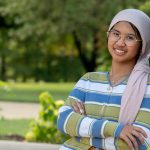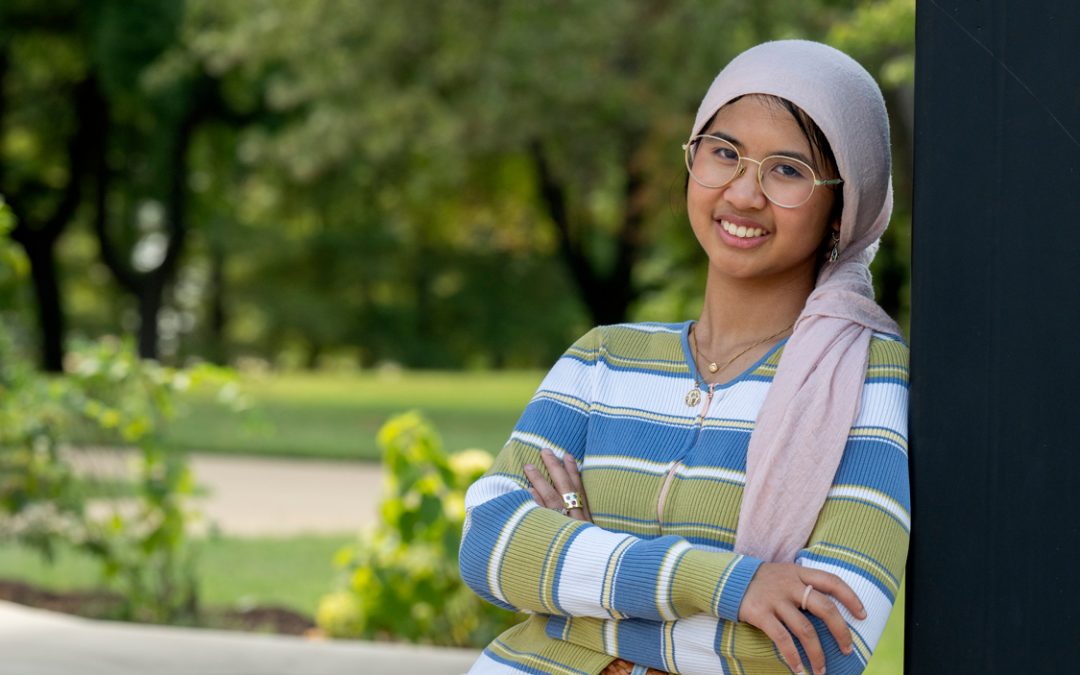
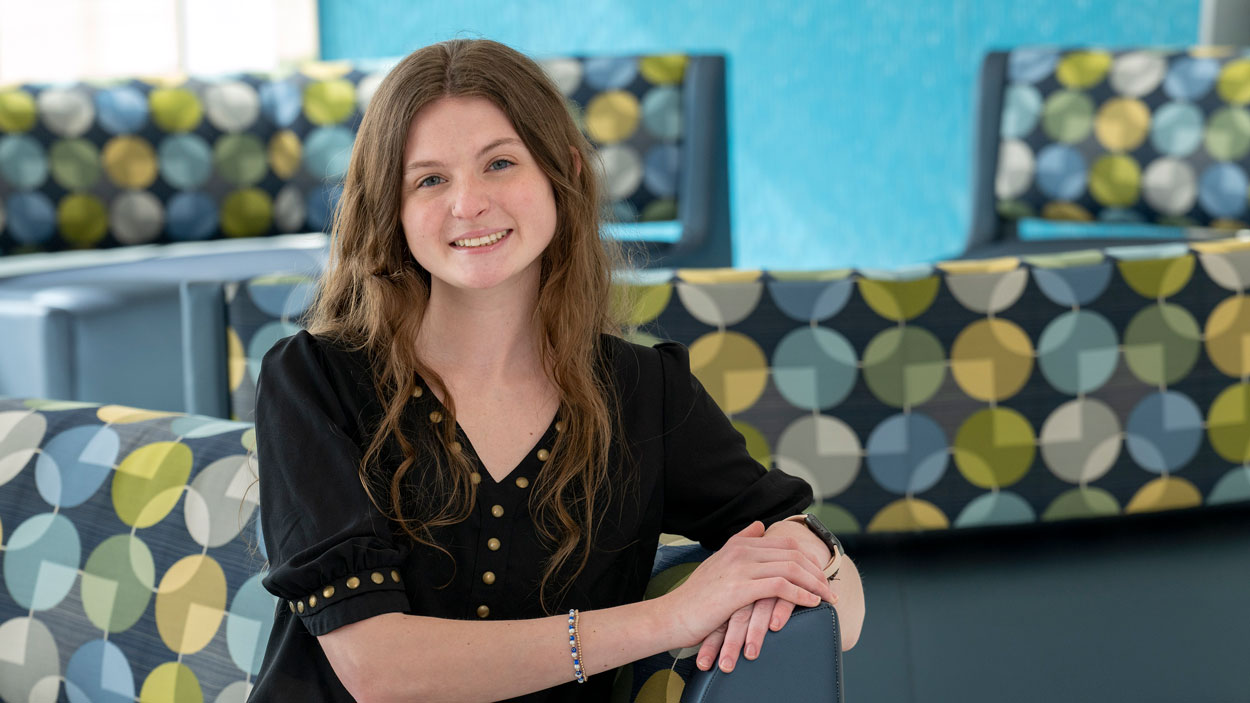
A first-year student in the College of Optometry, McKenna Burgess was first author on research published in the Journal of Supramolecular Chemistry. The research was conducted while she was an undergraduate at Central College in Pella, Iowa. (Photo by Derik Holtmann)
McKenna Burgess always loved going to the optometrist as a kid. She got her first pair of glasses in the third grade, and when she took an anatomy class in high school and started learning about the eyes, she started picturing a future for herself in eye care.
“It was just so fascinating to me how something that people often overlook is so vital and important in our lives,” she said. “It’s such a gift to be able to give that to others, and that was really important to me, and something that I feel is really special. Going into undergrad, I knew that’s what I wanted to do.”
After graduating from Central College in Pella, Iowa, it didn’t take long for Burgess to figure out that the College of Optometry at the University of Missouri–St. Louis was the right next step. She toured several optometry schools around the Midwest, but none offered quite the same sense of community and care as UMSL.
“It kind of already felt like home,” she said. “It felt like there was still that Midwestern charm where everybody is really friendly. I just knew that this was the place for me after that first interview day.”
Burgess is now more than halfway through her first year of optometry school, and that sense of community has been a hallmark of her experience so far. She enjoys the College of Optometry’s small class sizes, which allows her to easily connect with classmates for study groups and engage with faculty members one-on-one.
“It feels like one big community, so it’s been really lovely,” she said. “And so quickly, too. In just our first year, I already feel so close to everybody. It makes the challenging classwork a lot better.”
Burgess was also excited that UMSL’s College of Optometry boasts several active research programs, as she’s enjoyed conducting research since early in her college career. During her sophomore year at Central College, she joined a research program in organic chemistry in which her main role was to optimize a chemical synthesis. She continued working on the multi-year study, which examined macrocyclic systems with supramolecular applications, for three years, eventually becoming the lab manager.
Earlier this year, Burgess saw the fruits of that labor pay off when she was named first author on a paper published in the Journal of Supramolecular Chemistry, “A practical synthesis of cambiarenes with mechanistic insights.” The research centers on supramolecular chemistry, in which large host molecules are designed to bind smaller guest molecules. As Burgess notes, it can be difficult to get good reaction yields in supramolecular chemistry, as the large molecules can break apart during synthesis. To address this, she changed small parts of the reaction conditions to optimize it to the highest yield, enabling her to increase that yield to about 50%.
The resulting molecule was redox-active, meaning it can easily bind to and release guest molecules through reduction and oxidation reactions. This property makes it especially promising in carbon sequestration, such as removing CO₂ from power plants and factories. And unlike other carbon sequestration methods such as carbon sponges, which need to be heated to high temperatures, this molecule is able to remove CO₂ without a change in temperature or other variables.
“It’s a cool idea for climate change,” Burgess said. “One of our big problems is greenhouse gasses, so that’s why this molecule is so exciting – it has some pretty cool implications like that.”
Burgess said it’s been a long time coming for her and her co-authors to get enough data for the research paper. She finished her research and completed her thesis during her senior year of undergrad, then finished the paper last summer. It was accepted in late December and published in mid-February.
“It was pretty surreal,” Burgess said. “We never truly knew if we were going to get to the point where we were able to publish, so that feeling of being accepted into the journal – which is a huge, long process of having different editors – and then having the journal come out is such a wonderful feeling. And being noticed for it in optometry school now makes me feel so loved.”
As she finishes out her first year in the College of Optometry, Burgess is firmly focused on her coursework and getting more acquainted with faculty members. But moving forward, she hopes to continue conducting research, and can see herself getting involved in one of the College of Optometry’s research groups in the coming years.
“Research is something that I absolutely love, because there’s not very many times in our lives that we can say we’re the first one to do something,” she said. “When you’re the first person to do that, it’s such a surreal feeling.”