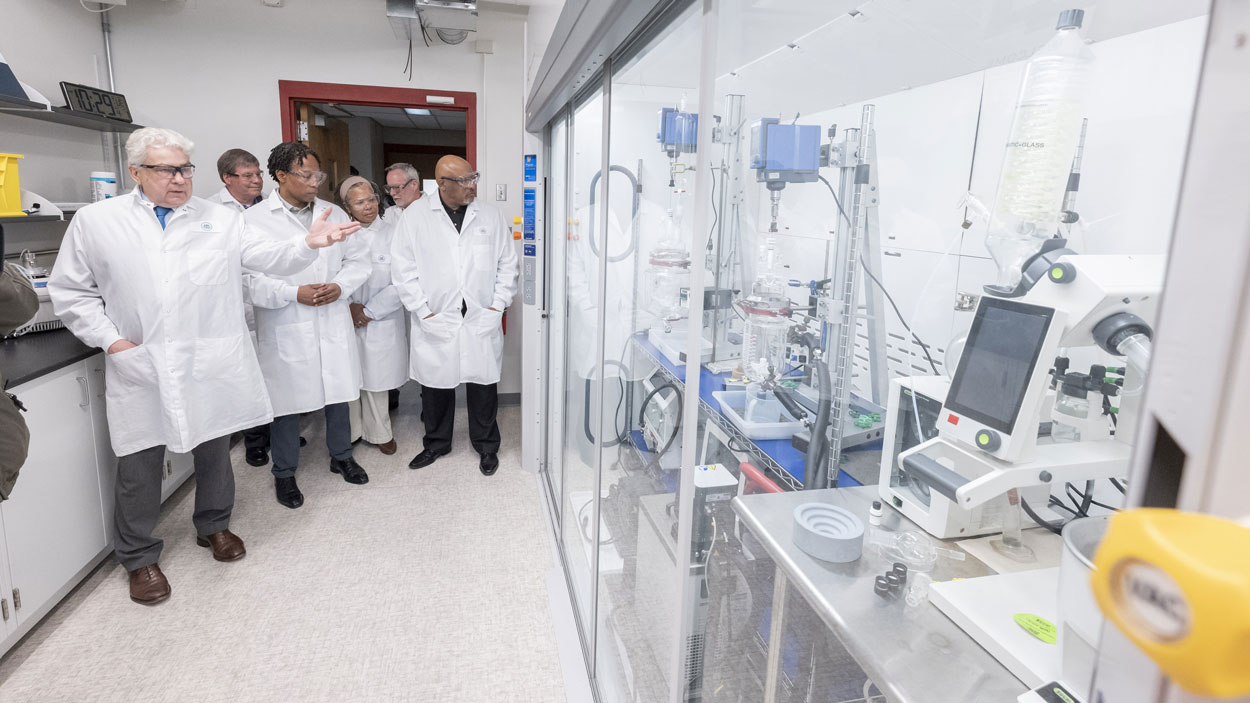
Chris Spilling (at left), UMSL’s vice chancellor for research and economic and community development, leads Congressman Wesley Bell and others on a tour through one of the API Innovation Center’s research and development labs in the UMSL Science Complex. (Photos by Derik Holtmann)
Congressman Wesley Bell joined University of Missouri–St. Louis Vice Chancellor Chris Spilling and API Innovation Center President and Chief Operating Officer Kevin Webb for a tour of APIIC’s research and development labs on Tuesday morning in the UMSL Science Complex.
Bell recently led the successful effort to secure more than $1 million in federal investment to support the launch and advancement of the API Advanced Manufacturing Innovation Hub on UMSL’s campus. The funding was included in the FY26 Commerce, Justice, Science Appropriations Act, and Bell brought along a ceremonial check to present to Spilling and Webb during a media event in the lobby of the Science Learning Building.
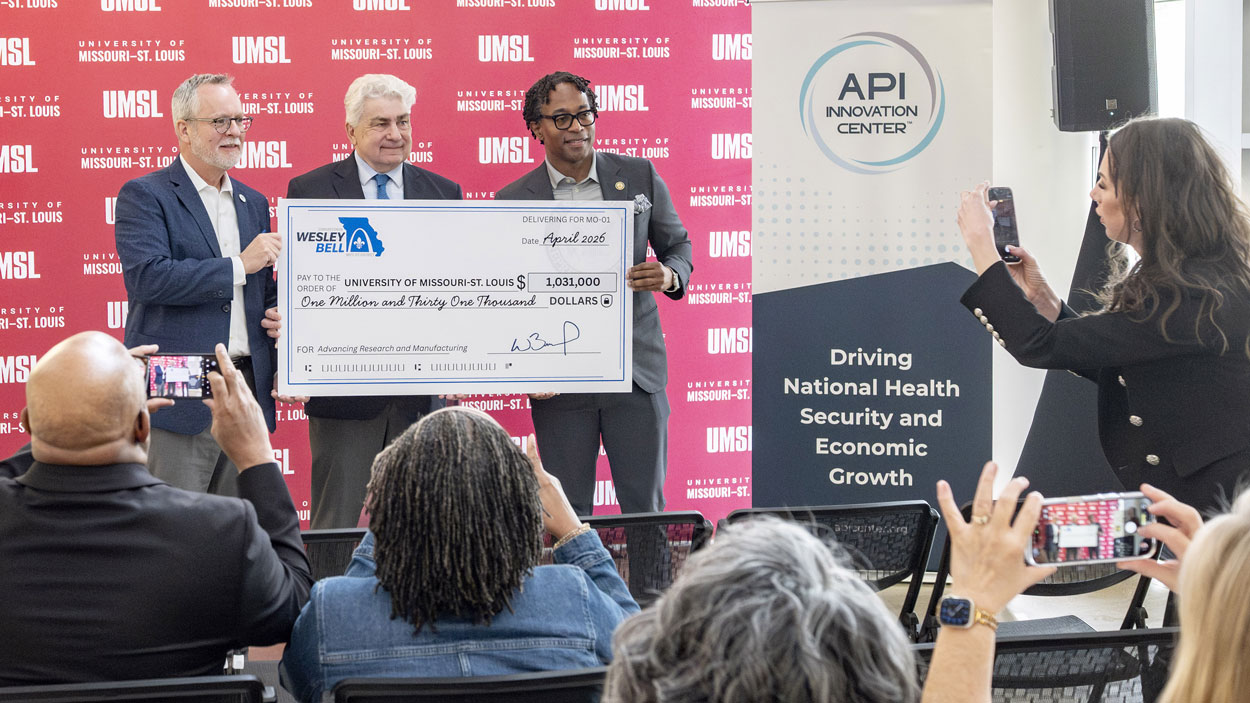
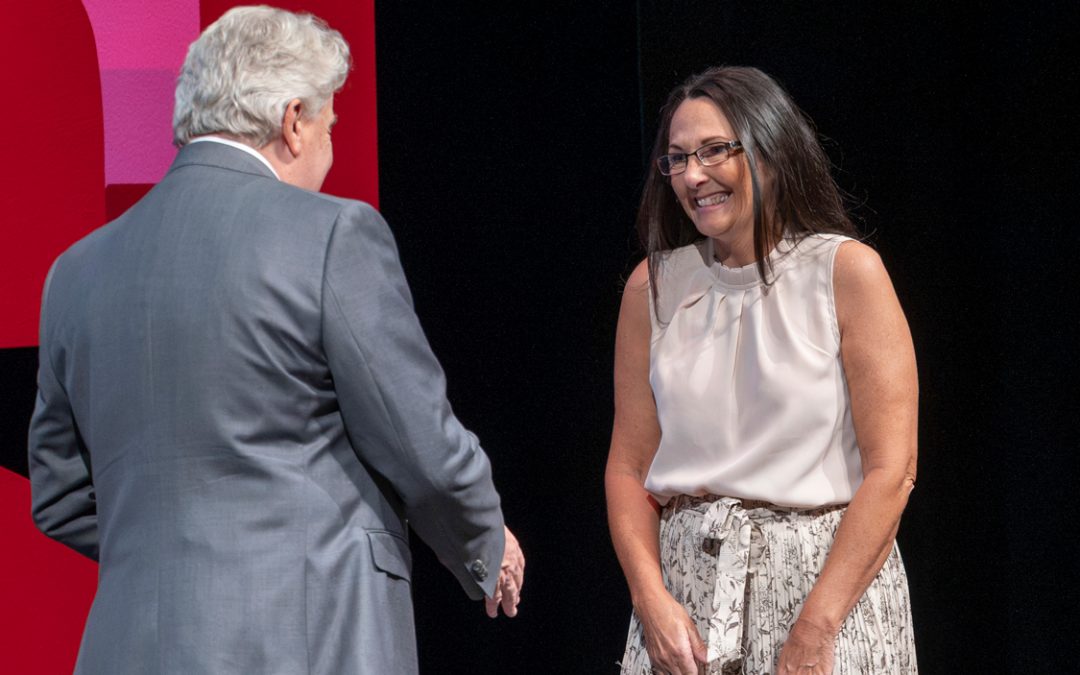
Congressman Wesley Bell presents a ceremonial check to UMSL Vice Chancellor Chris Spilling and API Innovation Center President and Chief Operating Officer Kevin Webb at a media event on Tuesday morning in the lobby of the Science Learning Building.
“Today, we’re here to announce $1,031,000 in federal community project funding to establish API Advanced Manufacturing Innovation Hub right here at UMSL, advancing cutting-edge pharmaceutical manufacturing research and strengthening domestic production of active pharmaceutical ingredients and finished drug products,” Bell said. “UMSL is exactly the kind of institution we should be investing in. This university sits at the center of one of the most important conversations happening in American manufacturing right now: How do we stop depending on foreign countries for the drugs Americans need? How do we build that capacity here, at home, in cities like St. Louis?
“This hub is a direct answer to that question. It positions UMSL as a national leader in pharmaceutical manufacturing research and puts St. Louis in the middle of a sector that is only going to grow. That means research dollars. That means partnerships with industry. That means jobs – good, high-skilled jobs for people who live and work in this region.”
Founder and Chair Tony Sardella and Webb first incorporated the API Innovation Center in 2022 and soon after began seeking out collaborations with industry leaders as well as with UMSL, looking to leverage the university’s strengths in research, workforce development and community engagement as it worked to make the pharmaceutical supply chain more secure and self-reliant.
“At the time, there was just the two of them – no labs, an office in Cortex and a really, really good idea,” said Spilling, UMSL’s vice chancellor for research and economic and community development. “From there on, we’ve been able to build out some impressive labs, well-equipped for the work that we want to do. We’ve been able to secure state funding, and we’ve been able to secure federal funding to bring back the manufacturing of the very much needed active pharmaceutical ingredients that are currently mostly manufactured offshore.
“We’ve enjoyed a lot of support. I was just in Washington, DC, where I had the pleasure of spending time with Congressman Bell and his staff, and I’ve got to tell you, the enthusiasm in that office for this project and for bringing jobs back to St. Louis is amazing, and that support is manifested now into actual financial support.”
Spilling said the funding will help APIIC and UMSL purchase needed equipment to support APIIC’s work in analytical chemistry.
“When the staff and myself are doing chemistry and thinking about chemistry, we need to know what’s going on as we’re running reactions, trying to develop new routes,” he said. “We need to know what the outcomes of those experiments are. And so, the equipment that we’ve decided to purchase will help us determine the outcome of these reactions. The other piece of equipment that we’re looking at is to help us determine the structure of the impurities. There are very, very strict rules around APIs. You are only allowed small amounts of impurity, and you need to know what those are.”
UMSL and APIIC are specifically working to reshore production of five essential generic APIs:
- Propofol (sedation and anesthesia)
- Bupivacaine (local anesthetic)
- Albuterol (asthma and COPD treatment)
- Metoprolol (cardiovascular treatment)
- Lorazepam (anxiety and seizure disorders)
These widely used medications are critical in acute and chronic care settings and have experienced supply chain pressures in recent years. Industry collaborators, including Missouri-based Sentio BioSciences and Par Health, are partnering to strengthen domestic production capacity and ensure reliable access to the treatments.
Spilling said the instruments purchased for APIIC’s research and development labs can also be used to support other projects in the Department of Chemistry and Biochemistry. Both graduate and undergraduate students will have opportunities to train on research equipment like what is being used in industry, so they will have familiarity with the high-end analytical equipment and can fit right into the jobs.
Media Coverage
KSDK (Channel 5)