
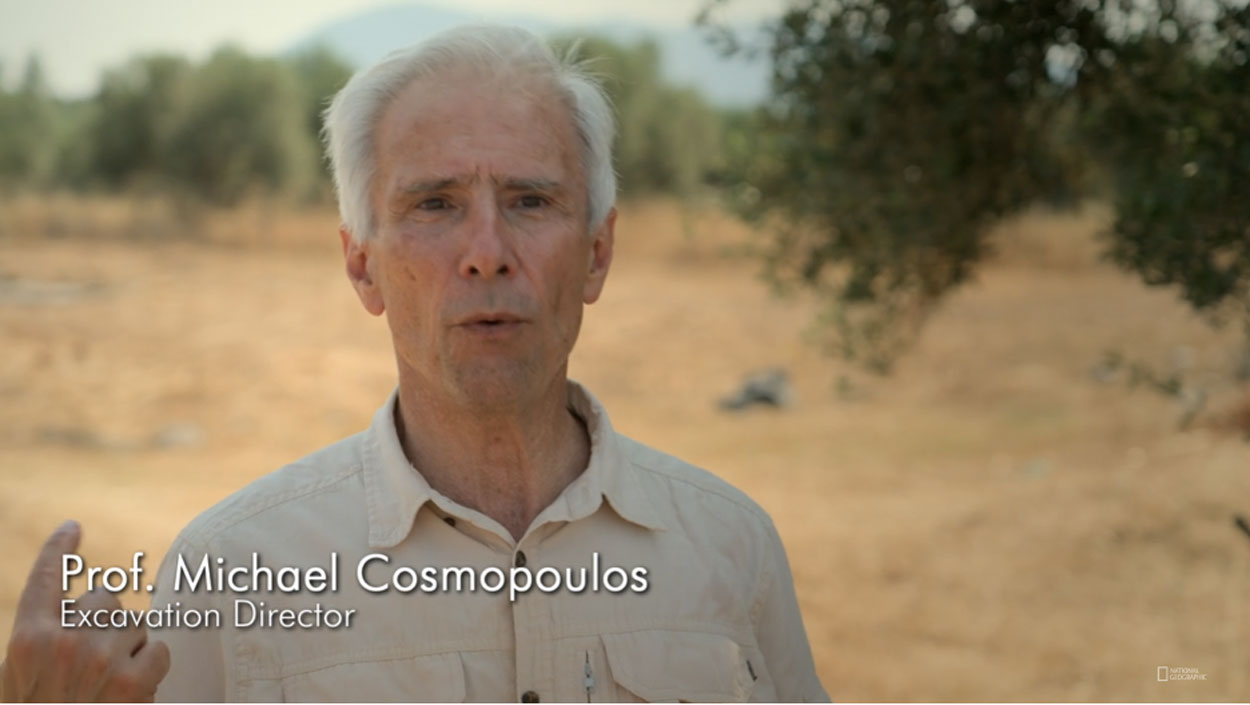
Michael Cosmopoulos appears in Episode 4 of National Geographic’s documentary series, “Treasures of Ancient Greece.” (Screenshot)
The Trojan War is a legendary conflict in Greek mythology, pitting united kingdoms of Greece in a battle with the city of Troy.
It was said to be sparked by the abduction of Helen and was waged over 10 years during the Bronze Age. According to myth, the Greeks, or Mycenaeans, finally prevailed when, after a fruitless siege, they used a wooden horse to sneak into the city and ultimately surprise the Trojans with overwhelming force. The war features prominently in Homer’s epic poems “The Iliad” and “The Odyssey,” while the story of the Trojan horse is recounted in detail in Virgil’s “Aeneid.”
National Geographic has highlighted the work of several teams of archaeologists – including one led by University of Missouri–St. Louis Professor Michael Cosmopoulos – that have been working to help uncover the truth behind that and other myths as part of its new documentary series, “Lost Treasures of Ancient Greece.” Cosmopoulos is featured prominently in the series’ fourth episode, “The Mystery of the Trojan War,” available to stream via National Geographic or on Hulu.
“This is the one myth that’s deeply embedded in our culture.” Cosmopoulos said as he was introduced to the audience during the episode’s opening sequence. “People have been looking for evidence that the Trojan War happened for the past two centuries.”
After highlighting the work of Turkish archaeologist Rustem Aslan, who has long been leading the excavation of the ancient city of Troy in modern day Turkey and found evidence of military conflict there, the episode turned its attention some 300 miles southwest to Iklaina, in the Peloponnese region of Greece. Cosmopoulos, the Hellenic Government-Karakas Family Foundation Professor in Greek Studies and professor of archaeology, has been directing work there for the past two decades.
His research suggests that between 6,000 and 8,000 people lived in Iklaina during the time of the Trojan War. Among the notable discoveries they’ve made were the buried remains of a Cyclopean limestone terrace, believed to have provided a foundation for a multistory structure typically only found in palaces and Mycenaean capitals. Further investigation revealed dozens of buildings extending across an area of nearly 32 acres surrounding the terrace, pointing to Iklaina not being merely a confined palace but an entire city, including paved streets and piazzas lined with homes and workshops, and one that operated as part of a two-tiered system of government under the umbrella of the nearby Palace of Nestor.
“What is truly fascinating is that in ‘The Iliad,’ we have hints of a similar organization of the Kingdom of Nestor, who is the legendary kingdom of Pylos,” Cosmopoulos said. “It’s by no means historical record, but at least preserves some kind of memory of the organization of Mycenaean states.”
Iklaina and Pylos were both destroyed around 1200 BCE during a period of upheaval throughout ancient Greece, and Cosmopoulos that could have ignited a fight for resources.
“It looks like there is some kernel of truth in the Trojan War,” Cosmopoulos told National Geographic. “A Mycenaean army may have attacked Troy in an effort to capture and plunder a rich city, and at the same time gain control of the straits to the Black Sea. But that war appears to have been exhaustive, and the Mycenaeans eventually did not survive much longer after that.”
But the myth of the Trojan War has remained for millennia and continues to captivate people in Greece and around the world.
“People think that myths are fairytales, and they’re not,” Cosmopoulos said. “Myths and legends are the product of human experiences – the wisdom of people over the centuries. One of the basic, core truths that we learn from ‘The Iliad’ and the story of the Trojan War is how war and violence affect humanity.”