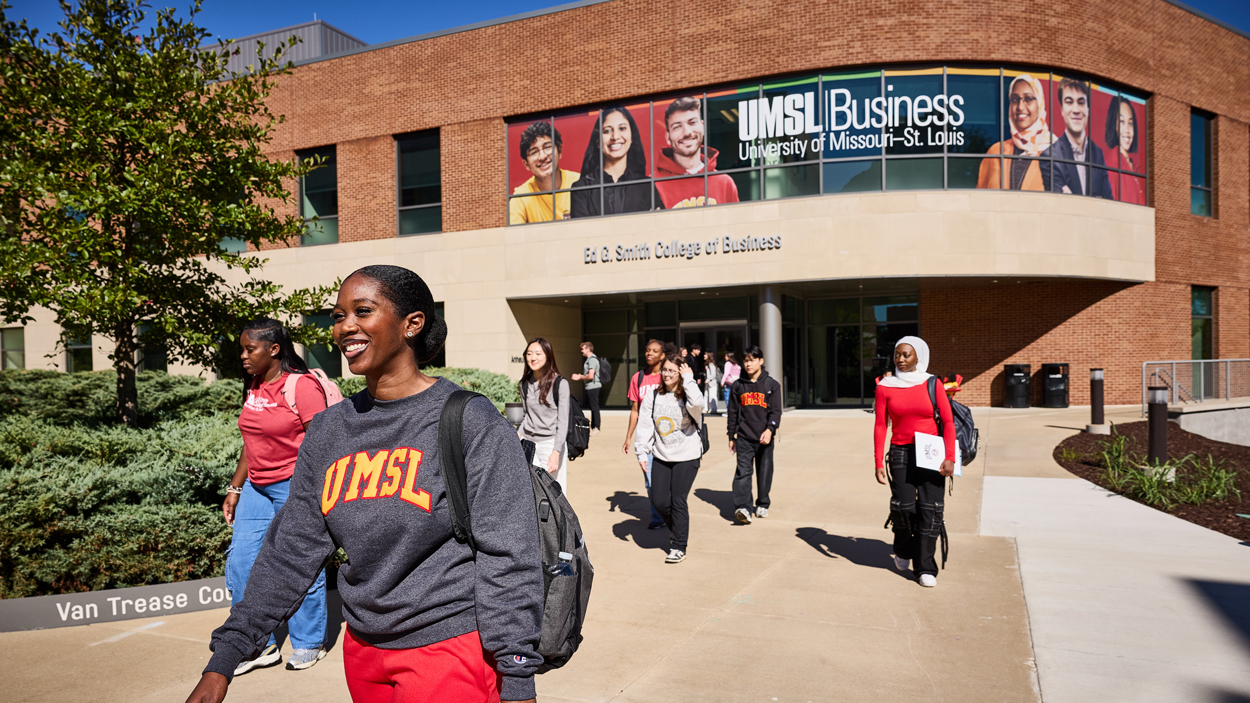
Students pursuing a marketing emphasis within the Bachelor of Science in Business Administration degree program at the University of Missouri–St. Louis’ Ed G. Smith College of Business will have more opportunities to develop the skills and experience needed to succeed in today’s evolving marketing industry following the program’s redesign. (Photos by Derik Holtmann)
Thirty years ago, marketing students could prepare for a career by learning the fundamentals of television, radio, print, telemarketing and direct mail. Today, they need to understand search engine optimization, customer relationship management, digital analytics, social media and artificial intelligence, and the pace of change shows no sign of slowing.
That evolution is at the heart of a newly redesigned marketing emphasis within the Bachelor of Science in Business Administration degree program at the University of Missouri–St. Louis’ Ed G. Smith College of Business, giving students more opportunities to develop the specialized skills they will need in an increasingly technology-driven industry.
Beginning this semester, the marketing emphasis expands from 18 to 30 core credit hours, exclusive of MKTG 2700 – Principles of Marketing, which is part of the business core required of all BSBA students regardless of emphasis. The revised structure places greater emphasis on digital strategy, analytics, artificial intelligence and applied learning. For Teaching Professor Perry Drake, chair of the Department of Marketing and Entrepreneurship, the changes reflect the unavoidable reality that marketing has become far more complex than it was even a decade ago.
“There’s just so many aspects now of marketing that I want to make sure the students walk away from here with the skills they need at the end of the day,” Drake said.
Drake recalled that when he arrived at UMSL in 2013, roughly 25% of marketing budgets were devoted to digital channels. Today, he estimates that figure is about 75% to 80%. The tools and strategies within digital marketing have evolved just as dramatically.
He has experienced that transformation throughout his career. Before joining UMSL, he was a professor at New York University and helped develop an integrated marketing master’s degree program at a time when the web was still emerging. Early digital analytics involved downloading web server log files and running them through software to determine how visitors navigated websites.
That world quickly gave way to Google Analytics, social media, increasingly sophisticated digital advertising and a growing array of marketing technology platforms. Now, artificial intelligence is accelerating the pace of change again.
“What that looked like in 2013 when I started is different than what it looks like today,” Drake said. “It will be different than what it looks like in five years.”
The redesigned UMSL curriculum is intended to keep pace.
One of the most significant changes is making Digital Strategies a required course for every student completing the marketing emphasis. The course gives students hands-on experience with areas including search engine optimization, paid search and pay-per-click strategy, Google Analytics, customer journey mapping, email marketing, automation, content strategy and marketing technology platforms.
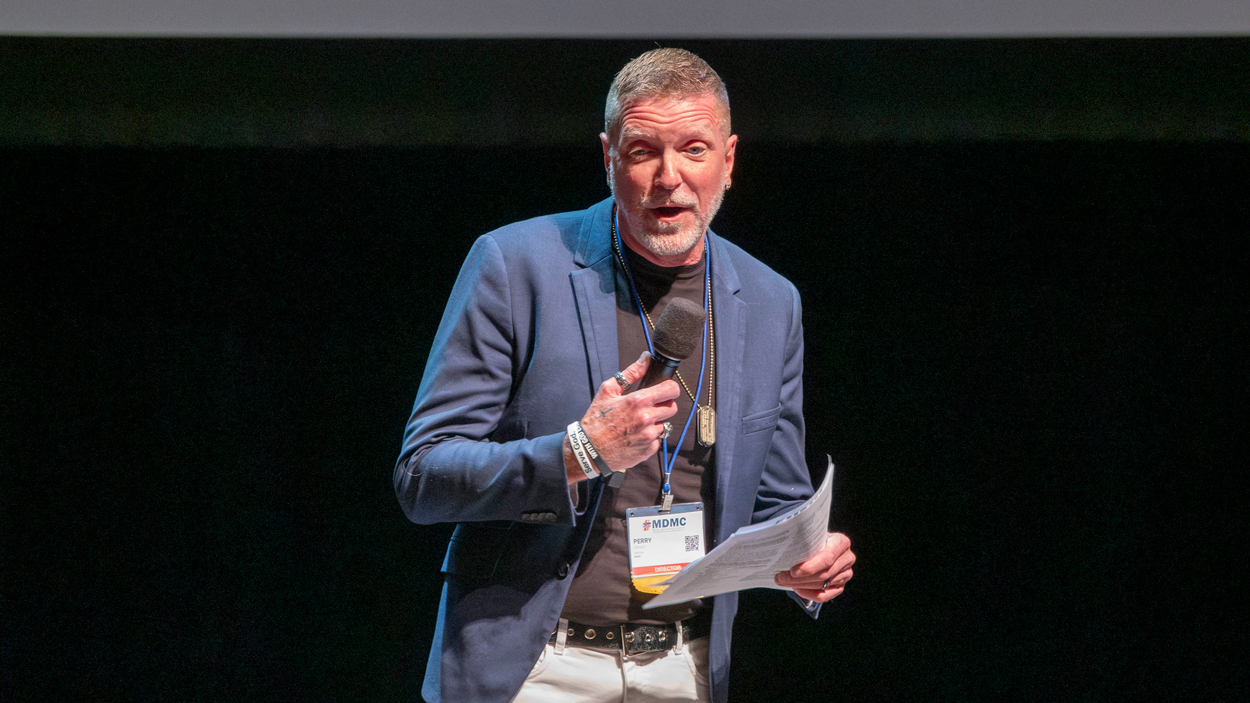
Perry Drake, teaching professor and chair of the Department of Marketing and Entrepreneurship at the University of Missouri–St. Louis, says the redesigned marketing program will give students a deeper foundation in the discipline and the practical skills they need to adapt to a rapidly changing industry.
Drake stressed that this change will potentially give UMSL students a significant advantage. While digital marketing courses are widely available at most schools, they are still often treated as electives, concentrations or specialized tracks. In UMSL’s review of 10 regional peer universities, only one required a dedicated digital marketing course for every marketing student.
“At a lot of other schools, you could have students graduating without knowledge of Google Analytics or SEO or paid search,” Drake said.
Marketing Analytics has also been redesigned as Marketing Analytics with AI, incorporating predictive tools, AI-supported analysis and data-driven decision-making into required coursework. But AI certainly will not be limited to a single course.
Drake said the department has worked to incorporate AI throughout the curriculum, with faculty members considering not simply how students can use the technology but how professional marketers are using it. The goal is to give students practical experience with the technologies and analytical approaches they will encounter in the workplace while helping them understand how those tools fit into broader marketing strategies.
That approach also reflects a major shift in how faculty are thinking about AI in the classroom. A year ago, much of the conversation centered on whether students should be allowed to use AI and how its use should be restricted. The question now is increasingly how to teach students to use AI responsibly and strategically in ways that mirror professional practice – to strengthen research, challenge assumptions, improve analysis, generate alternatives and ultimately make better-informed decision.
Simply allowing or prohibiting AI on an assignment is no longer enough; students need to understand how to use it well.
“We’re just trying to stay on top of where the market’s going,” Drake said.
The changes grew out of a yearlong process involving marketing faculty and members of the UMSL Marketing and Entrepreneurship Advisory Council.
Drake met with faculty members and three key advisory board members at an off-campus strategy session last fall to map out the skills they believed students should possess when they graduate. The group identified 25 to 30 key areas of knowledge and skills, then assessed where those competencies were being taught within the existing curriculum.
The process provided a roadmap for determining where the program needed to go deeper.
“It was a lot of work, but it was necessary,” Drake said.
The pace of the redesign is notable because curricular change at UMSL – or any university – requires much more than rewriting a list of courses. Proposed changes move through a formal shared-governance process that includes department faculty review and approval, college-level curriculum review and approval, and university-level review through the Faculty Senate Curriculum and Instruction Committee and the full Faculty Senate, along with Academic Affairs. The work also requires clearly defined learning outcomes, curriculum mapping and an assessment plan. Completing that work in less than a year reflects the faculty’s commitment to responding quickly to changes in the profession while still following the university’s academic-review process.
Drake said the department also views the redesign as an ongoing process rather than a finished product. As AI, marketing technology and employer expectations continue to change, faculty will need to revisit the curriculum map, required competencies and course content regularly to make sure the emphasis remains aligned with the skills graduates need.
The revised curriculum creates a clearer progression in which students are introduced to concepts, then develop their skills through applied coursework and ultimately demonstrate their knowledge through a capstone experience.
Within the marketing emphasis, students will complete three required upper-level marketing courses: Digital Strategies, Marketing Analytics with AI and Marketing Management, the capstone course. In addition, all BSBA students take MKTG 2700 – Principles of Marketing as part of the business core.
Marketing emphasis students will also choose five marketing electives, allowing them to pursue areas that align with their interests and career goals. Those electives include subjects such as consumer behavior, social media marketing, customer relationship management, brand strategy, advertising and promotion, sales management, international marketing and sports marketing.
“I’m excited that now my students have to take five marketing electives, so I know they’re going to go out the door having a real solid base of what they need,” Drake said.
The structure also reflects the growing importance of specialized knowledge within marketing.
Customer relationship management, for example, has become an important part of modern marketing, with platforms such as HubSpot and Salesforce allowing organizations to track customer interactions and develop more targeted strategies. Social media marketing has also become increasingly popular among UMSL students. Drake said more than half of the students in his courses are also taking Introduction to Social Media Marketing, even though it remains an elective.
The curriculum is designed to ensure students have opportunities to explore those areas while building a strong common foundation in digital strategy and analytics. Drake said the changes are ultimately about making sure students get meaningful value from the time and money they invest in their education.
“It’s like trying to steer them down the right path,” he said. “They don’t know that they need CRM, that they need to know how to use HubSpot and Salesforce.”
The result is a marketing emphasis designed to give students more room to focus their coursework within the discipline while still developing the broader business knowledge needed to work across functions.
“The bottom line is, we want to make it easier for the student to obtain the degree of interest and get a deep dive in content around that business area,” Drake said.