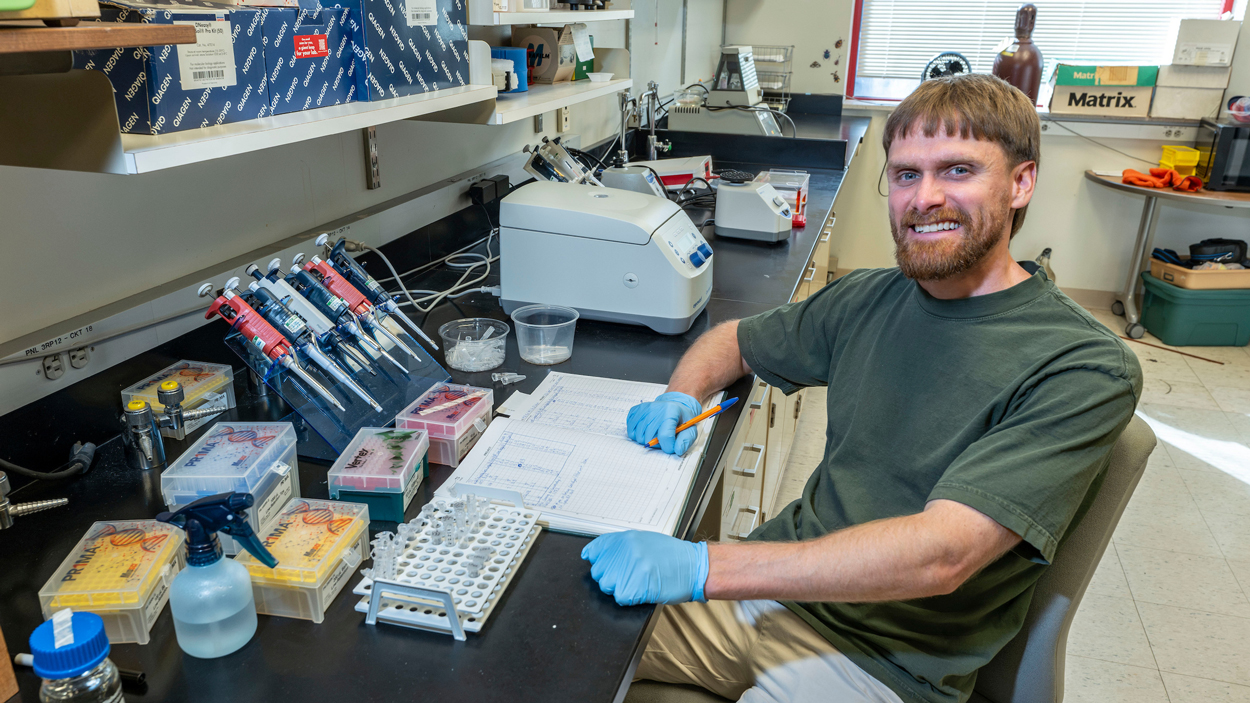
Garrett Behrends, a doctoral candidate in the Department of Biology at UMSL, uses molecular techniques to characterize insect diets and species interactions in Assistant Professor Sara Miller’s Social Insect Diversity Lab. Last spring, Behrends traveled to South Africa, with support from the University of Missouri South Africa Education Program, to study paper wasps. (Photo by Derik Holtmann)
Garrett Behrends was walking through a park in Cape Town this spring when he spotted a giant swarm of paper wasps circling a light fixture about 20 feet above the ground. Behrends remembers thinking, “That’s a massive nest.”
He tracked down the park staff, not so they could call an exterminator, but to borrow a ladder to retrieve the nest. Most people tend to keep their distance from a swarm of wasps. Then again, most people aren’t evolutionary biologists.
“One of the workers stood there and directed me because I actually had to climb up the ladder and then climb up into this tree that was next to the light because it wasn’t tall enough and get up in there,” Behrends recalled. “All I could do was reach my arm up inside, and I couldn’t really see because the bee suit has a brim on it. So, he was directing me, like, ‘Oh no, you need to go over to the right a little bit.’ They were happy to help.”
In April, Behrends, a doctoral candidate in the Department of Biology at the University of Missouri–St. Louis, spent three and half weeks in Cape Town on South Africa’s southwest coast, conducting research and networking with international colleagues.
Behrends uses molecular techniques to characterize insect diets and species interactions in Assistant Professor Sara Miller’s Social Insect Diversity Lab. His work contributes to the lab’s mission to investigate how genomics, behavior and ecology interact to shape biological diversity.
The University of Missouri South Africa Education Program supported his research trip through its Henry Mitchell Scholarship. Since 1986, the University of Missouri System has partnered with the University of the Western Cape on such projects to advance cross-cultural understanding and foster cooperative education and research efforts. Behrends received a $4,000 award with the scholarship, which paid for his flight, housing and rental car.
One word came to mind as Behrends reflected on the experience.
“Lifechanging,” he said. “It really changed my perspective on the world. I always wanted to go there because there’s so much floral diversity and just a really cool biome. The second thing is, it was really good for career development. It gave me the opportunity to go meet other people in in South Africa that study the same problem and form connections I probably wouldn’t have made otherwise.”
In South Africa, Behrends collaborated with UWC Associate Professor Vanessa Couldridge as well as Stellenbosch University Extraordinary Associate Professor Ruan Veldtman, with whom Miller had previously worked. Couldridge acclimated Behrends to the UWC lab space and advised him on areas to collect samples, while Veldtman expedited necessary permits so he could actually conduct field work.
The multi-week expedition advanced Behrend’s research on paper wasps, which are a particularly good model for studying social behavior in insects and exploring drivers of speciation and diversification in specific environments. The work requires collecting honey and larval feces found within nests to extract DNA. Those samples are then sequenced and compared against existing genetic databases of other plant and insect species to identify what the paper wasps eat.
The resulting data can be used to map food webs among the species, which have many gaps presently. Behrends said there are two other important aspects involved in his research. The first is the ability to gain a greater understanding of invasive species.
“There are certain traits that invasive species have that make them successful, and one of them is being more flexible in their diet, so they’re able to invade new habitats and take over a niche not occupied by native species,” he said. “One of my species is an invasive species that’s found in North America and South Africa, and it’s spread all across North America, but it’s been sort of contained around Cape Town in South Africa.”
That invasive species is Polistes dominula, or the European paper wasp. It was introduced in America sometime in the 1970s, and it expanded steadily across the East Coast and the Midwest during the following decades. Meanwhile, the species arrived in South Africa in 2008 and has been primarily relegated to the Western Cape Province.
Behrends has been comparing its diet to those of native species in the U.S., such as Polistes metricus and Polistes fuscatus, and in South Africa, such as Polistes africanus. The goal is to ascertain whether the European paper wasp was able to spread, in part, due to its more flexible diet.
Preliminary findings from the U.S. have shown that the European paper wasp does have a more diversified diet overall than its native counterparts. Behrends also identified an interesting quirk that could help explain why the species thrives in more populated suburban and urban areas.
“The diet’s more diverse relative to the native species, but on a nest-by-nest basis, they’re not eating a greater diversity of items,” Behrends said. “As it moves across the landscape, it’s either optimizing its diet – foraging certain things that are more numerous in the environment – or it could be that, in these urban areas, there are less diet items available, and they’re able to modify their diet in order to survive and meet the challenges in areas where there are less resources. Essentially, you can think of it as a generalist population of specialized nests. So, they’re being more selective on a nest-by-nest basis.”
The second key application of Behrend’s research is providing awareness of what these wasps offer to society and how they benefit humans. Understandably, many people don’t care for wasps, especially if they’ve been stung. However, Behrends suggests looking past their intimidating reputation.
“They actually do provide a lot of services,” he said. “They’re pollinators and insect predators, so they’re actually performing a lot of important roles in the environment. We’re identifying what plants they’re associated with and what sort of pest species they’re eating. I’ve gotten back some pest species, and one of them that’s really stuck out is the tobacco budworm.”
The moth species is a common agricultural and garden pest in the U.S., and Behrends contends if more people knew that paper wasps controlled the pests eating their tomato plants, they might be more inclined to leave them be to perform their function in the local ecosystem.
Ultimately, Behrends was grateful the UMSAEP and Henry Mitchell Scholarship provided the means to travel abroad. The experience was particularly useful given the European paper wasp’s massive invasive range. He noted that a hypothesis can be validated in one environment, but it might not be generalizable elsewhere. It takes efforts to replicate research across the globe to gain new insights and truly advance knowledge.
“I think that that scholarship was really valuable to my research,” he said. “I wouldn’t have been able to go to another introduction zone like that otherwise, so I think that it’s a good opportunity. I think (the UM System) should keep doing it.”