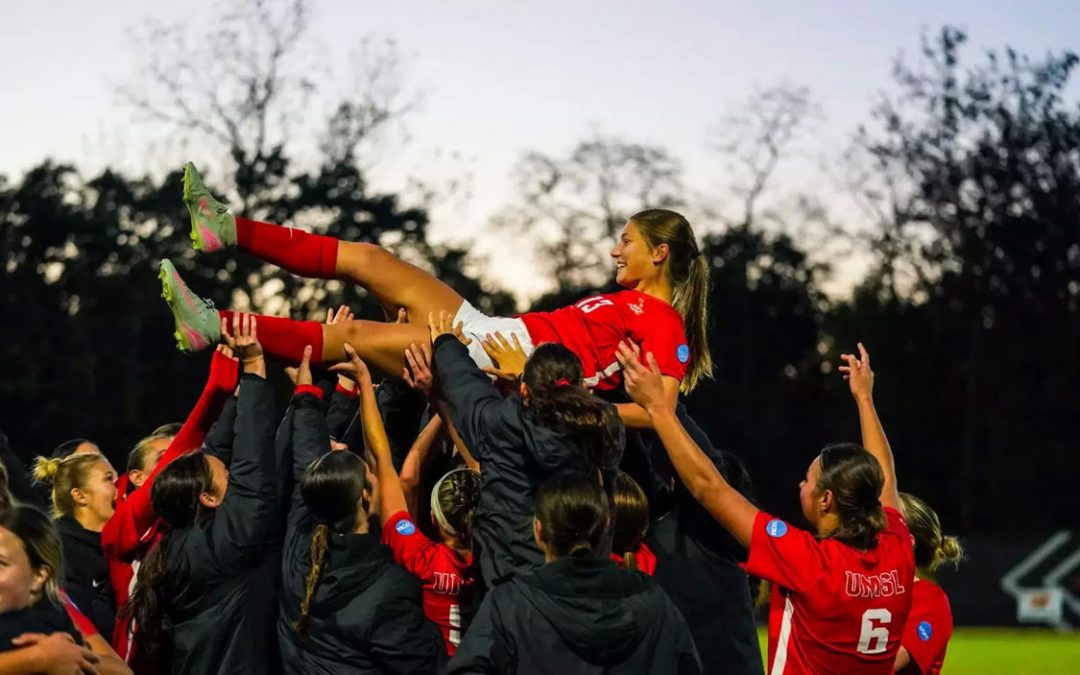
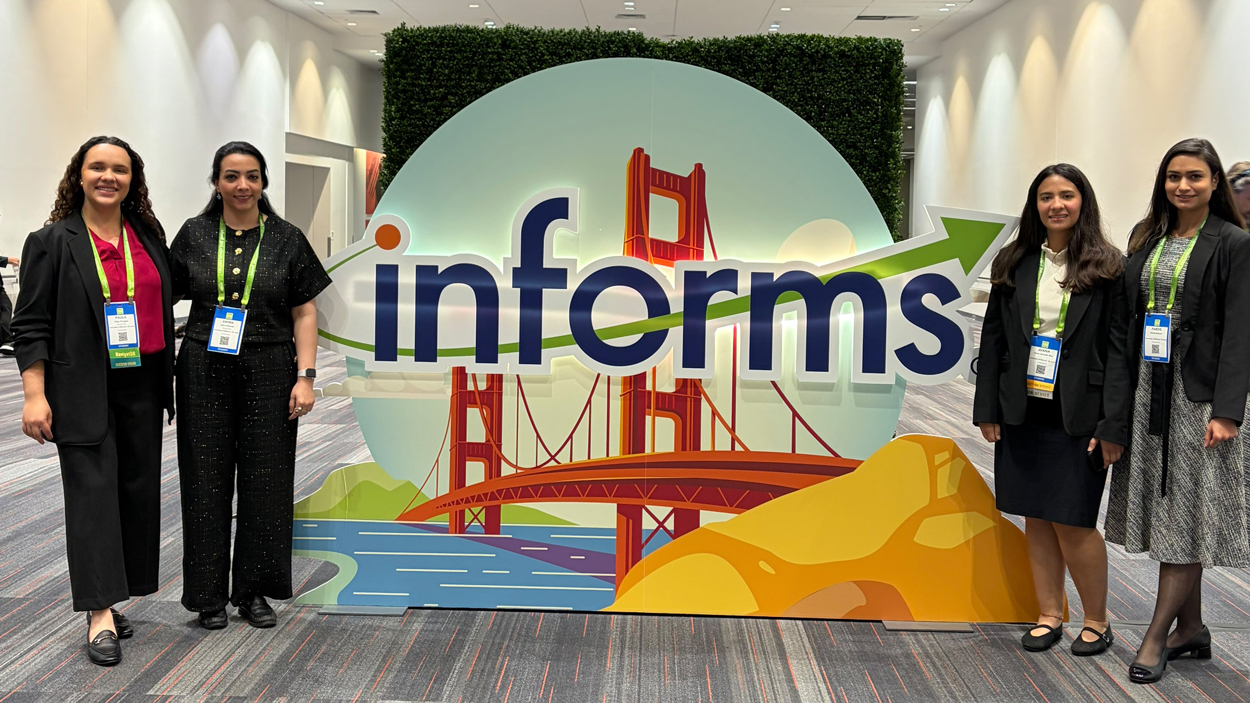
Four doctoral students in UMSL’s Department of Supply Chain and Analytics – (from left) Paula Penagos, Zahra Rahmati, Juana Jaramillo Rios and Pardis Bahmani – presented research in operations research and management science at the 2026 INFORMS Annual Meeting, held Nov. 1-4 in San Francisco. The opportunity offered by UMSL allowed the students to showcase their skills and build professional relationships, which will help them launch their careers in academia or industry. (Photo submitted by Paula Penagos)
Doctoral students need to showcase their research skills and build professional relationships if they are to successfully launch careers in academia or industry. The supply chain and analytics department in the Ed G. Smith College of Business at the University of Missouri–St. Louis recognizes the importance of providing students with opportunities to do both.
A quartet of UMSL students recently took advantage. Paula Penagos, Pardis Bahmani, Juana Jaramillo Rios and Zahra Rahmati traveled to San Francisco for the 2026 INFORMS Annual Meeting, held Nov. 1-4, where they presented their research in operations research and management science and connected with more than 6,000 researchers, academics, industry professionals and students from around the world.
“It’s an excellent forum for students because it’s very welcoming, and they have the opportunity to see so many other students presenting,” said Associate Professor Trilce Encarnacion. “They’re also among the leaders in the field, where the cutting edge of ORMS research is happening. This is the conference to go to where they can start developing their professional networks, start to make themselves known for what they can do, and they can establish connections that will be important to their careers.”
The four students are at different stages of their doctoral studies, but they share an understanding that building professional relationships takes time, and the connections they begin making at conferences can become valuable well before they enter the job market.
INFORMS was the first conference as a doctoral student for Rahmati, who is in her third semester at UMSL, and she was appreciative of the chance to begin establishing those relationships early. Rahmati presented her research on “Giving Retired Wind Turbines a Second Life: The Hidden Value of Rail and River Transport,” and she said that developing a professional network requires more than reaching out to potential colleagues when a job opportunity arises.
“The network cannot be built last minute; you have to work on it for two or three years,” Rahmati said. “You cannot just the night before your application send an email that asks, ‘Would you please refer me?’ It doesn’t work that way. You have to start it earlier and really get to know people.”
Bahmani, a third-year doctoral student, is already seeing how those interactions can help her better understand the academic profession and the expectations of a future faculty position.
In her second experience at INFORMS, Bahmani presented research from a pair of projects – “Beyond Emergencies: Drone-Enabled Routine Delivery for Healthcare Systems” and “Designing Equitable and Efficient Telehealth Networks: A Behaviorally Realistic Optimization Approach for Rural Communities.” With several conferences now under her belt, she said the experiences have helped her become more comfortable approaching established researchers, asking questions and learning what she needs to do to prepare for the next stage of her career.
“The first time I went to this conference I was so overwhelmed,” she said. “I knew no one, but this was the second time, and I was seeing familiar faces, and I kind of feel like I’m finding my identity in academia. I can identify people. I know how to have conversations with people, and now, they know me. I’m grateful to our department for providing me with this valuable opportunity to connect with researchers and grow professionally.”
Jaramillo Rios, also in her third year of UMSL’s PhD program, has found that the experience extends beyond the formal research presentations.
Conversations with other researchers have given her opportunities to receive feedback on her work and learn how others approach similar challenges. She also sees these conferences as chances to become more comfortable presenting and discussing her findings.
“The day that you don’t feel nervous about your presentation, you are doing it wrong,” said Jaramillo Rios, who presented her research on “End-to-End Freight Resilience Under Geopolitical and Inland Disruption: A Preparedness-Recovery Optimization Framework.” “It’s a special thing to show to a room full of people what you have spent many days, many weeks, many months working on, but at the same time, you don’t know what questions they are going to ask. And for me, English is not my first language, and I’m a very shy person, so I need to get more natural, more authentic talking about my research.”
For Penagos, who is preparing to graduate in May, the value of those experiences has become even clearer over time.
She first attended INFORMS five years ago, just three months after arriving in the United States. At the time, navigating a large conference and networking in a second language felt intimidating. But after attending five consecutive years, she knows how to make the most of the experience and is helping younger students do the same.
“Now it’s just like a walk in the park, and I enjoy it,” said Penagos Rodriguez, whose presentation was titled “Location-Allocation Optimization for Disaster Sheltering: A Behavioral Modeling Approach.” “I know who to meet and where to go and how to present myself because it’s also like selling what you do to a different audience. It makes me feel that I am finding my place in this field, and my work is gaining visibility and relevance.”
Encarnacion said those experiences are an important part of preparing doctoral students for the demands of academic and professional life. Presenting research means opening it up to questions, criticism and suggestions for improvement, and students need to become comfortable with that process.
“The nature of our careers in academia is that we are presented with a lot of rejection,” she said. “You get more comfortable with it the more you are exposed to it, and that’s just the truth of it. They have to have that balance of accepting criticism and taking it and leveraging it as it will be useful for them to improve their research, but they also have to develop the ability to defend it and explain it in a way that comes across as rigorous as it is.”
That balance is part of what makes conferences such valuable learning experiences. For the students, the opportunity to attend is also a reflection of the support they receive from UMSL and its faculty, including Encarnacion, Shakiba Enayati, Haitao Li and Siqiang Guo. Their encouragement allowed the students to grow as researchers while helping them build the relationships and confidence they will need throughout their careers.
“There is a family feel here, that’s for sure,” Penagos Rodriguez said.
“It’s a very important thing that the university gives us the opportunity to go to these conferences,” Jaramillo Rios said. “I’m really grateful to UMSL, the College of Business and also the supply chain department because they are the ones that allow us to live this experience.”