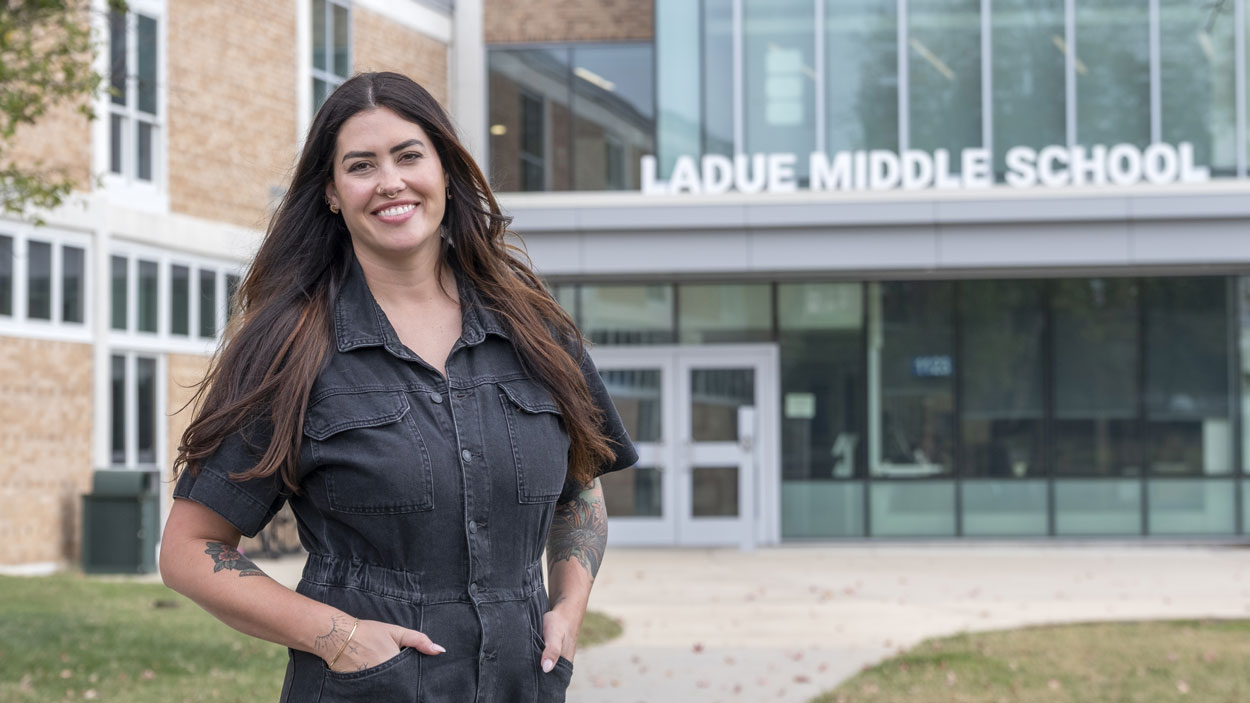
UMSL school counseling PhD alum Sara Carpenter, now a school counselor at Ladue Middle School, has been named the 2026-27 chair of the American School Counselor Association Ethics Committee. (Photo by Derik Holtmann)
Sara Carpenter’s training to become a school counselor included several core curriculum areas, such as clinical practice and human growth and development, but she found herself particularly intrigued by lessons on ethical practice.
“I always found that in any of our ethical discussions, every single core issue would come up,” said Carpenter, a school counselor at Ladue Middle School. “There would be some case study that we would be presented with, and all these different intersections of identities and cultural issues were present in this case study. So, how do we then determine what the route of action is, upholding our obligation to do no harm and be just and fair toward the client? I found that the quandary of ethics and legal issues got to the meat of professional practice.”
Carpenter, who graduated from the University of Missouri–St. Louis in 2018 with a PhD in school counseling, is now helping counselors across the nation navigate those dilemmas. In October, the American School Counselor Association named Carpenter the 2026-27 chair of the ASCA Ethics Committee. She previously served as the 2025-26 assistant chair and has been a featured presenter as part of the ASCA’s webinar series and at the organization’s annual conference.
“Dr. Carpenter has been a valuable member of the ASCA Ethics Committee for the past two years, and we look forward to working with her in her new leadership role,” said Jill Cook, ASCA executive director.
The ASCA is a nonprofit professional organization dedicated to expanding the impact of school counseling through advocacy, collaboration among members and systemic change. Its Ethics Committee concentrates on developing content, resources and presentations that reinforce the organization’s commitment to professional ethics.
Carpenter had also been a leader at the state level in the Missouri School Counselor Association, serving on its ethics committee and training school counselors. The experience motivated her to get more involved at the national level with the ASCA, and she began working on its Position Statement Committee.
The advisory body reviews and revises the organization’s proposed and existing position statements – briefs on the appropriate responses to potentially thorny matters. Carpenter was instrumental in rewriting the ASCA’s guidance on suicide prevention, intervention and postvention, which led to serving on the Ethics Committee. As a committee member, she was the lead contributor to the 2026 ASCA Information Gathering Tool: Suicide Concern.
Carpenter said it’s humbling to now lead the Ethics Committee, and she considers it an honor to be in a position to support her peers.
“This is a very, very hard profession,” she said. “It gets harder every year because society exists in our schools, so we are responding to societal issues daily when we’re encountering an ethical or legal dilemma. The American School Counseling Association publishes quite a bit of resources to help school counselors understand their highest obligation to the principles of ethical behavior to support all students.”
From one day to another, there’s no telling what school counselors might encounter. Sometimes trauma is involved, but even if it’s not, each student brings deeply layered concerns to their offices that must be treated with nuance and understanding. Carpenter added that there’s no one-size-fits-all approach, which requires counselors to reflect on the values they might apply to each new situation.
But that’s exactly why professional standards, like positions statements, are so crucial. They provide a solid practical foundation and remind counselors of their ethical and legal responsibilities. To that end, Carpenter will oversee the first revision of ASCA’s ethical standards since 2022. Next year, the Ethics Committee will reach out to affiliated state organizations, like the MSCA, to solicit input on the changes to ensure a variety of perspectives are represented.
Carpenter’s work at the national level has been informed, in part, by her education at UMSL. A mentor in Carpenter’s MEd program at Southeastern Oklahoma State University encouraged her to pursue a doctorate, which she hadn’t initially considered. However, the idea grew on her, and she surveyed the country for a program that would meet her needs.
UMSL’s highly regarded doctoral program quickly attracted her attention. Its CACREP accreditation – the gold standard for counseling education – and the university’s Play Therapy Institute set it apart from other contenders. While the program maintains rigorous academic standards, it is also very adaptable to students’ interests.
“When I got into the program, my future goals were two-part,” she explained. “One was to gain the leadership and expertise needed to move up into the world of a director of school counseling in a public school system, and the other was to become a future educator who trained school counselors.”
Now, Carpenter is meeting and exceeding those goals. She’s training the next generation of counselors, serving her community at Ladue Middle School and shaping the profession at the national level. She tries to impress upon others that they can do the same. They just need to take the first step to get involved.
Sometimes that first step is more of a push from Carpenter to present about the innovative work that they do.
“School counselors are doing incredible work, and some of them are really humble and shy and don’t want to share that stuff, right?” Carpenter said. “So, I’m like, ‘Let’s get you to present. Let’s get you to talk about these things. That’s a really innovative program that you’re running, and I think a lot of school counselors would benefit from hearing about how you’re doing that and how you’re making that work.’
“I try to encourage a lot of folks to share their knowledge because people are so good at what they do, and a lot of it happens in silos. So, share it. Someone will hear it and want to do something with that.”