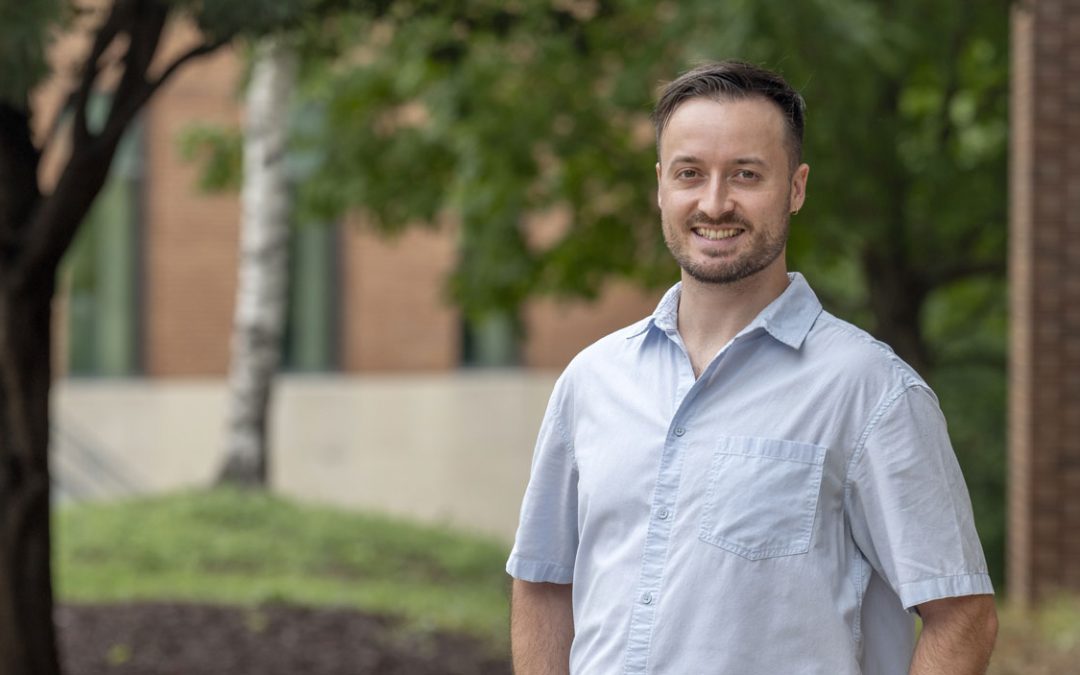

Anna Heinzmann is researching how instituting plea bargaining is altering the legal system in her native Brazil as a doctoral student in the Department of Criminology and Criminal Justice. (Photo by Derik Holtmann)
Anna Heinzmann received her law degree from the Federal University of Rio Grande do Sul in her native Brazil and moved immediately into a residency in a local public defender’s office.
She was learning the ropes, assisting with legal research, drafting petitions and preparing case files, among other tasks in criminal, civil and family law cases. Such a role is often a jumping off point to go into private practice after building practical experience in legal representation.
But Heinzmann already knew she wanted her career to follow a different path.
“I wanted to teach,” she said. “I was unhappy being an attorney, to be honest. I wanted to go to academia.”
She liked the idea of studying the criminal justice system more than working on the inside, but she said doctoral programs focusing on criminology and criminal justice are rare in Brazil. Instead, she looked abroad – at both the United States and Europe – to continue her education and eventually landed at the University of Missouri–St. Louis.
“I applied to other places in the U.S.,” Heinzmann said, “but I think UMSL is one of the best programs in criminology and criminal justice that we have here.”
Heinzmann arrived in St. Louis in the fall of 2023 with a clear direction for her doctoral research. She wanted to study how more widespread adoption of non-prosecution agreements – which are a form of plea bargaining or negotiated justice – has impacted the Brazilian criminal justice system.
Brazil is one of many countries to add or expand its use of the tool to resolve criminal cases in recent years, with defendants – especially nonviolent or first-time offenders – given the opportunity to admit guilt in exchange for reduced sentences or admission into diversion programs.
The use of plea bargaining comes with obvious benefits, including reducing the time it takes to resolve cases and limiting the number of people spending time in prison. That can come with financial benefits for the government and society more broadly. Heinzmann said it also enhances the safety and well-being of offenders given the prevalence of violent gang activity in prisons in Brazil and throughout Latin America.
But non-prosecution agreements also upend the power dynamics that have long been at play in Brazil’s legal system, where judges have served as the arbiters of guilt and rule on sentencing. Instead, it shifts much of that power onto prosecutors to decide which cases are settled through negotiation.
“I wanted to investigate how this change of power works in practice,” she said. “I thought the U.S. would be the right place for me to study that and to do this comparative perspective.”
For her research, she’s been conducting interviews with defense attorneys to learn how the practice of negotiations impacts their work and how they’re studying, preparing and adapting to these changes. Most attorneys in Brazil went to law school and began their training before the adoption of non-prosecution agreements, so many are having to teach themselves how to operate in this new environment.
“Because of Anna’s background as a former defense attorney, she has some wonderful real-world experiences to draw from,” said Associate Professor Marisa Omori, who is the director of the PhD program in the Department of Criminology and Criminal Justice and has been serving as Heinzmann’s advisor. “Even though she has lived experience, she is still discovering some surprising findings as she talks to other practicing defense attorneys. It’s been interesting for her to see the wide range of practices in how defense attorneys are approaching non-prosecution agreements.”
Heinzmann is compiling those findings into her qualifying paper as she progresses in the doctoral program. She credits Omori with helping her continue to adapt her writing so that her work reads less like a legal brief and more like the work of a social scientist.
She said the defense attorneys she’s spoken with tend to fall into three categories: passive attorneys who accept any agreement a prosector presents to them and don’t push for any changes; strategists, who are proactive negotiators and try to present proposals for resolutions before the prosecutor approaches them; and escalators, who try to bypass negotiations with prosecutors entirely and work with a superior in the prosecutor’s office or take up the issue with a judge.
She has also started interviewing prosecutors to get their perspective on how non-prosecution agreements have altered their approach to handling criminal cases. She hopes to incorporate the perspectives of both sides into her dissertation.
As she’s conducted her own work, she’s also found time to serve as a graduate research assistant with both Omori, on a report for the American Civil Liberties Union, and Associate Professor Valerie Anderson, who is conducting a study involving human trafficking.
Beyond her research activities, Heinzmann is excited for the opportunities she’s had to teach. She has relatives on both sides of her family who are educators.
“I think it’s something that’s in my blood because my whole family does that,” she said. “I think it’s kind of cliché to say, but I just really enjoy spreading knowledge. I feel like I am doing some good to the world by helping shape people’s minds.”
Heinzmann said she enjoys the connections she’s been able to have with undergraduate students. She likes it when they come to her office hours – something she wishes would happen more often – and ask for help or share something about a challenge going on in their lives.
“I’ve been in that position of being a student and undergrad, and I just like sitting and talking to them and remembering that they are actually human beings,” Heinzmann said. “It’s OK to not be operating at 100% all the time and that you also have a job and you have a life and everything. I like being that sort of teacher.”
One of the things she’s appreciated most about her time at UMSL is that faculty members have been just as open and empathetic.
“It’s a small department. Everyone goes by their first names,” Heinzmann said. “They like being very casual, and you can approach them informally. It’s not a policy there but most of the professors, when they are in the office, they keep their door open, just to let students know, ‘Hey, you can come here and talk and ask a question.’ Even though that professor is not in your advisory committee, they will always be happy to talk to you and answer your questions, and they are happy to share materials they have. They are not selfish at all.”
They’ve modeled the type of professor Heinzmann hopes to be in her own career.