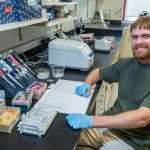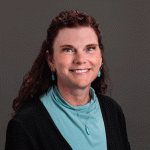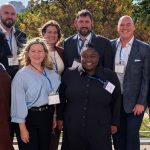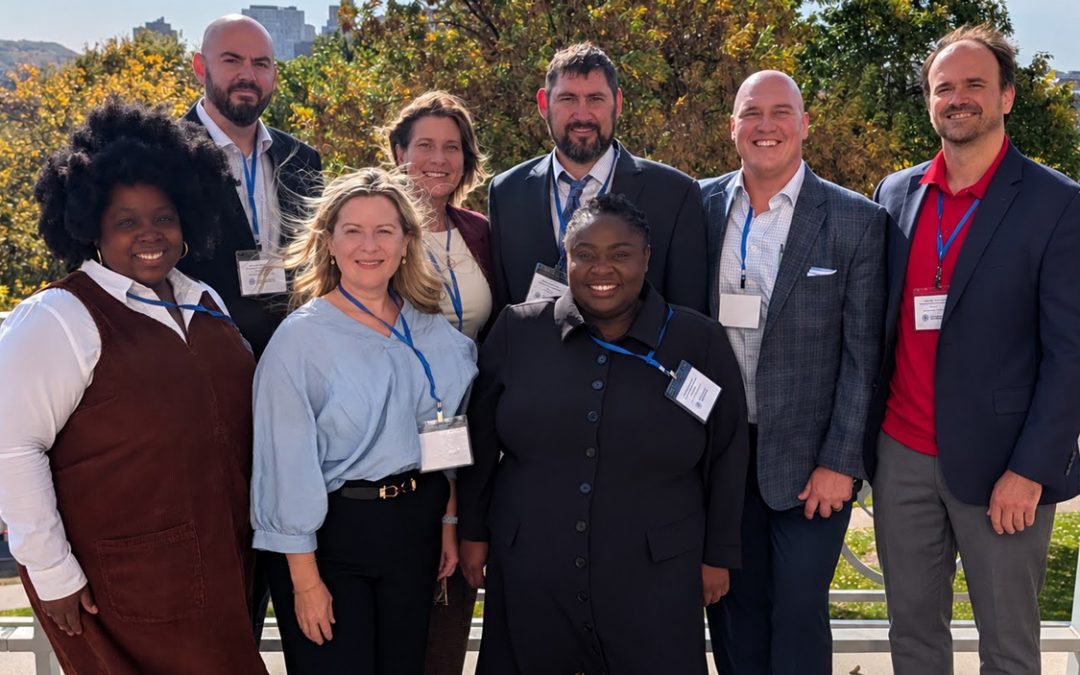
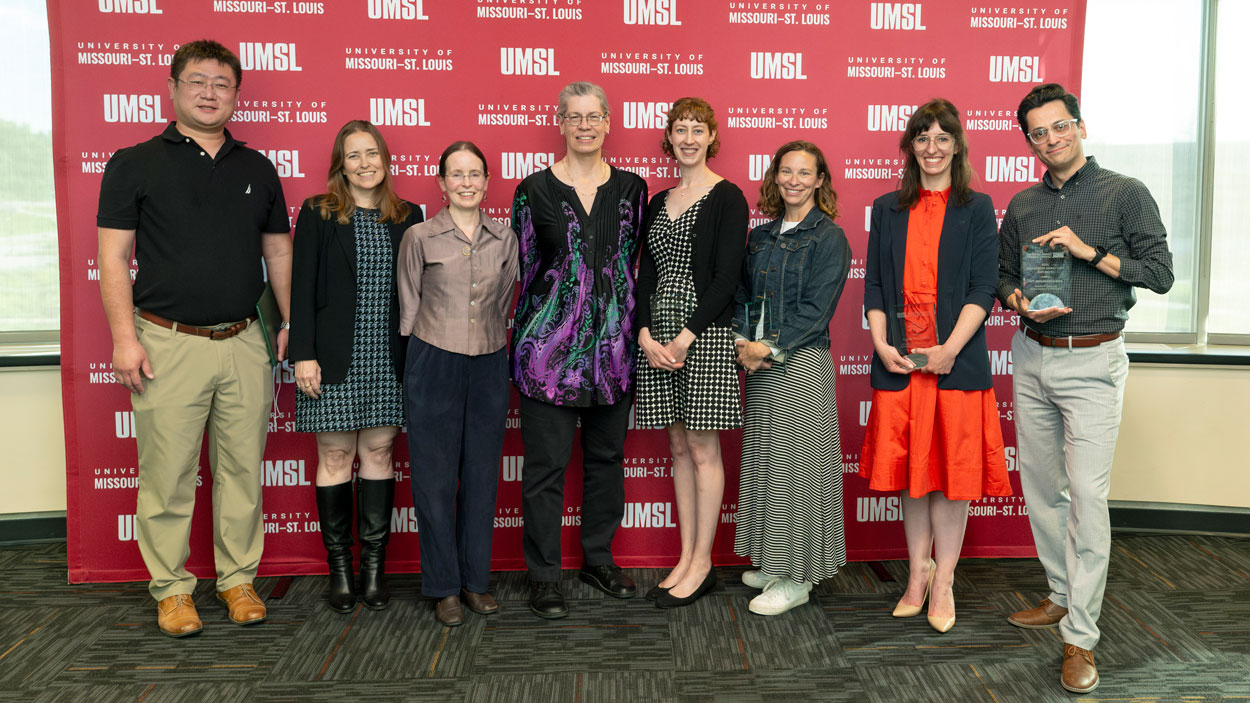
UMSL faculty members (left to right) Xin Wang, Jalene LaMontagne, Erika Gibb, Cynthia M. Dupureur, Jill Delston, Jodi Woodruff, Claire Wolff and Azim Ahmadzadeh were honored at this year’s Faculty Research, Creativity and Innovation Awards. The awards recognize outstanding faculty in the areas of research, creativity and innovation. (Photos by Derik Holtmann)
Chancellor Kristin Sobolik has come to really look forward to the annual Research and Innovation Celebration during her tenure at the University of Missouri–St. Louis, beginning as provost and over the past seven years as chancellor.
This year was no different.
“This is truly one of my favorite events,” she said Friday evening as she looked across the third-floor rotunda of the Millennium Student Center filled with faculty and staff members enjoying refreshments and mingling with each other. “It’s been great to see it grow through the years. We get to come here as a community. We get to take a pause and reflect on our research strengths as an institution. We get to recognize our faculty for their impactful work that is strengthening the St. Louis region and beyond.”
The university has much to celebrate. A television screen cycled through synopses of some of the sponsored projects being undertaken by UMSL faculty and staff members across campus.
Growing collaborations with organizations such as AMICSTL, the API Innovation Center, Taylor Geospatial and others have helped UMSL researchers expand their research and grow their impact.
UMSL’s research awards have increased by nearly 350% over the past nine years and reached a new single year high of $88 million during the last fiscal year. The success has continued with more than $56 million in awards for research and sponsored activities during the first three quarters of this year.
“We’ve had a lot of wins through the work of faculty and staff,” said Chris Spilling, UMSL’s vice chancellor for research and economic and community development. “This is a little bit of a thank you for the effort you’ve put in.”
Friday’s reception also served as a chance to recognize eight faculty members for their exceptional accomplishments.
Claire Wolff Rippel, the education director for Community Development and Regional Economic Development and director of Creating Whole Communities, was honored as UMSL’s Innovator of the Year. Erika Gibb, a professor and chair of the Department of Mathematics, Physics, Astronomy and Statistics, was named the Senior Investigator of the Year. Jodi Woodruff, an associate research professor with the Missouri Institute of Mental Health, received the Mid-Career Investigator of the Year Award. Azim Ahmadzadeh, an assistant professor in the Department of Computer Science, was chosen as the Early Career Investigator of the Year.
The university also honored Jalene LaMontagne, the E. Desmond Lee Endowed Professor in Botanical Studies in the Department of Biology, with the Research Collaboration and Team Science Award and Jill Delston, an assistant professor in the Department of Philosophy, with the Arts and Humanities Award.
Cynthia Dupureur, a professor in the Department of Chemistry and Biochemistry; and Xin Wang, a professor and the program coordinator for electrical engineering in the UMSL School of Engineering, were both inducted into the UMSL Chapter of the National Academy of Inventors. They joined 26 previous inductees, all of whom are inventors named on issued U.S. patents.
The innovator of the year is selected with consideration of outstanding contributions to advancing intellectual property, innovation and commercialization through licensing or startup venture formation.
The investigators of the year are chosen based on criteria including but not limited to major external funding over the past year, contributions to their field or societal impact, and their record of publications, books, creations, compositions, exhibits, or performances. Each awardee received a $500 prize.
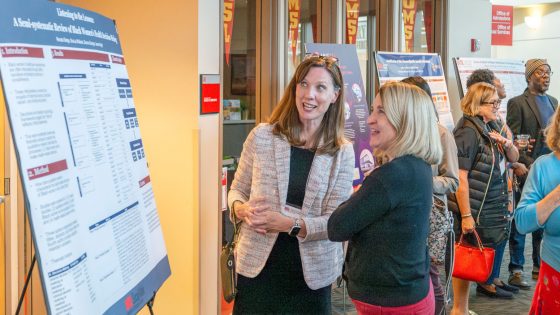
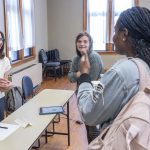
Renata Sledge, an assistant professor of social work, speaks with Senior Associate Director of Corporate and Foundation Relations Pamela Farrar about her research titled “Listening to the Lessons: A Semi-systematic Review of Black Women’s Health Decision-Making.”
Read more about the projects that were honored through this year’s research and innovation awards:
Innovator of the Year: Claire Wolff Rippel
Rippel leads teams that connect university research and resources with community priorities, advancing leadership, belonging, contribution and vitality across Missouri. Her work centers on building civic muscle to strengthen local capacity for change. She is passionate about cultivating place-based leadership and leveraging lived experiences to address complex challenges. She collaboratively develops neighborhood leadership programs to build civic leadership capacity and is working to expand the reach of the curriculum across national and international geographies, including in South Africa. Before her current roles, Rippel served as director of community development at Grace Hill Settlement House and as a community engagement specialist with Old North St. Louis Restoration Group. She holds a BA and MSW from Washington University in St. Louis and is also a Gallup-Certified Strengths Coach, using a strengths-based lens to support individuals and teams in reaching their full potential. Her work is funded by the Missouri Foundation for Health and the James S. McDonnell Foundation.
Senior Investigator of the Year: Erika Gibb
Gibb is an astrophysicist who studies the chemical composition of comets using high-resolution, near-infrared spectrographs on various telescopes around the world, particularly Keck and the NASA Infrared Telescope Facility located on Mauna Kea Observatory in Hawaii. She is particularly interested in what comets can tell us about how the molecules necessary for life were distributed through the early solar system and how comets may hold molecular clues to the Earth’s water and to life itself. She has built regional and national partnerships that support student research and developed an outstanding publication record. Gibb’s research is currently funded by NSF, NASA Ames Research Center, National Radio Astronomy Observatory and NASA Jet Propulsion Lab. She has been consistently funded by NASA and NSF since 2005.
Mid-Career Investigator of the Year: Jodi Woodruff
Woodruff’s research focuses on the use of data-driven methods to inform healthcare practices across systems, teams and individuals with chronic health conditions such as HIV, severe and persistent mental illness, diabetes, asthma and cardiovascular disease. Her research team integrates data from public health sources, medical records and environmental factors to evaluate the effectiveness, safety and overall impact of healthcare practices, treatments and interventions. Additionally, she and her colleagues analyze the implementation of interventions in community-based settings to identify practices that yield optimal health outcomes at both individual and population levels. The work informs medical decision-making, policy development and the improvement of healthcare systems, and she has collaborated with hospitals, clinics, mental health providers, the state of Missouri and with researchers at Washington University, the University of Missouri–Columbia, the University of Missouri–Kansas City and the University of Washington. Her research has been funded by PCORI, Missouri Primary Care Association, Missouri Behavioral Health, Missouri Department of Mental Health, SSM Health Care System and others with more than $1.6 million in external funding in 2025.
Early Career Investigator of the Year: Azim Ahmadzadeh
Ahmadzadeh’s research focuses on applying artificial intelligence to advance physicists’ understanding of the sun and the fundamental processes driving its activity. At UMSL, he founded the Earth-Space AI Research – or ESAIR – Lab, where his team investigates extreme space-weather events with significant societal and economic implications for critical infrastructure and astronaut safety. Ahmadzadeh has conducted novel research on forecasting solar events and evaluating AI algorithms used in this field. He has established collaborative partnerships with leading institutions, including Georgia State University, New Jersey Institute of Technology, Stanford University and the National Solar Observatory. He is currently the primary investigator on two research projects funded by the National Science Foundation.
Research Collaboration and Team Science Award: Jalene LaMontagne
LaMontagne is a forest ecologist, macrosystems biologist and global change ecologist, with broad interests in the patterns and environmental drivers of synchrony and variability over space and time. She focuses on a form of tree reproduction known as “mast seeding,” which she has been studying for 25 years. LaMontagne has been a contributing member and leader of multiple international collaborative research groups working on continental to global research. In 2025, a paper from the NSF-funded Long-Term Ecological Research Synthesis Working Group led by LaMontagne was awarded the Robert P. McIntosh Award for best paper in Vegetation Ecology by the Ecological Society of America Vegetation Section. She is currently the Primary Investigator on three NSF-funded collaborative research projects. Her work has also been funded by USDA and the U.S. Department of Energy.
Arts and Humanities Award: Jill Delston
Delston is a bioethicist whose research examines medical bias and health disparities, and the ethical use of AI used to predict, prevent and treat a variety of conditions. Her book “Medical Sexism: Contraception Access, Reproductive Medicine, and Health Care” has received wide critical acclaim, and her next book “Imprecise Medicine: Precision Health Ethics” is forthcoming from Oxford University Press in early 2027. Delston, who holds affiliations with NextGen Precision Health, the MU Center for Health Ethics and UMSL Gender Studies, is a contributing author to several other books and is co-editor of “Applied Ethics: A Multicultural Approach, Eds. 5 and 6.” She has published widely in philosophy journals, and her bioethics work has been published in Bioethics. She collaborates with faculty across disciplines including with MIMH, the School of Social Work and Department of Psychological Sciences. Her recent funding includes serving as a co-investigator on NIH-funded research with MIMH Director Robert Paul.
National Academy of Inventors Inductees
Cynthia Dupureur, a faculty fellow in the UMSL Graduate School, has focused much of her research around understanding how the structure of a molecule dictates its biological activity. Her team collaborates widely on federally funded projects involving inhibition of medically relevant enzymes, drug-DNA interactions, and most recently on biological applications of fluorescent molecules as cellular probes. Dupureur is the former recipient of a prestigious NSF CAREER Award and has served in multiple leadership capacities at UMSL, including as program director for Biochemistry and Biotechnology from 2011-2015, chair of the Department of Chemistry and Biochemistry from 2016-2019, and faculty fellow for Faculty Success from 2020-2022.
Xin Wang’s research interests include power systems, power electronics, electric machines and control problems related to smart grids, robotics and vehicle electrification. He has authored or co-authored more than 90 publications and has served on the editorial boards of several IEEE and ASME transactions, journals and conferences in the areas of power systems, industrial electronics and automatic control. In November 2019, he received the IEEE St. Louis Section Outstanding Educator Award.
Find a list of previous awardees here.