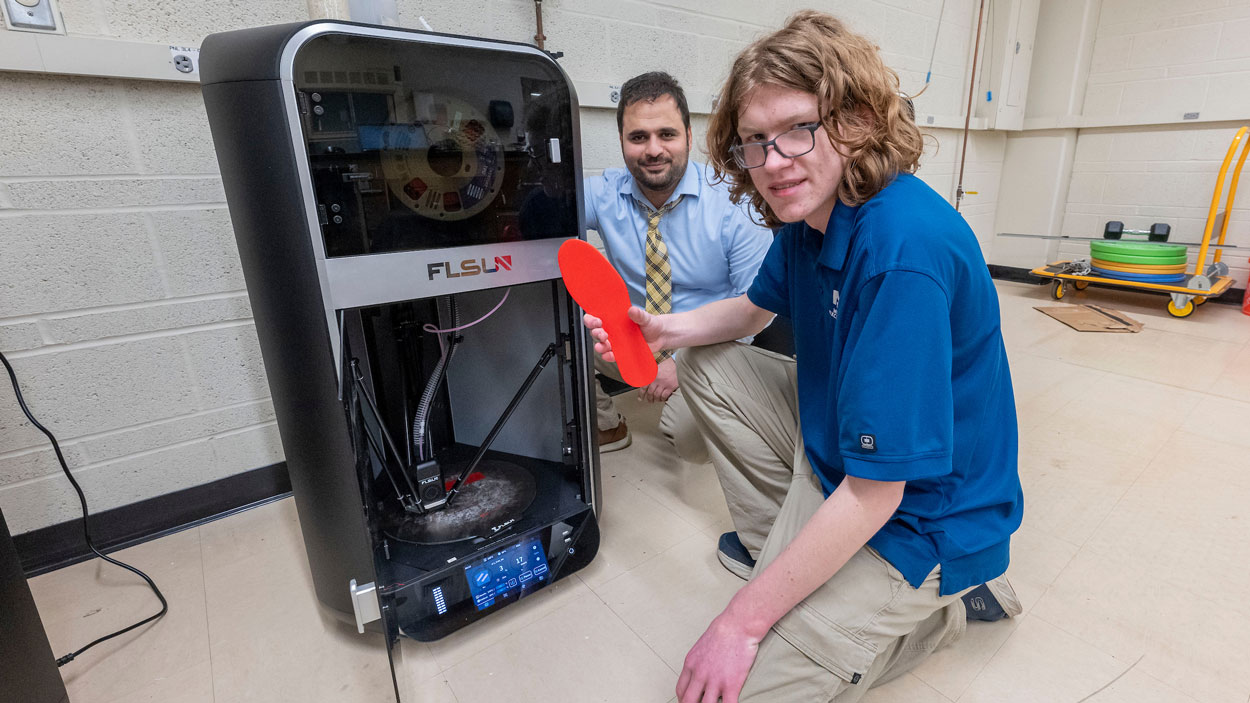
Hamid Sanei, associate professor and chair of mechanical engineering in the School of Engineering, works with Harlan Sigler using a Flsun S1 Pro 3D printer to create a shoe insert for diabetic patients. (Photo by Derik Holtmann)
According to the American Academy of Orthopaedic Surgeons and the National Institutes of Health, about 20% of diabetes-related hospital admissions are related to complications affecting the feet.
Harlan Sigler, a senior at Collegiate School of Medicine and Bioscience, is working to address those challenges and make a tangible difference in the lives of diabetic patients through an internship with the University of Missouri–St. Louis School of Engineering.
This semester, Sigler has worked two days a week with Associate Professor Hamid Sanei to research and develop custom shoe inserts via additive manufacturing, or 3D printing. Collegiate students are required to complete an internship or capstone during their final semester, and UMSL stood out amongst Sigler’s options.
“The research aspect was interesting to me because all the other [internships] were commercial,” Sigler said. “I was excited that I saw 3D printers. I just thought it would be fun to go in-depth on that.”
Sanei, whose research focuses on additive manufacturing related to composite materials and their use in orthopedics, noted that this is the first time Collegiate has partnered with the university. He added that Sigler was well suited for the task at hand.
“I knew Harlan had a background in 3D printing, and he loved hands-on activities,” Sanei said. “Immediately, I knew this is the perfect project for him. It’s the beginning now, but so far, he has made good progress.”
Sigler presented that progress to a room full of UMSL faculty and staff members as well as Samantha Moyerman, the bioscience internship coordinator at Collegiate, on Feb. 10. First, he deftly explained the insidious nature of diabetic foot and Charcot neuroarthropathy to the audience.
High blood sugar caused by diabetes can lead to a weakened immune system, nerve damage, neuropathy and restricted blood flow. These ailments often reinforce each other and result in people changing their gait due to joint and muscle stiffness, causing repetitive stress to certain areas of the foot. Left untreated, ulcers form – diabetic foot – and in extreme cases, bones begin to deteriorate – Charcot neuroarthropathy.
“The way these diseases are prevented is regular foot care to ensure that you don’t have one of these issues,” Sigler said. “That is done both with constant maintenance of your feet and inspection, but also wearing insoles are a key thing to remove that peak pressure when you step.”
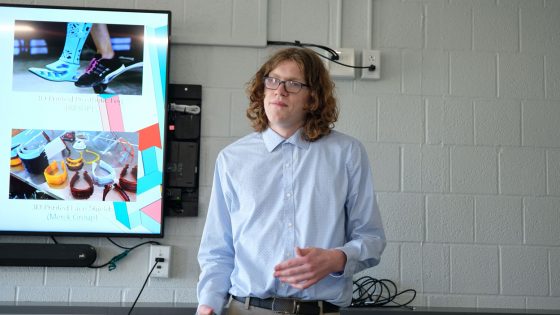
Harlan Sigler presents his progress on the research project to UMSL faculty and staff members in Benton Hall 517. (Photo by Burk Krohe)
Sigler added that 3D printing makes it possible to provide customized shoe insoles for patients. The process is a form of rapid prototyping and manufacturing that turns digital design files into physical products. Fused deposition modeling, in which plastic is extruded out of the hot nozzle of a 3D printer, is the most common technique.
By measuring a patient’s plantar pressure and adjusting details with computer-aided design – or CAD –software, engineers can create thermoplastic polyurethane insoles uniquely suited to patients’ individual needs. This makes them potentially more effective in addressing diabetic foot and Charcot neuroarthropathy than mass-market, one-size-fits-all products.
“You can evaluate exactly where the pressure is being applied on each person’s individual foot,” Sigler told the audience. “Once you have that, you can take a scan of that foot and create an exact negative area in your CAD, so you get an exact fit on their foot. Then you can further augment certain areas in the CAD. If you have an ulcer, you can completely build around it, create a gap where that is and try to distribute pressure even further away from that specific area. That’s the biggest advantage of these custom orthotics – atypical regional issues such as ulcers or deformations that you need to alleviate.”
Currently, Sigler is consistently producing prototypes that divert pressure away from specific areas of the foot. He expects the insoles to improve as the semester progresses and hopes to receive more detailed feedback from patients to evaluate the efficacy of the prototypes.
Sigler’s background with 3D printing was a valuable starting point for the project. His father is a member of a maker space in downtown St. Louis, and the family owns a 3D printer. During his freshman year of high school, Sigler began fabricating video game props in his free time.
However, the internship at UMSL has required more than a familiarity with the technology. Sigler has also learned to conduct an academic literature review, evaluating a problem and exploring the available research on the topic.
“At the start, I was like, ‘Oh, man, that’s a lot of reading,’” he said. “But I actually started getting into it. I think it’s something to do with getting really in-depth. I think building that deep understanding helped me get more interested.”
Sanei said the internship was ideal for an aspiring engineer like Sigler because it’s open-ended. Unlike a practice problem in a textbook, there was no definitive correct answer at the start of the project. He noted that Sigler’s investigation into creating a custom insole required critical thinking, proactive problem-solving and trial and error.
“We want somebody to understand the challenge and then go ahead and find a solution to that challenge,” Sanei said. “Instruction is always there, but there is a time that you need to make a decision. You need to go ahead and find what you can do and explore different options. Harlan had those qualities. He’s a high school student, but in terms of research, he’s really mature. He understands what it takes.”
In addition to firsthand experience with the research and development process, Sigler also began to appreciate the potential real-world impact of his work. Sanei said that’s very motivating for young researchers.
“I like projects where you can see that the impact on the society is really powerful,” Sanei said. “If somebody asked you, ‘What’s the end goal of this? What’s the outcome to society?’ you could immediately answer that. It’s going to help diabetic patients.”
Sanei believes Sigler’s success is a sign of things to come. He expects to host more students, from Collegiate and other area high schools, in the future. Not only will they gain research experience that bolsters their resumes, but they will also take part in campus life at the university.
Ideally, some will choose to attend UMSL.
“We want high school students to come and experience what it feels like to be at UMSL, not only in the research aspect of it, but to go to the student union and get coffee, go to the library and sit down and work on your laptop, get absorbed by the environment,” Sanei said. “Now we have a meaningful relationship with the high school, and this is just the beginning. Next year, we are hoping to get a lot more students coming in and doing research and, hopefully, to see what UMSL has to offer.”