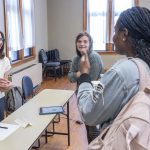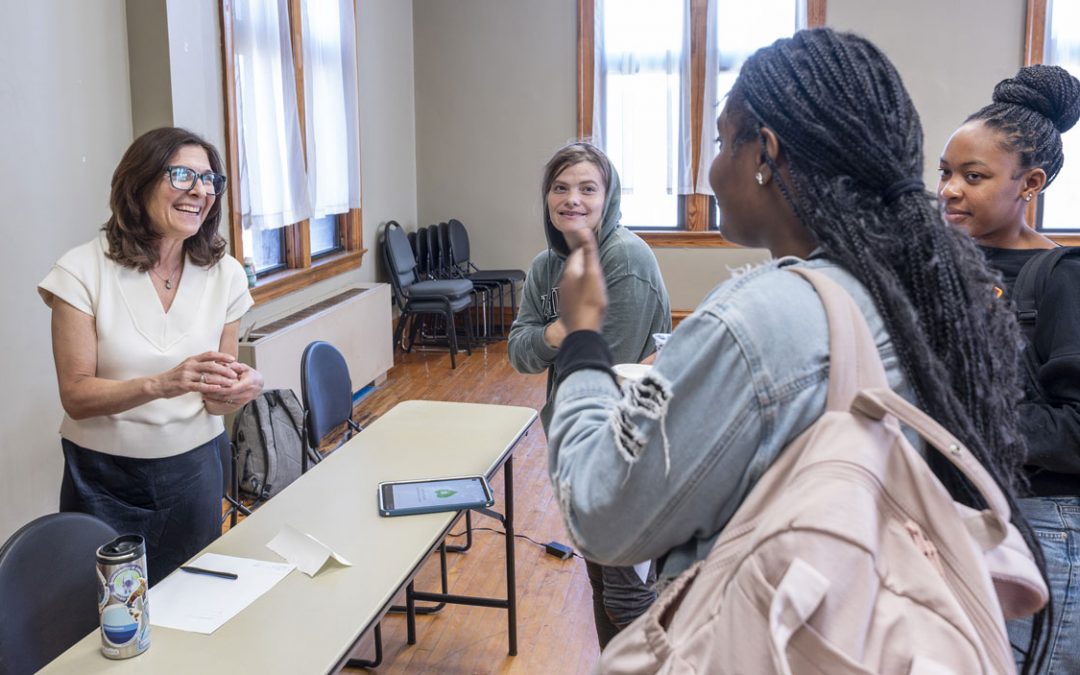
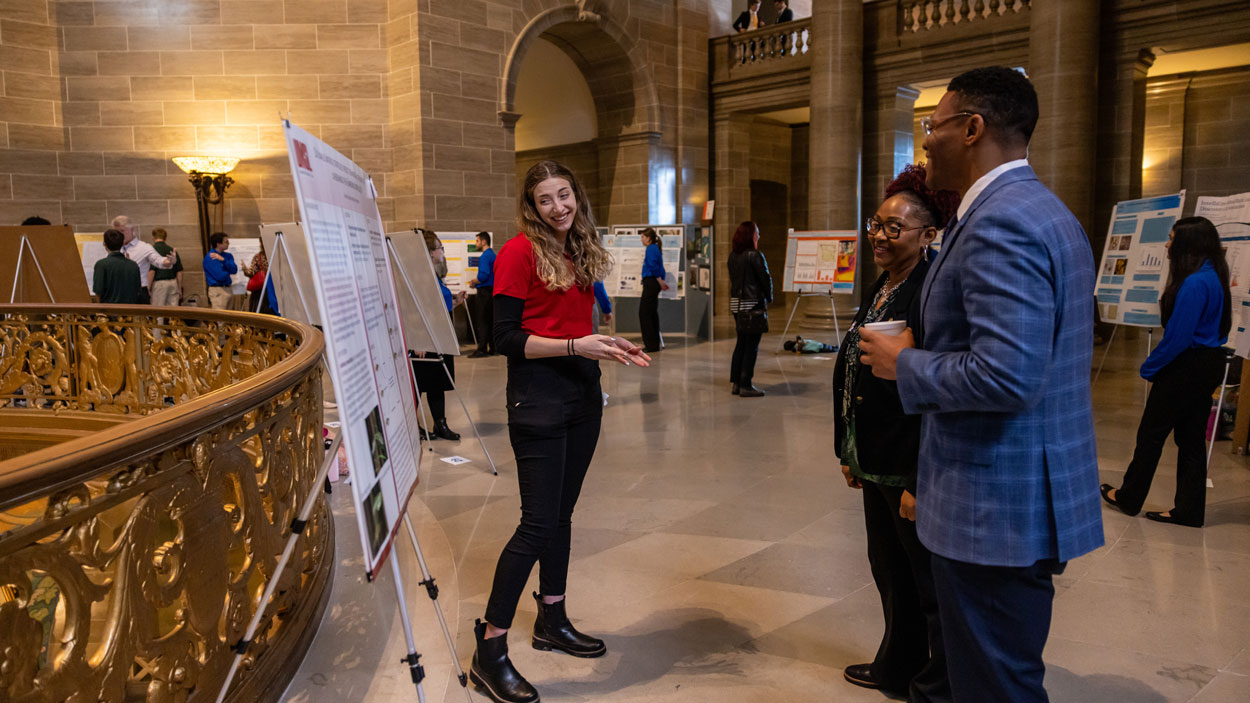
Biology major Zoe Ellis discusses her research on livebearing fish with Representative Marla Smith and Senator Brian Williams on March 12 at Undergraduate Research Day at the Missouri Capitol. (Photos by Abbie Nell Lankitus/University of Missouri)
A group of 10 students from the University of Missouri–St. Louis joined peers from across the University of Missouri System last Thursday at Undergraduate Research Day at the Missouri State Capitol in Jefferson City.
The annual event gave them a chance to share their research work with state leaders and lawmakers. Their poster presentations covered a range of subjects, including animal science, astronomy and astrophysics, chemistry and psychological sciences.
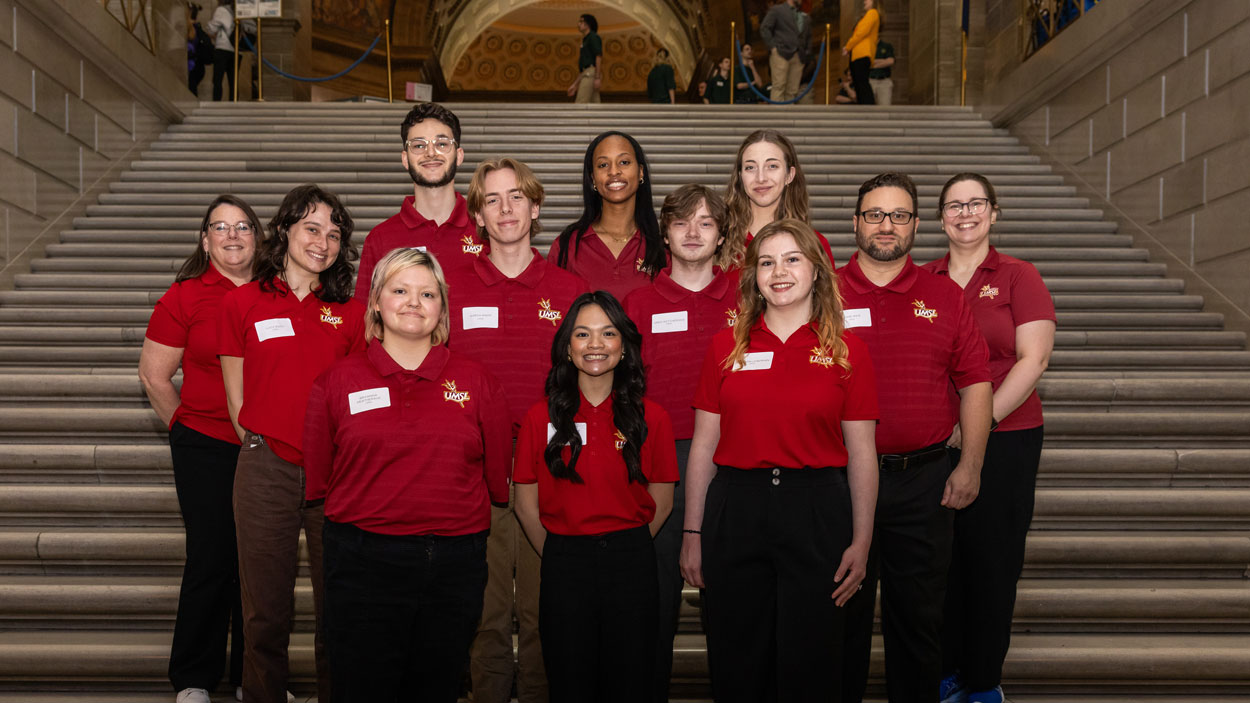
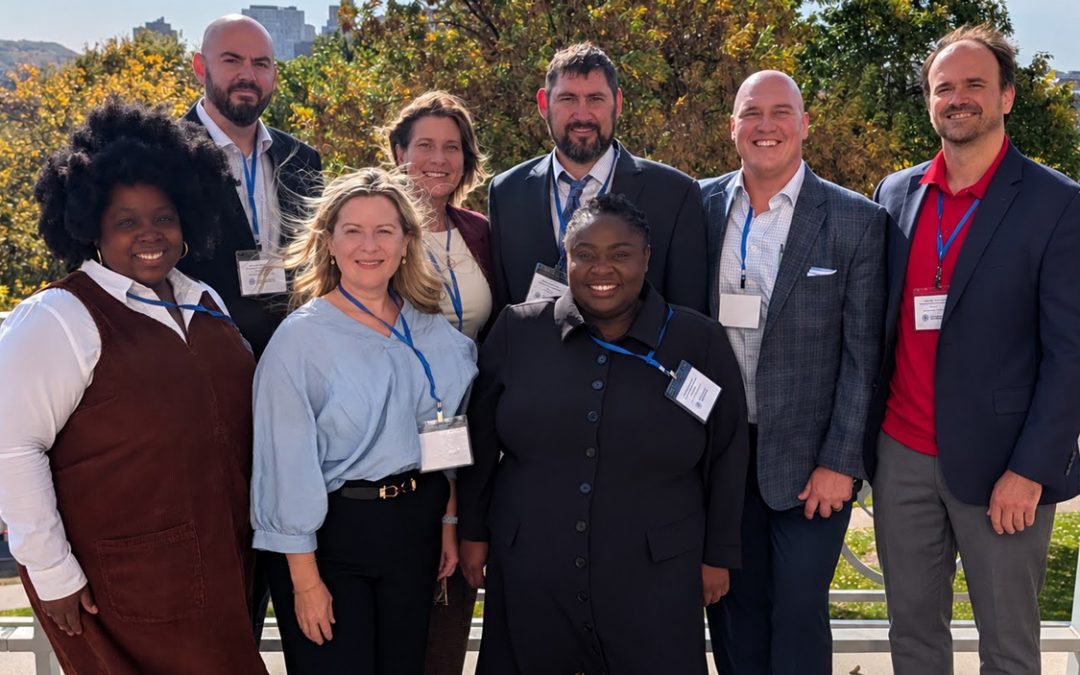
(Back row, from left) Patricia Zahn, Lucy Roth, Samuel Voell, Karch Knipp, Kyliah Walker, Greg Ketcherside, Zoe Ellis, Jesse Bier, and Kate Votaw. (Front row, from left) Bryanna Deatherage, Lorah Crame and Allison Lendman.
Kate Votaw, an associate teaching professor in the Pierre Laclede Honors College and UMSL’s undergraduate research coordinator, has traveled to the capitol for the event on at least five occasions and has been struck by the genuine curiosity of the legislators and the excitement of the students who participate.
“There is such a pattern of students reporting some version of nerves or anxiety for the event, but they leave saying, ‘I’m so glad I did this. This was so interesting. I’m really glad that I got to represent UMSL, meet other students from the system, talk to my representatives and just have a chance to present my research,’” Votaw said.
As the only public research universities in the state, MU, UMKC, Missouri S&T and UMSL provide unique student opportunities to work alongside faculty members on groundbreaking research in areas that range from science to medicine to the humanities. The lessons they can learn through research help prepare them for graduate and professional studies as well as careers in leading industries.
This year’s UMSL participants at the UM System Undergraduate Research Day at the Capitol were:
Jesse Bier, St. Louis
Major: Astrophysics
Faculty mentor: Erika Gibb, Department of Mathematics, Physics, Astronomy and Statistics
“An ALMA Study of the Great Comet of 2024: C/2023 A3 (Tsuchinshan-ATLAS)”
Comets are approximately 4.5-billion-year-old remnants of the formation of the solar system, likely preserving the icy volatiles and dust grains that were present during the time of planet formation. Hence, studying them has the potential to reveal our solar system’s chemical, thermal and dynamical history as well as provide insights into other young stellar systems and the potential for life elsewhere. Some formed in situ in the Kuiper belt outside the orbit of Neptune, but others were scattered via interactions with the forming giant planets into either the scattered Kuiper belt or the Oort cloud, where they remain until perturbations send them to the inner solar system. Those with favorable apparitions can be studied by ground-based observational facilities. One such Oort cloud comet was C/2023 A3 (Tsuchinshan-ATLAS). C/2023 A3 was extensively studied due to its anticipated brightness and favorable observing conditions near its closest approach to Earth during its 2024 perihelion passage. Reaching a perihelion of 0.39 au, this comet offered an opportunity to study an OCC at small heliocentric distance.
Lorah Crame, Mexico
Major: Psychological sciences
Faculty mentors: Theresa Moore and Hannah White, Department of Psychological Sciences
“Examining Associations Between Caregiving Networks, Social Support, and Infant Stress”
Recognizing that caregiving environments vary across families, this study examined associations between the number of caregivers involved in an infant’s life, perceived social support, caregiver stress and infant stress behaviors using an observational, correlational design. Caregivers, each representing one family, were recruited via social media and completed an online survey through Qualtrics. The survey included measures of caregiving structure, perceived social support, caregiver stress and infant stress behaviors. Results indicated significant associations between the number of caregivers, perceived social support, caregiver stress and infant stress behaviors. Descriptive findings showed most families reported two caregivers, while many reported four caregivers, often consisting of grandparents, highlighting that caregiving is frequently shared. Preliminary findings suggest infant stress may be related to the caregiving environment and support system. More specifically, increased number of caregivers and social support are associated with decreased parenting and infant stress. While no causal conclusions can be drawn, this study emphasizes the importance of considering caregiving structure, social support and parent stress when examining infant stress.
Bryanna Deatherage, St. Charles
Major: Psychological sciences
Faculty mentor: Sandra Langeslag, Department of Psychological Sciences
“Love and Artificial Intelligence: A Research Proposal”
What happens when people fall in love with Artificial Intelligence? This study seeks to examine individuals who are in love with AI companions to gain a deeper insight in the cognitive and affective consequences. In addition, this study will examine the most effective forms of intervention regarding growing or reducing feelings of love toward AI. The first part of this study will be a questionnaire about the social and emotional impact of being in love with an AI companion. Three hundred participants will be recruited through online communities related to AI companions. The second part of this study will involve 25 participants who are in love with AI companions from the greater St. Louis area. This task will involve measuring the brain responses elicited from viewing images of their AI companion, a friend and a stranger. Participants will be given a love regulation intervention, which are cognitive and behavioral strategies meant to lessen, increase or maintain intensity of feelings, catered toward people in love with AI companions. Having a better understanding of the impact falling in love with AI can have on an individual’s mental health will help in determining the best approach to policies and regulations regarding AI.
Zoe Ellis, Ballwin
Major: Biology
Faculty mentor: Michi Tobler, Department of Biology
“Do Male Mating Strategies Predict Behavioral Laterality in the Livebearing Fish Girardinus metallicus?”
Ellis’ work aims to determine whether alternative male mating strategies are associated with behavioral laterality, which can be defined as an individual’s propensity to use one side of the body over the other. Both laterality and morphology have been shown to be linked to differences in male mating and courtship behaviors among a variety of taxa. Within the livebearing fish species from the Poeciliid family, there is a unique species that exhibits multiple male mating strategies associated with color phenotype. Girardinus metallicus has both plain and black-belly male morphs. Plain morphs of this species exhibit a uniform yellow-tan coloration throughout the body. Black-belly morphs exhibit yellow-tan coloration with black ventral coloration and black coloration on the copulatory organ, the gonopodium. Since both courting and noncourting males are represented in Girardinus metallicus, Ellis can test whether the presence of courtship behavior is associated with increased behavioral lateralization with courting males (black-belly morphs) more likely to have lateralized behavior while sneaking males lack lateral behavioral bias.
Greg Ketcherside, St. Louis
Major: Astrophysics
Faculty mentor: Erika Gibb, Department of Mathematics, Physics, Astronomy and Statistics
“Volatile Outgassing and Production Rates of the Interstellar Comet 3I/ATLAS (C/2025 N1)”
Ketcherside presents a high-resolution infrared spectroscopic study of the third confirmed interstellar object, comet 3I/ATLAS (C/2025 N1). Studying volatile outgassing and production rates of interstellar comets is vital for understanding the formation of other solar systems and their constituents, as analysis of the composition of ISOs tells us about the chemical diversity of protoplanetary disks beyond our solar system. The research utilized the iSHELL spectrograph on the NASA Infrared Telescope Facility (IRTF) in Maunakea, Hawaii, to conduct observations between Dec. 3-5, 2025. These dates followed the comet’s Oct. 29 perihelion (~ 1.35 AU), providing a critical window to measure its post-perihelion volatile evolution at a heliocentric distance of approximately 1.9 AU. The analysis targets the primary volatile species, specifically H2O and CO, to determine their production rates and compare our results with other studies done on 3I/ATLAS.
Karch Knipp, Jefferson City
Major: Biology
Faculty mentor: Michi Tobler, Department of Biology
“Phenotypic Gradients of Poecilia Mexicana Along the Cueva Del Azufre Cave System”
Knipp has spent the past couple of months assisting PhD student Soren Johnson in data collection for his dissertation project. The project focuses on the phenotypic changes of Poecilia mexicana – the Atlantic molly – across different chambers of the Cueva del Azufre cave system in Southern Mexico. The fish were collected from different chambers of the cave along a light-dark gradient, including samples from the outflow of the cave at the surface, toward the front of the cave where there is some light, and at the back of the cave where there is no light. Others were also collected from a nonsulfur containing surface site – Bonita – and a nonsulfidic cave site – Luna. They then measured the various phenotypes of each fish across these different populations, including metabolic rate, and took pictures to quantify skin coloration, the lateral line system and body shape. Knipp did the bulk of the data collection regarding skin coloration and the lateral line systems of each fish. He and Johnson measured these traits to see how they vary along this light-dark gradient as well as between other habitats. They hypothesize that these traits will change based on the varying amount of light in the habitat and that some traits will be correlated.
Allison Lendman, Maryland Heights
Major: Biochemistry and biotechnology
Faculty mentor: Michi Tobler, Department of Biology
“Relationship between physical and behavioral asymmetry in Astyanax mexicanus”
Populations within the Astyanax genus of fishes occur in a variety of different environments. This leads to distinct variation among individuals from these populations, or local adaptation. One unique environment that Astyanax inhabit is streams within subterranean caves. Individuals from cave populations of these fish are eyeless and lack pigmentation. They also express asymmetries in their skull morphology, where all individuals have skulls that are bent in a leftward direction. In this project, Lendman explored a possible relationship between this physical asymmetry and behavioral handedness. She tested for behavioral handedness in male and female Astyanax mexicanus from the Pachón cave in Mexico. She found that both sexes demonstrated behavioral handedness, observed as a consistent left-turn bias in these trials. This supports the hypothesis that these cave populations display behavioral handedness correlated with the physical asymmetry of their skulls. These results provide insight into the connection between morphological and behavioral asymmetries and help improve understanding of how organisms change in unique environments.
Lucy Roth, University City
Major: Biology
Faculty mentor: Jalene LaMontagne, Department of Biology
“Winter Contents of Tree Cavities in Oak Woodland Habitats”
Woodpeckers create cavities in dead and decaying trees and in the branches of live trees, many of which are used by a range of other animals. They are thus called “ecosystem engineers.” A species of conservation concern in the Midwest is the red-headed woodpecker, which are facultative migrators, meaning some individuals stay in their territories over winter and others migrate south. Most tree-cavity research is done during the breeding season, leading to a knowledge gap of their use in the nonbreeding season; therefore, studying them in winter could help us understand their ecological impact. Red-headed woodpeckers require food to remain overwinter, caching acorns and other tree nuts. They are territorial, so those who do stay in their breeding territories reduce the cavity choices for secondary users. To document evidence of caching – the storage of acorns – and prior occupancy, in winter 2026, Roth surveyed trees in known prior red-headed woodpecker nesting territories using a camera mounted on a 15-meter telescoping pole, collecting data across 15 forest preserves in Missouri and Illinois. She also collected data on habitat characteristics, including tree decay class, cavity orientation and height. By documenting the winter contents of tree cavities, her study aims to further understanding of oak habitats and the cavities within them as integral to overwinter persistence.
Samuel Voell, St. Louis
Major: Arts and sciences
Faculty mentor: Eike Bauer, Department of Chemistry and Biochemistry
“Making Indole-Based Drug Ingredients Faster with a Simple Iron Catalyst”
Substituted indoles have significant pharmaceutical relevance and are common building blocks in medicinal chemistry. They are part of many approved drugs across various areas and are also widely explored as leads for antiviral and antibacterial activity. This includes treatment of MRSA, a bacterium type that is resistant to common antibiotics and responsible for complicated infections. Many reactions in pharmaceutical production are slow and inefficient. Catalysis, which facilitates the synthesis of pharmaceutically relevant products, provides an efficient, lower-energy pathway to form a product. Ferrocenium tetrafluoroborate is a catalyst Voell is currently investigating. FcBF4 is an iron-based catalyst used in small amounts. Iron is affordable, abundant in the U.S., and exhibits low toxicity. This is consistent with green-chemistry principles, which are aimed at safer and more affordable ways to synthesize material. It also makes the domestic pharmaceutical industry less dependent on foreign metal sources typically used in pharmaceutical production. Voell applied FcBF4 as a catalyst in a reaction between 2-methylindole and a propargylic alcohol, yielding a substituted 2-methylindole product. The reaction provides a useful synthetic intermediate for pharmaceutical production and allows for testing a diverse library of structural analogs as potential drug candidates.
Kyliah Walker, St. Louis
Major: Biology
Faculty mentors: Michi Tobler and Bethany Williams, Department of Biology
“The Effect of Diet on Hydrogen Sulfide Tolerance in Extremophile Fishes”
Poecilia mexicana are a species of live-bearing fish that have adapted to surviving in hydrogen sulfide, or H2S, abundant waters. Sites that are high in toxic H2S are also characterized by low food availability. Tolerance of multiple stressors is impacted by numerous external environmental factors. Diet and body condition naturally differ between populations from varying aspects of fitness. In this study, Walker explored whether diet affects how well these fish tolerate H2S. She looked at 80 laboratory-bred female P. mexicana originating from a sulfidic and a nonsulfidic population. Half of the fish from each population were separated into control and low-food groups. The weights of the two groups were measured and compared at 30-day intervals. Although an expected reduction in body mass was not observed in fish from the low-food diet, all fish underwent sulfide tolerance trials, and the results were compared among the differing groups and populations. Higher H2S tolerance was expected in the sulfidic population and for them to be less affected by a poor diet, as fish who naturally reside in sulfidic environments have lesser-quality diets. The results indicate that the sulfidic population was more H2S tolerant; however, neither population experienced a significant reduction in body condition. Overall, diet did have an effect on H2S tolerance but only in the sulfidic population.
To see more images from the event, visit the UMSL Flickr page.