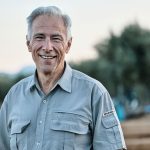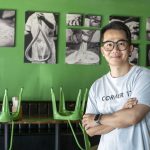
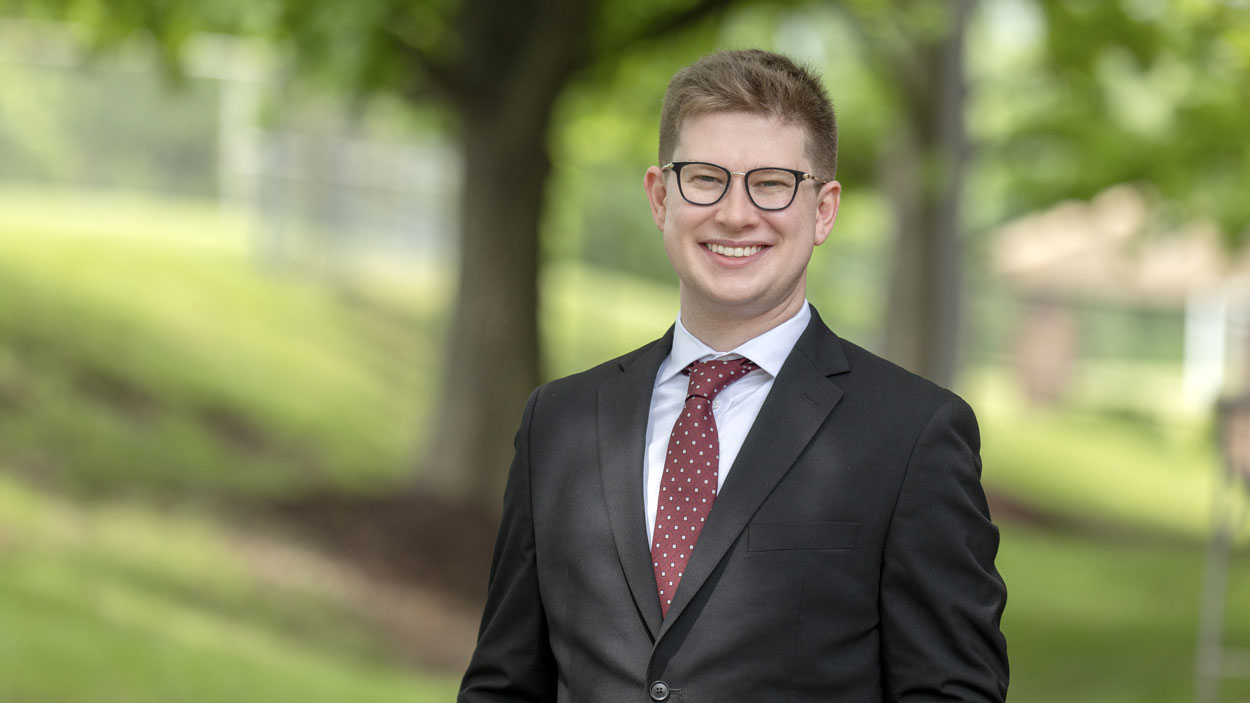
Jake Shaw graduated with his PhD in political science and will begin a tenure-track position as an assistant professor at DePauw University in August. (Photo by Derik Holtmann)
Jake Shaw boarded the Missouri River Runner Amtrak train with members of his family Friday morning in Kansas City and took the roughly 5½-hour ride across the state, arriving in St. Louis early that afternoon to officially kick off a weekend-long graduation celebration.
Shaw, who completed his PhD in political science this spring at the University of Missouri–St. Louis, had a list of spots he wanted to visit in the time available.
“As I close out my final experience in St. Louis, I want to go around to all the places that kind of formed me into the person I am,” he said in the lead up to the trip. “I’m looking forward to sharing that with my family and trying to celebrate while doing that.”
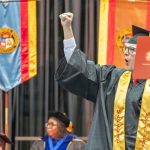
Of course, he had blocked off early Saturday afternoon to join fellow graduates taking part in a commencement ceremony for the College of Arts and Sciences and School of Social Work at the Mark Twain Athletic Center.
Shaw has had a little time to reflect on this moment of transition in his life since successfully defending his dissertation, titled “From Disaster to Decision: Spatial and Temporal Patterns in Disaster-Affected Voting,” on April 14.
He’s also excited to start his professional career this August when he begins a tenure-track position as an assistant professor at DePauw University, a private liberal arts college with nearly 2,000 students in Greencastle, Indiana.
“It feels really good,” he said. “It feels rewarding.”
Shaw has nothing but gratitude for the experience he’s had in the Department of Political Science, particularly with faculty members such as David Kimball, Anita Manion, Stephen Bagwell, Ruth Iyob and Todd Swanstrom, over the past five-plus years.
“They are not afraid to share their honest opinions about academia and the experiences that they’ve had and what sort of strategic steps that I should take to position myself well,” he said. “I think that’s led to a closeness with them, but also it’s helped me become more confident in doing what I’m doing, because I’ve really felt like I’ve had people guiding me along the way, like a true mentor-mentee relationship.”
Bagwell even provided a reference for him at DePauw, where Bagwell spent two years as a visiting professor before coming to UMSL. Kimball and Manion too provided letters of recommendation on his behalf.
An unlikely path
Shaw’s time in St. Louis started long before he entered UMSL’s doctoral program. He arrived as an undergraduate student at Saint Louis University in 2015 with no inkling of where his educational path would lead him. In fact, he began in a pre-med program while also majoring in German Studies and International Studies, and he was looking forward to becoming a surgeon. But he started rethinking things after taking organic chemistry.
Shaw decided to leave the natural sciences for political science – inspired, in part, by the rising attention being paid to the field in the leadup to the 2016 election – but he also figured it’d be a good area to study if he wanted to one day go to law school. It also seemed to make good sense to tack on an extra year to get a master’s degree in political science and public affairs.
While working toward his master’s at SLU, Shaw got involved in research on mass incarceration and U.S. and comparative penal policy. He started to realize the deliberative process of research captured his interest more than the idea of arguing legal cases.
“After a little bit of deliberation, I was like, ‘I don’t know if I want to be in a courtroom all the time,’” he said. “The research-oriented stuff spoke to me a little bit more.”
That’s what led him to pivot and explore PhD programs in political science, and he wound up finding a fit nearby at UMSL.
Hands-on learning
Early in the doctoral program, Shaw served as a teaching assistant with Manion in her Intro to Public Policy course.
“That role was more focused on teaching, and he led several class sessions, and always was well prepared, had a lesson plan, and you could tell that he was really committed to helping the students and engaging them,” Manion said.
But Manion said she developed an even stronger professional relationship with Shaw and learned more about his talents when she hired him as a research assistant, working alongside her and Kimball, on several grant-funded projects, starting with one sponsored by United WE that investigated the demographic makeup of civic boards and commissions across the state of Missouri. Shaw assisted with data collection and analysis, and it led to a co-authored journal article that was published in Politics, Groups and Identities, and they received an invitation from The London School of Economics and Political Science to write about their research for its United States Politics and Policy blog.
Later, Shaw worked with Manion and Kimball again on a pair of projects related to vote centers, like the ones that have been adopted across St. Louis County in place of the traditional neighborhood-based precinct model. He helped plot and analyze voter turnout data to gauge the effect vote centers have on voter participation in particular communities.
More recently, Shaw has been helping develop a national database of jurisdictions in the U.S. that are using vote centers.
He also assisted Manion and Bagwell on a book chapter exploring food security in the St. Louis region.
A new direction
After initially thinking he’d continue to explore penal policy for his dissertation, Shaw found himself gravitating more toward voting behavior, particularly in the present time of heightened partisanship. He liked the more quantitative nature of the work.
“I’m really interested in finding out the conditions that create that situation where a voter changes their mind and votes against their party allegiance, because I think that’s important to democracy,” Shaw said. “If we just have people that are voting for D or R or whatever it may be, we’re not really having a responsive government where people are equipped to critically engage with the performance of incumbent candidates, and so if we can narrow that down, maybe we can make a better case for educating voters or changing the media environment so that they’re more equipped to make those decisions in the next election.”
It turns out one area where voting preferences have proven to be a little less rigid is in the aftermath of natural disasters, as Shaw investigated for his dissertation. He surveyed gubernatorial and presidential election turnout and returns for the 3,066 counties and parishes in the contiguous United States that occurred in the wake of hurricanes, wildfires and tornadoes that occurred in 2016, 2018, 2020 and 2022.
“Jake stands out for his eagerness to conduct social science research,” said Kimball, who chaired his dissertation committee. “He largely taught himself how to use geospatial tools, like ArcGIS. He then used that knowledge to map the locations of natural disasters for his dissertation research.”
He measured for direct impact, near distance and the severity of each disaster and used it to determine its effects on voting behavior.
“There are these instances where an individual is faced with something catastrophic, like a hurricane, that can cause them to change their vote choice,” said Shaw, noting that elected officials tended to benefit from recovery packages that provided funds to help with the cleanup.
Shaw had moved back home to Kansas City for the past two years after completing his coursework so that he could save some money while finishing his research and writing his dissertation. But he was back in St. Louis last month to defend the work.
“I was nervous because it’s the last big thing you do,” he said. “I wasn’t nervous in the sense of, ‘Oh, I’m going to have to defend this in front of my professors.’ It just felt like a conversation amongst colleagues and friends, and it was rewarding. They’ve been with me every step of the way with this project.”
Ready for the future
Shaw is looking forward to continuing those relationships and research collaborations as he starts his career.
He plans to move to Indiana at the beginning of August and will spend his first semester at DePauw teaching Intro to American Politics and another course on the legislative process. He also expects to begin building on his doctoral research.
Shaw believes his time at UMSL has prepared him well for what’s ahead.
“It’s been wonderful,” Shaw said. “I’ve learned something, whether it be about politics, whether it be about the field or about life, from about every professor that I’ve come into contact with, and they’ve always made time for me, without a doubt – always made time for me and made me feel valued and supported. I would do it over again a million times at UMSL.”