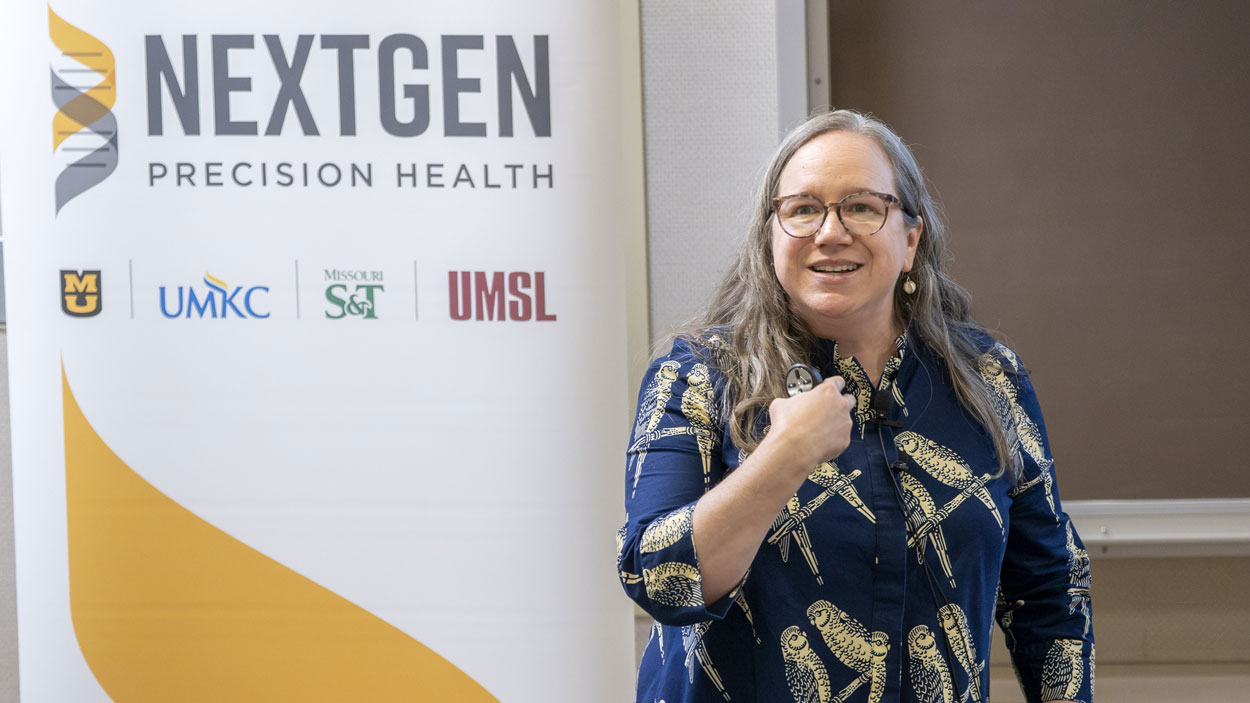
Biology Professor Aimee Dunlap was the featured speaker in last week’s NextGen Precision Health Discovery Series event at UMSL’s Millennium Student Center. (Photos by Derik Holtmann)
Aimee Dunlap has long been fascinated by how animals learn – and how learning evolves.
As a graduate student at Northern Arizona University, she had a chance to study pinyon jays, birds that live in colonies of 300 or more in the pine forests of the western United States, including in northern Arizona. Their distribution overlaps with pinyon pine trees, and they’ve adapted to be able to hammer into the tree’s green cones and extract seeds full of lipids and proteins. The jays can cram up to 600 of the seeds into their expandable esophagus and often fly miles away before caching the seeds in the ground.
Dunlap, a professor of biology at the University of Missouri–St. Louis and the director of the Whitney R. Harris World Ecology Center, said each bird might assemble a cache of some 25,000 seeds each fall, and that will account for 70% to 90% of its winter diet. The trickiest part might be remembering where those seeds are stored.
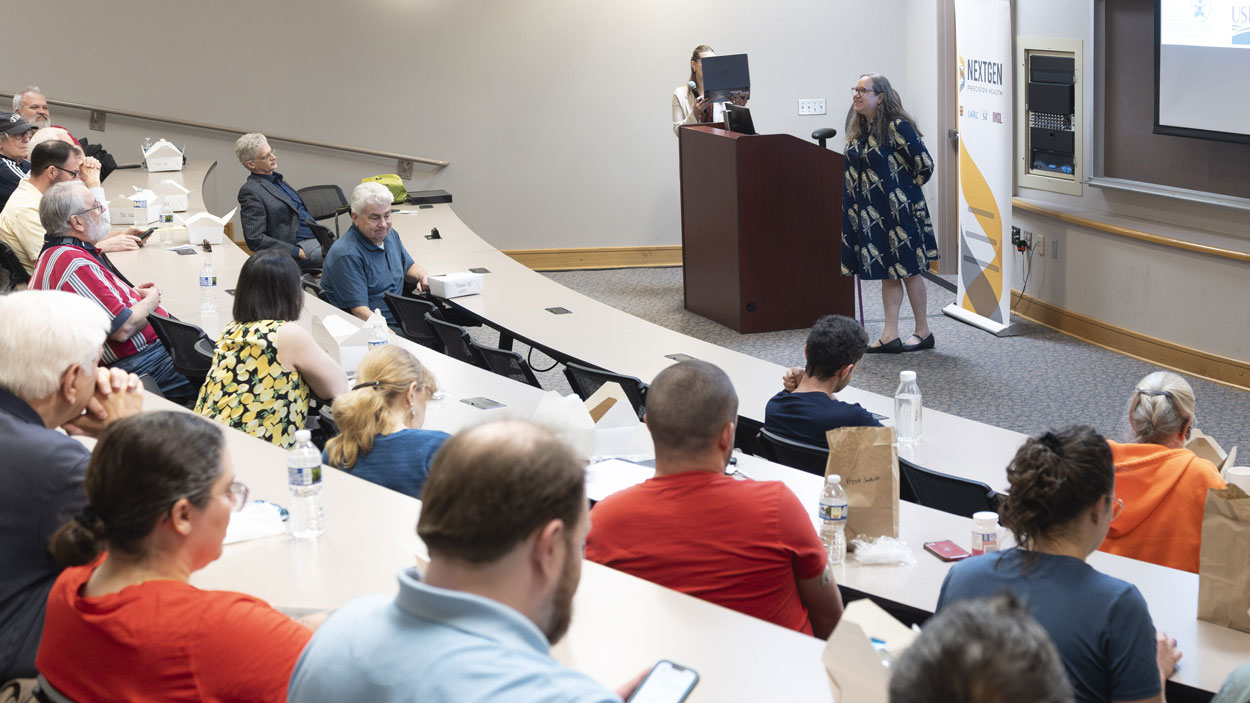
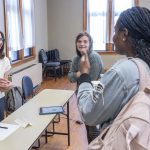
Students, faculty and staff members listen to Aimee Dunlap as she presents during the NextGen Precision Health Discovery Series event last Tuesday in the MSC.
But the jays’ ability to pull it off is why Dunlap described them as “superstars of spatial memory.” She was presenting to an audience of faculty, students and staff members as the featured speaker in the latest installment of the University of Missouri System’s NextGen Precision Health Discovery Series, held in the SGA Chamber at the Millennium Student Center.
“They’re excellent at finding where those caches are later, up to several months at a time,” Dunlap said. “They actually nest in the winter, and in February, it’s very cold. The females cannot leave their nests, and so those males are bringing the food to both the females and to the young. So, it’s incredibly important that they find these seeds again, which is really fantastic.”
Dunlap has seen it up close and showed a picture of a lab environment from her days as a graduate student where that research took place.
“We’re able to test them,” Dunlap said. “We can bring them into the lab and put them in a room like this, where they can make choices about where to put seeds and where to find those seeds.”
Today, Dunlap continues to study cognition, including how animals learn, in her own lab at UMSL. Rather than work with pinyon jays, Dunlap and her students examine the behavior of arthropods – primarily bumblebees, fruit flies and tarantulas. They use that to better understand the role of environmental variability in the evolution and ecological function of perception, learning, memory and decision-making.
“A problem in general in evolutionary biology is that we don’t have a time machine,” Dunlap said. “We can’t go back in time and measure the environment. We can’t measure the ancestral environments of these animals. We can measure things right now, but a direct test would be going back closer to the beginning.
“There’s really only two ways that we can track this. We can use digital evolution, and that’s essentially using populations of self-replicating digital organisms that can replicate, mutate and compete. That’s a very powerful approach. The other one is using experimental evolution, and this is where we can put populations of real organisms into specific environments. We can put them into separate environments, and then we can watch and see what evolves.”
Dunlap described some of the experiments her lab has undertaken to better understand how animals learn as well as how they balance learning with preference. She said sampling is the first step in learning, and that animals – whether they be blue jays or bumblebees – have to test differences in their environment to find out.
“We found that bumblebees sample resources according to the change in the environment, just like the theory says that they should, and they respond to costs and benefits of making errors,” Dunlap said. “They’re making really solid economic decisions.”
She said the bees might display an innate bias, say for color preference in flowers. If the rest of their environment doesn’t change, they will stick with that bias. But if their surroundings do change, they will scrap that innate bias and follow the lessons that they’ve learned.
Dunlap’s lab is exploring how learning occurs in different environments, testing a theory that patterns of environmental change can lead to evolved behavioral plasticity, which helps animals adapt and survive in more environments. That in turn exposes the animals to greater patterns of environmental change.
This is particularly relevant because cities and other human-affected places expose animals to greater environmental change, and there’s evidence that the animals that learn better are the ones best-equipped to survive.
One of the biggest takeaways to be gleaned from Dunlap’s presentation is how much more still needs to be learned about animal cognition.
“We have a history of sometimes making assumptions about the cognitive complexity of animals,” she said. “It’s easier to empathize with animals that have fur or animals that live a long time or that we can look into their eyes and see ourselves in them. But we don’t do such a good job of doing that with other animals. When we think about the evolution of cognition and we think about learning, for the vast majority of animals on this planet we do not know anything about their cognition. If we want to understand how patterns of change in the environment affect animals, if we want to understand how animals are going to respond to changes in the environment, we need to tackle more of them – more of the animals that get a bad rap as movie villains when they’re actually really fascinating creatures. That’s just something to think about.”