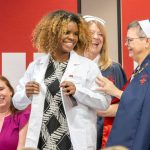
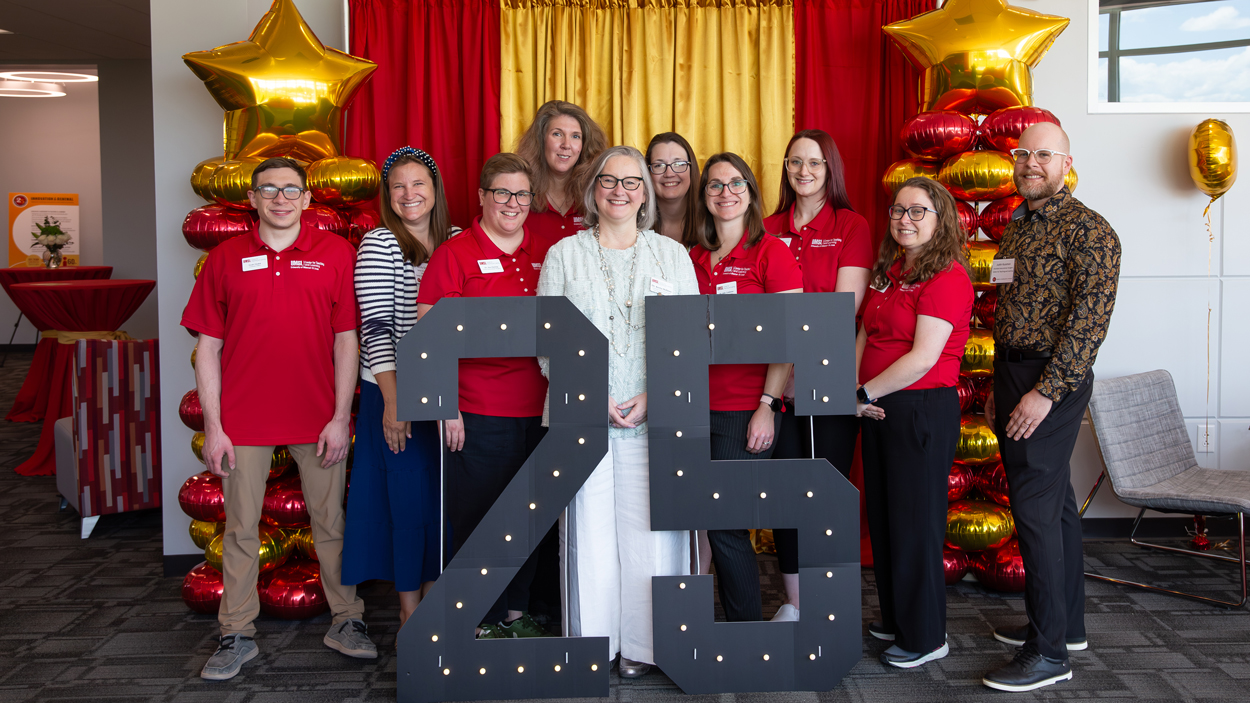
UMSL’s Center for Teaching and Learning recently celebrated its 25th year of building a community that encourages collaboration among faculty members to better serve the students. Keeta Holmes (center, in white), associate vice provost and executive director of CTL, stands with staff members (from left) Noah Vlodek, Emily Goldstein, Ana Quiring, Chalyn Elking, Emily Litle, Julia Calabrese, Sarah Butler, Katie Harster and Justin Kussman. (Photo by Erin Lewis)
A common theme from students talking about their University of Missouri–St. Louis experience is the incredible amount of support they receive.
Professors provide mentorship and help students navigate challenges. Advisors offer one-on-one guidance to assist them in charting a path to success. Alumni eagerly give back to the institution that shaped them, sharing advice and creating opportunities that can launch careers for the newest batch of Tritons.
For the past 25 years, the Center for Teaching and Learning has fostered that same spirit among UMSL faculty. Rather than positioning itself as a place where experts teach professors how to teach, CTL has built a community where faculty members learn from one another, share ideas across disciplines and find encouragement from colleagues facing many of the same issues.
“Our programs are designed so that the faculty are talking with other members of the faculty,” said Keeta Holmes, associate vice provost and executive director of CTL. “We ask prompts, we provide resources, but our faculty are so talented and dedicated to our students that we really want to break down departmental silos and get them talking to each other across disciplines. No matter what program we’re running, whether it’s for online or in-person delivery, that’s a hallmark of what we try to do is build relationships among faculty across the institution.”
That collaborative approach has helped shape teaching at UMSL since the center opened its doors and remains central to its mission today. For a recent celebration marking the center’s 25th anniversary, faculty members reflected on the impact CTL has had on their teaching and professional development.
“One of the most important things for me is that CTL connected me with other people, faculty and staff on campus who are constantly looking for ways to be better teachers,” said David Kimball, chair of the Department of Political Science. “How can I make my course better? How can I engage students in new ways? I think that’s why we’re all here, and I think it’s very important to have CTL on campus to support those values.”
A division of the Office of Academic Affairs, CTL serves as a catalyst for a culture of continuous improvement at UMSL, creating opportunities for faculty members at every stage of their careers to reflect on their teaching, explore new approaches and compare notes with colleagues. Through workshops, consultations, teaching observations, course design support and professional development programs, CTL partners with instructors to strengthen the learning experience for students in traditional, blended and online classrooms.
Holmes said the CTL staff helps faculty members shift their focus from simply delivering content to creating meaningful learning experiences that engage and motivate students. Through programs such as “Transparency in Learning and Teaching,” CTL encourages instructors to make the purpose behind their courses, assignments and activities more visible to students, explaining not only what they are being asked to do, but why they are doing it and what skills they are developing along the way. By helping faculty articulate those connections, CTL supports instructors in designing learning experiences that demonstrate the value of their courses and prepare students to apply what they learn beyond the classroom.
“We all are attracted to this work because we like helping people, and it allows us to marry our own academic backgrounds,” Holmes said. “Many of us come from other faculty positions, and we love teaching, and we love helping others to realize their own teaching strengths, so that really drives us here.”
Jim Craig, associate dean of the College of Arts and Sciences and chair of the Department of Sociology, said CTL’s assistance can be particularly valuable for those faculty members coming from industry or other non-teaching backgrounds, helping them examine how they can share their expertise with students.
As scholars and professionals become experts in their fields, many of the skills and thought processes that helped them reach that level can become second nature. Through faculty consultations and approaches such as “Decoding the Disciplines,” CTL works with instructors to break down expert knowledge into teachable steps that allow students to better understand not only what they are learning but how they are learning to think like professionals in their fields.
“A lot of teaching professors are like me; they come from a non-academic space and are good at what they do but need some help learning how to take what’s in their brain and then relay it to students in a way that’s usable, valuable, and moves their lives forward,” said Craig, who was a 20-year Army service member before transitioning to academia. “CTL taught me how to teach, and I still rely on the lessons I learned from them a decade ago.”
As higher education transitioned to more of an online environment, the center expanded its support to help faculty members navigate the unique challenges of teaching in a digital setting. Through its “Online in 9” program, CTL worked alongside instructors to develop effective online courses, providing guidance on course design, student engagement, instructional technologies and strategies for creating meaningful connections with students beyond the traditional classroom.
“It’s challenging to connect with students, and it’s challenging to make sure that your course is accessible and engaging on all different levels,” said Jill Bernard Bracy, associate teaching professor in the Department of Supply Chain and Analytics. “CTL really provides an amazing amount of resources that enables us as faculty to do our job in the best possible way.”
CTL’s support extends beyond faculty development by creating opportunities for students to become active partners in the learning process. Through programs such as “Supplemental Instruction” and “Active Learning Assistants,” CTL trains student employees in teaching and learning practices, equipping them with the skills to help their peers succeed. These students work alongside faculty members in courses that benefit from additional support, providing peer-led learning sessions, reinforcing course concepts and helping create more engaging classroom environments.
“They provide so much in-classroom support,” Bernard Bracy said, “and the way that CTL works with the students to help support the faculty is just such outside-of-the-box thinking, but it’s incredibly valuable and beneficial.”
Craig said overall, CTL has played an instrumental role in developing the inclusive and welcoming atmosphere that has helped so many UMSL students find success.
“Anytime you can work across disciplines and across colleges and bring people together into the same room, around the same table to share their experiences, then we get better as a university,” Craig said. “CTL does this really well.”