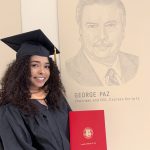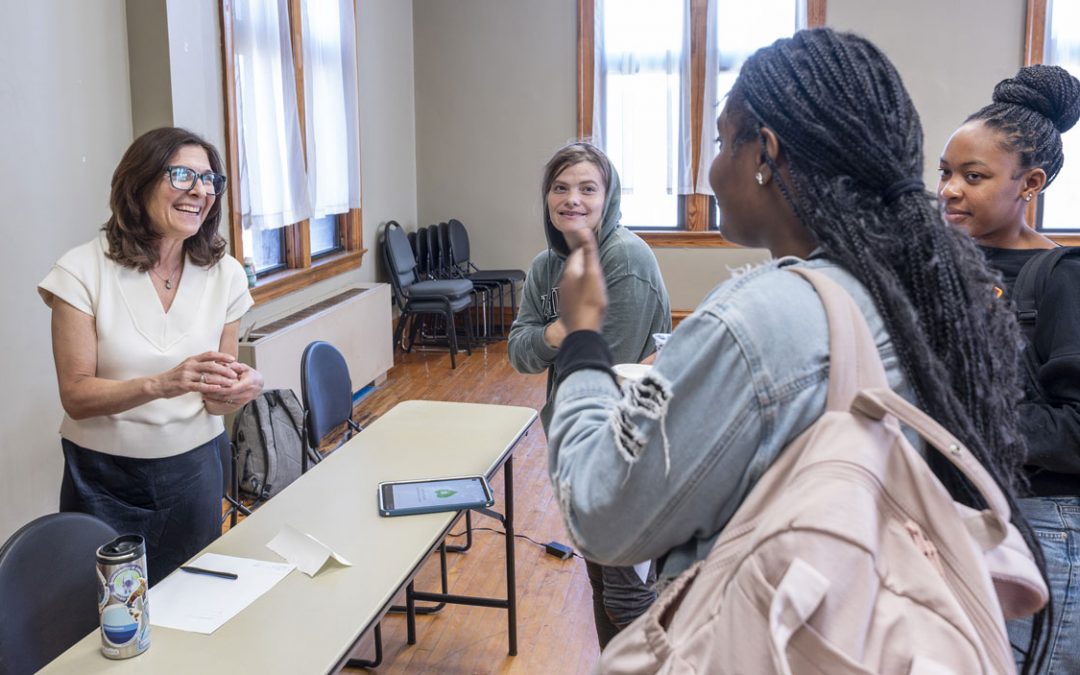
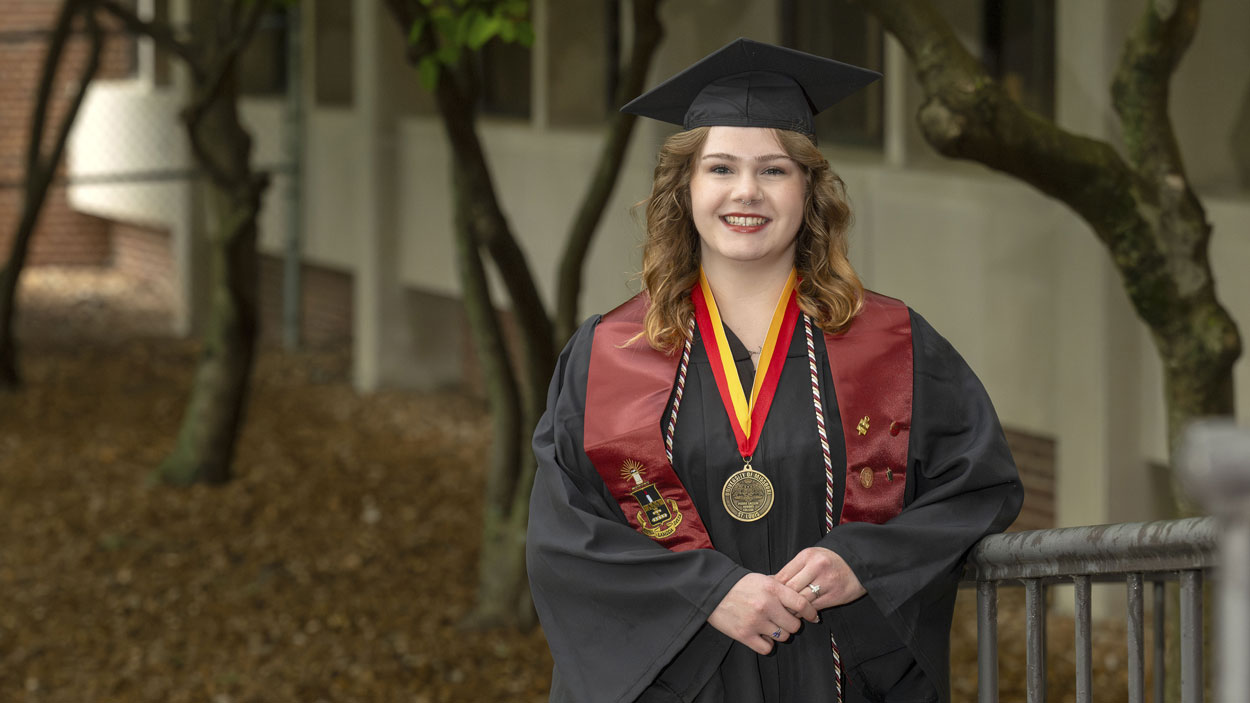
Allison Lendman graduated in May with her bachelor’s degree in biochemistry and biotechnology, but she’s remaining at UMSL this fall to pursue her master’s through the accelerated master’s program. (Photos by Derik Holtmann)
Allison Lendman celebrated commencement last month with her fiancé and other members of her family in attendance as she walked across the stage at the Mark Twain Athletic Center at the University of Missouri–St. Louis.
It marked a significant milestone in her educational journey as she earned her bachelor’s degree in biochemistry and biotechnology along with a certificate from the Pierre Laclede Honors College. Her fiancé even bought concert tickets that evening so they could revel in the accomplishment.
But Lendman hasn’t yet left UMSL. She’s dividing her time this summer working as a research assistant in three labs as she continues in the accelerated master’s program.
“I’m appreciative that the master’s program will allow me to have an extra degree in one additional year,” Lendman said. “It gives me the opportunity to take more classes that I’m still interested in or haven’t gotten the opportunity to take yet.”
Advanced Genetics is one she’s looking forward to because she’s gained a greater understanding of the related concepts from molecular biology and immunobiology since she took her undergraduate genetics course.
But the always curious Lendman has found herself captivated by nearly all her classes while taking a science-heavy workload since enrolling at UMSL in the fall of 2023.
The right fit
Lendman came to the university with most of her prerequisites already completed after taking part in the Early College Partnership program through Eureka High School and St. Louis Community College. She had nearly earned her associate degree by the time she completed work for her high school diploma.
Choosing UMSL was an easy decision, especially with how simple she found it to navigate the application process as a first-generation college student.
“I looked around at a few different schools, and I was hoping for something pretty close to home,” said Lendman, who now lives in Maryland Heights. “Specifically, I wanted something where research was prioritized and they had a really big STEM department.
“UMSL seemed to have a very inclusive community. I found that on my tour there were lots of opportunities to include all different types of students, whether they’re traditional, nontraditional, living on campus. So, I didn’t quite feel like such a little fish in a big pond, even though it’s a larger campus.”
Lendman started giving campus tours herself during her first semester while serving as a Triton Leader, just one of the ways she’s gotten involved during her time at UMSL.
She began with a plan to major in biology.
“Ever since I can remember, I’ve always been interested in it,” she said. “I’ve always been catching bugs outside or watching the National Geographic for Kids documentaries. I’ve always had a fascination with the human body and the world around me, and biology has always just come naturally to me.”
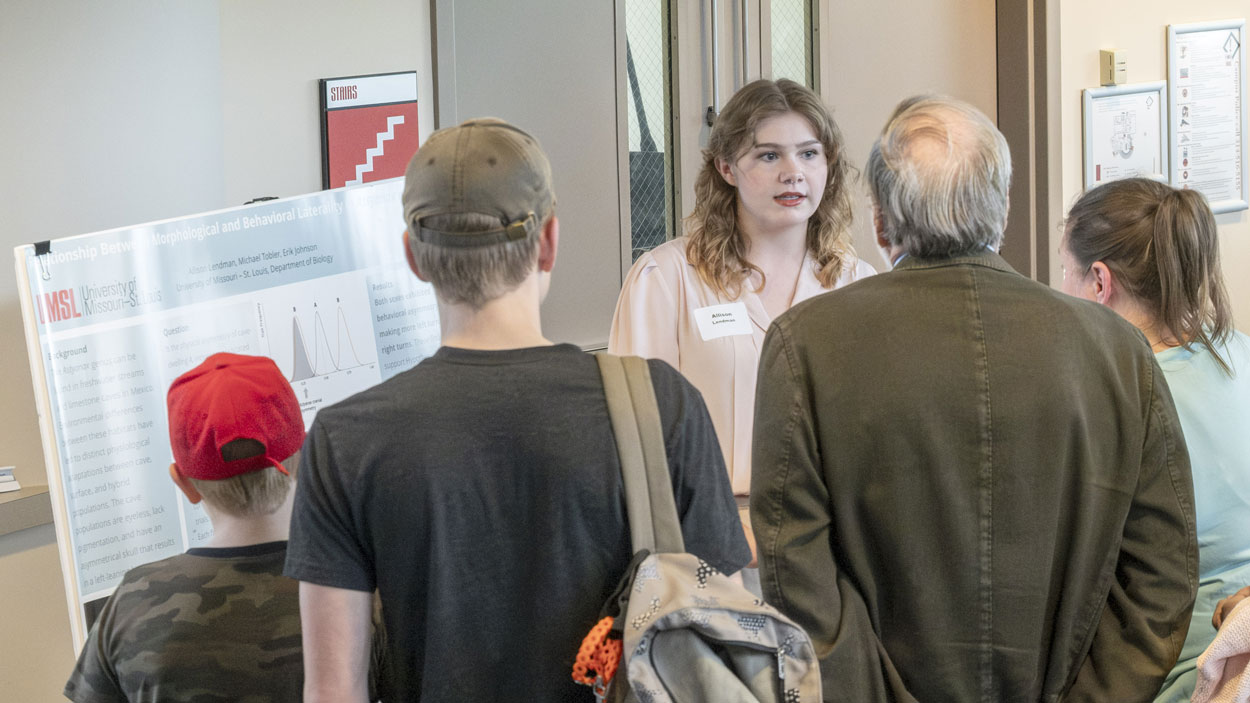
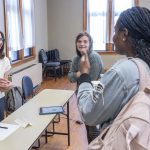
Allison Lendman gives a poster presentation of her research on blind cave fish during the Undergraduate Research Symposium in April.
What Lendman didn’t expect was how much she’d also enjoy organic chemistry. She had been a little intimidated starting out that semester after hearing how challenging most people found the subject to be, but she wound up really loving learning the material with the help of adjunct faculty member Nicholas Jentsch, one of the many faculty members in the Department of Chemistry and Biochemistry and the Department of Biology who made a positive impression on her over the past three years.
It ultimately led her to switch here major to biochemistry and biotechnology.
“I’ve absolutely loved it,” she said. “I’ve loved the opportunity to take a more diverse set of classes, I would say, where I get to experience the biochemistry and biotechnology classes, obviously, but I also had a minor in chemistry, which is built into the major, and I chose to minor in biology. The amount of electives in the field of biology that I’ve been able to take has been really interesting, and it’s given me a lot of perspective on what I might be interested in doing in the future. I think it’s also given me the opportunity to just see more realms of biology and chemistry than it would have if I just stuck with biology or chemistry.”
Lendman also said she made a point to take one course each semester through the Pierre Laclede Honors College. She appreciated the writing-intensive and discussion-based design of those classes, which gave her a chance to step back and think more philosophically about the science she was learning.
Deeper learning
Some of Lendman’s most impactful lessons over the past three years came not in the classroom but rather through her work in the lab of Michi Tobler, the E. Desmond Lee Endowed Professor in Zoological Studies.
Lendman first got connected with the lab – which investigates fish living in extreme environments – in the spring of 2024 when she applied for an on-campus job tending to the tanks in the Research Building.
“I initially started as just kind of an assistant and not even doing research, but I fell in love with the fish themselves and also the idea of working with live animals and seeing how their behavior is shaped by all sorts of different factors,” she said. “Much of the research that they do in the fish lab is about behavior in some form or another, or physiological responses, and they can do that without hurting the fish, which I thought was also interesting, so I just kind of fell into the rhythm of it.”
She’s worked alongside doctoral student Erik Johnson studying blind cave fish, which are eyeless and lack pigmentation. She investigated whether the fish display behavioral handedness correlated with the physical asymmetry of their skulls.
Lendman had opportunities to present her research at the University of Missouri System’s Undergraduate Research Day in March as well as at UMSL’s Undergraduate Research Symposium in April.
“I think the main benefit I’ve gotten from it is that it made me more involved in my education,” Lendman said. “It encouraged me to be on campus longer and kind of immerse myself my education. It also gave me more motivation and excitement for job opportunities afterwards and different career paths. I have gotten a lot of confidence in public speaking out of it ever since I started my own research project.”
The opportunity to continue doing research is one of the things that intrigued her most about the accelerated master’s program, which allows students to simultaneously earn credit toward both their bachelor’s and master’s with up to nine credits counting toward both degrees.
“There was really no drawback besides a few extra assignments or a little bit of extra work for the master’s credit, and I was happy to put that in,” she said.
This summer, while continuing her work in Tobler’s lab and preparing to continue working toward her master’s, she has started doing research in the labs of both Bethany Zolman, an associate professor of biology, and Michael Nichols, a Curators’ Distinguished Professor of chemistry and the director of the biochemistry and biotechnology program. Zolman’s lab specializes in plant genetics while Nichols’ is focused on Alzheimer’s research.
Lendman has made a positive early impression.
“Even though she only recently started in my lab, she already has been learning new skills in characterizing plant growth and collecting DNA to look at plant genomes,” Zolman said. “Her curiosity is abundant, and she asks many questions about how things work and what things mean.”
At home in academia
Lendman is excited for the year ahead, but she’s also looking forward to some time away from classes after completing her master’s degree.
“I would like to take a few years off of school,” said Lendman, who hopes to land a position in St. Louis’ vibrant biotech industry. “I haven’t decided which field interests me the most because everything seems interesting to me. But ultimately, I’d like to do some kind of biomedical research. Immunobiology has really been interesting to me and my favorite class I’ve taken here.”
Eventually, Lendman, who also worked as a supplemental instructor during her time as an undergraduate, expects to find her way back to school to pursue her PhD with the ultimate goal of working in academia.
“Academia is just a space that I always felt like I’ve thrived in,” she said. “I think the ability to teach and also do research has the best of both worlds for me, because I love connecting with people, and I’ve always liked like tutoring or being a supplemental instructor. Helping people to learn and seeing when they make those connections because I helped is a really cool feeling, but I also want to be able to pursue my own ideas and practice research and bring in undergrads to give them inspiration and opportunity. That is something I’m looking forward to.”