

Todd Swanstrom, the E. Desmond Lee Endowed Professor of Community Collaboration and Public Policy, is the co-editor of a new book, “The Other Housing Crisis: Ending the Deterioration and Loss of Affordable Homes.” (Photo by Derik Holtmann)
Todd Swanstrom has spent his career immersed in issues of public policy and urban development.
He brought a background in neighborhood and city planning with him into academia and served at the Rockefeller College of Public Affairs and Policy at the University of Albany and Saint Louis University before coming to the University of Missouri–St. Louis in 2008.
As the E. Desmond Lee Endowed Professor of Community Collaboration and Public Policy Administration in the Department of Political Science and Economics, Swanstrom has conducted research on urban politics, regional collaboration, public transportation, neighborhood change and gentrification. He’s also used resources from his professorship to support the Community Builders Network of Metro St. Louis in its efforts to strengthen neighborhoods throughout the region.
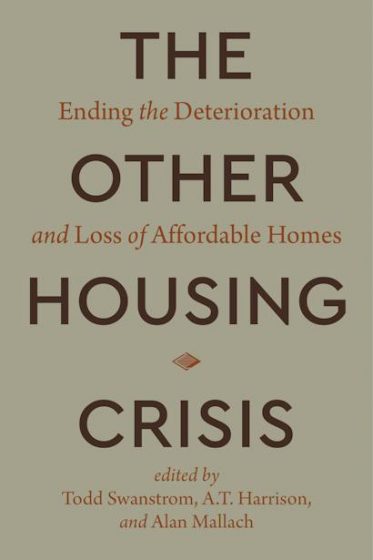
“The Other Housing Crisis: Ending the Deterioration and Loss of Affordable Homes” was published last month by Princeton University Press.
But in all his years studying urban – and suburban – life, Swanstrom had never spent much time thinking about the condition of housing and the need to maintain it. That changed about six years ago.
“What happened is the Vacancy Prevention Working Group of the Vacancy Collaborative in St. Louis approached researchers at the University of Missouri–St. Louis and said, ‘Can you tell us how much housing deterioration there is in St. Louis and whether that contributes to housing vacancy and abandonment?’” Swanstrom said. “When we did a literature search, we found out there was zero data on the extent of housing deterioration. There was some national data, but it didn’t allow you to get down to the city or neighborhood level.”
Swanstrom has spent much of the past six years working to change that. Locally, he helped lead a study into the home repair needs facing older adults in the City of St. Louis and also helped form the Home Repair Network with an aim to address inefficiencies and improve access to home repair services for area residents.
Collaborating with colleagues across the country, he’s also tried to shine a light and offer solutions for a growing problem that is impacting cities, as well as suburban and rural communities, across the country. Recently, he served as co-editor – along with A.T. Harrison and Alan Mallach – of “The Other Housing Crisis: Ending the Deterioration and Loss of Affordable Homes,” which was published last month by Princeton University Press.
In the latest installment of the Ask an Expert series, Swanstrom spoke to UMSL Daily about the book and the need for greater investment to preserve housing.
Start with the title of the book. Why is this the other housing crisis?
There’s a national conversation in the United States about housing affordability, and that’s a very needed conversation because many people spend far too much for housing. However, the whole debate about housing affordability completely ignores the issue of housing quality. Housing affordability and housing quality are not two separate issues. They’re two sides of the same coin, because most people acquire their affordable housing not through government subsidies but by owning or renting older homes that are sufficiently deteriorated or in sufficiently disinvested neighborhoods that they are affordable. So, housing quality needs to be part of the housing affordability conversation.
How did you first start to dig into the scope of the home repair issue?
We got a grant to do a study of older homeowners in St. Louis about six years ago. We devised a methodology to survey people about the experience of their home and then converted those answers into home repair scenarios. We sent out 2,500 surveys. We received roughly 587 responses. We found out that the average older homeowner in St. Louis has over $13,000 in needed repairs for a total cost of more than $300 million. Just those numbers don’t do justice to the problem because a lot of people are living in homes that are unsafe and unhealthy. Excessive moisture is a big issue causing mold and asthma and other breathing problems. And then with global warming, if you have inadequate cooling, that can lead to heatstroke or can exacerbate all sorts of other conditions. So, it’s a really, really serious issue.
On the front page of the original survey, it said, “If you have any questions, contact Professor Todd Swanstrom.” With 2,500 surveys, I was worried I’d get a lot of phone calls, and the survey researcher said to me, ‘Don’t worry, Todd. You’ll get about five.’ I got over 200 phone calls because people were desperate for help.
How much more do those qualitative anecdotes stick with you compared to just the numbers that you were able to put together?
That’s exactly it. We don’t really care about the physical house. We care about how it functions for the people who live in it. That’s what we care about, and so the physical deterioration of the house is simply a way to understand people’s experience of the home. In our study of the city of St. Louis, we conducted 31 in-depth interviews with people – over an hour long, each of them. There were just mind-boggling things.
What kinds of things did you hear?
The one that I remember best is the woman who said, “Well, Professor, I filled out your survey, but I couldn’t get to the mailbox because my steps have collapsed. But I was able to give it through the window to the boy next door, and he took it to the mailbox.” Then she, of course, asked if I knew of any funding to help her repair her stairs. The only thing I could do is refer people to programs with two or three or four-year waits. It drove home to me the seriousness of the problem.
It can really kind of cut you off from society, and you know, people are forced to make choices between crucial prescription drugs, that are necessary for their health, and home repairs.
Is St. Louis more susceptible to these issues because the city has so many older homes?
There’s not enough good research at the local level to really dig down and see whether newer Sun Belt cities have problems with housing deterioration, but I fear that they do. We know that there are a lot of new buildings that are experiencing problems through shoddy construction, so it’s not just old buildings that are a problem. New buildings, if they’re not built properly or not maintained properly, can easily get problems quite quickly, and I fear that developers and contractors are cutting corners when they do things and don’t do them properly.
How has the problem risen to the scale that it has?
I think home repair programs have been cut significantly in the last 30 years. Back in the ’70s and ’80s, we invested much more in home repair. Around 1980 was the peak of the community development block grant, which was the main successor to all the poverty programs in the ’60s. It’s down 81% now in inflation-adjusted dollars. In other words, that was money that was specifically geared toward repairing older cities, housing and infrastructure. The repair for individual homes is just part of a broader problem of neighborhoods that need repair. It’s not just homes that deteriorate; it’s whole neighborhoods, and for that matter, cities. The tax base of the cities.
So, we need to invest in homes. We need to invest in the infrastructure around those homes. When you get neighborhoods that have very weak demand, very weak housing demand, people tend not to invest in repair because if they put money into repairing and renovating the home, they won’t get that money out when they try to sell because the market is so weak. It’s not just an individual home issue. It’s a neighborhood issue.
When did you decide to actually produce the book?
The book is a process. What happened is my co-editors and I did a panel at a conference a number of years ago, in which we kind of challenged the dominance in urban scholarship on the issue of gentrification, which is about neighborhood reinvestment and renovation and not enough of a focus on disinvestment and deterioration. I think we were pleasantly surprised that a lot of scholars said, “Yeah, you know, you’re right. Something’s missing here. Scholars are not spending enough time looking at disinvestment. They’re spending a lot of time looking at reinvestment.” Gentrification is a problem, but disinvestment is a much more serious problem in terms of the magnitude and its effect on people’s lives.
So, what we did is we put out a request for proposals for chapters to a book on the issue of housing deterioration. We got back 43 proposals, we selected 14, and we went through a whole process, including a conference we had in St. Louis two or three years ago at the St. Louis Federal Reserve Bank. Several of the authors presented at the conference, and we met together and critiqued each other’s chapters. So, there was a whole process in the evolution of the book. It took two or three years to get it where it is now.
I think the book is probably the first book in many years that covers the landscape of housing and deterioration home repair programs.
Is it true you’ve been expanding on your earlier research?
Yes, we did a recent study of St. Louis County, which we’ll be announcing at the end of this month. We conclude that for single-family homes in the county, home repair is a $2.9 billion problem. The most acute problem is for those who are low income and have low home values. They just simply don’t have the money to do the work, and as a result, they’re living in places that are unsafe and unhealthy. But in our study of the county, we found that in areas of the central corridor and in South County – which are not extremely poor, they’re often middle class – there’s still a lot of need for home repair. People are letting things go. Why are they doing that when they have the resources? I don’t really know. We need to look into that. But I have a feeling that sometimes they don’t know what to do. Maybe they have trouble getting a hold of a contractor or they don’t want to take on debt or there aren’t enough home repair loans from private banks. Whatever it is, I think it’s a problem also among people with resources.
It’s what the title says: it’s the hidden housing crisis. We don’t really see it now. Maybe when you drive by a house, you see a dilapidated porch or a broken window or something like that. But you don’t see the young kid in the house who goes to the emergency room every few months with asthma, or the elderly couple who suffer from heat stroke during a heat wave. You really have to try to understand this in terms of the experience of people in the home.