
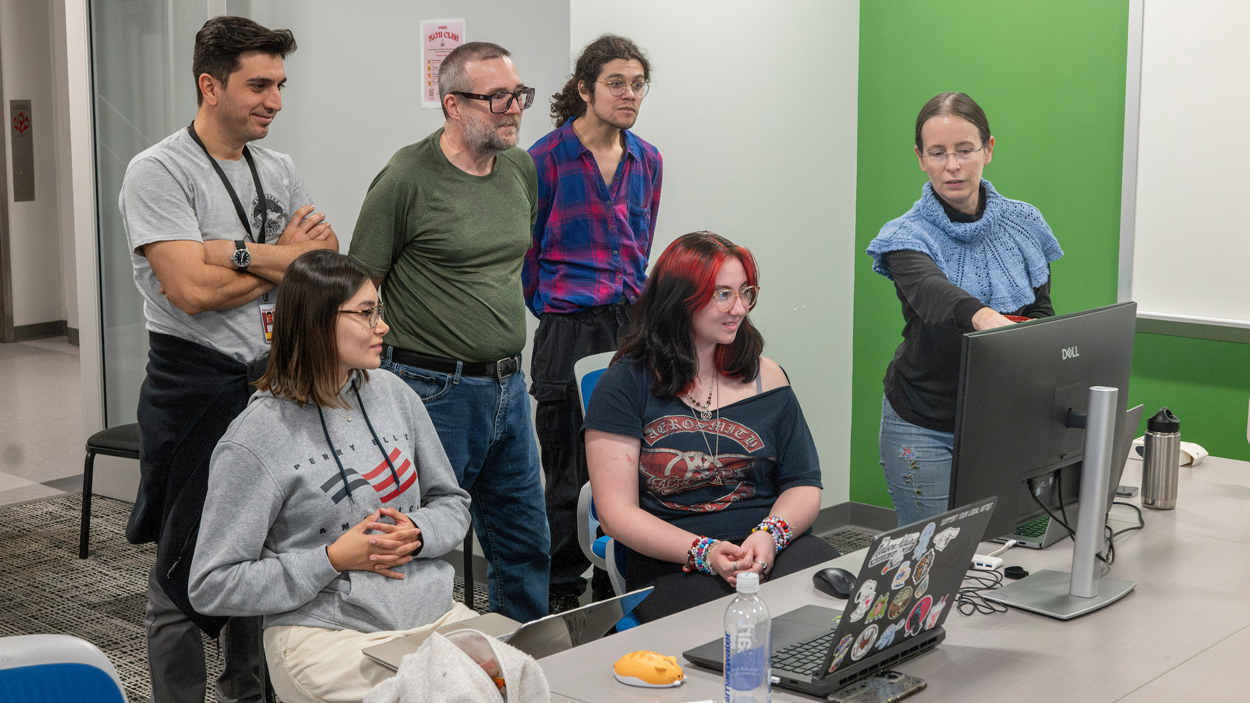
A group of UMSL faculty members and students, including (from left) Assistant Teaching Professor Mohammad Saki, physics major Camila Soto, physics major John Robbins, physics major Gideon Underwood, physics major Taylor Burns and Professor Erika Gibb, conduct an observation of Halley Type Comet 161P on Oct. 15. The UMSL team guided a telescope operator at the NASA Infrared Telescope Facility at the Mauna Kea Observatory in Hawaii remotely from St. Louis. (Photos by Derik Holtmann)
Taylor Burns estimates she was awake for about 48 hours by the morning of Oct. 17
Burns, a first-year physics major and president of the Physics Club at the University of Missouri–St. Louis, was more than willing to sacrifice sleep for the opportunity to participate in research with NASA’s Infrared Telescope Facility.
“It was a dream,” Burns said. “It’s huge to me. I always have been a very hands-on person. I love getting to actually do something and work hard toward a goal. Being able to participate and run things that most people don’t get a chance to do, it really meant a lot to me and was a really cool experience.”
Five UMSL students, including Burns, and three local high school students joined Assistant Teaching Professor Mohammad Saki and Professor Erika Gibb from Oct. 15-17 to observe Halley Type Comet 161P as it passed through the inner solar system. Each night, the group gathered in 517 Benton Hall around 11:30 p.m. and worked until about 5:30 a.m. the next morning.
“My intention is to make sure that students get this type of experience,” Saki said. “Being able to work with these state-of-the-art telescopes and having the students there to learn is great. I want to make sure that it goes out to UMSL community that, ‘Hey, we do this type of amazing work. If you’re interested, we’re happy to host you.’”
The team tracked the comet via the NASA-IRTF at the Mauna Kea Observatory in Hawaii, directing a telescope operator remotely from St. Louis. The observations were part of Gibb and Saki’s ongoing research on Halley-type comets, those with orbital periods of 20 to 200 years. With highly advanced tools such as NASA’s IRTF and James Webb Space Telescope, they’ve used high-resolution spectroscopy to study the composition of these celestial bodies.
To do this, Gibb and Saki leverage the telescope’s ability to discern the near infrared spectrum, the 1-to-5-micron wavelength, which is not visible to the human eye. During observations, they look for molecular emission lines from the comet’s coma – the atmosphere of gas and dust surrounding its nucleus. This happens when the Sun’s radiation starts warming up the comet and the ice in the nucleus sublimates – goes from a solid to gas without becoming liquid – exciting the molecules present. Theoretically, based on the composition of the coma, they can then extrapolate the composition of the solid nucleus and the relative ratios of major molecules.
Saki said students had three primary jobs during the observations of Comet 161P. Someone was always tasked with recording an observation log with information such as the telescope’s exposure and filter settings and air mass readings. Another person helped with a guider that kept the telescope on target as the comet moved through the night sky, while the third student ran the spectrograph.
“It’s very beneficial for students that they see how a professional telescope and a professional observation work, and how things can go wrong in the middle of it,” Saki said. “We had fog. We had a comet that drifted away. We had errors in coordinates. But we still got great data. Being able to solve those problems right in front of them is very beneficial to students. No matter what they do, if they choose astronomy or not, our hope is to build up that analytical thinking in them.”
Burns and Camila Soto, a fellow physics major, were both eager to gain hands-on research experience. Soto has previously worked with faculty members in the Department of Mathematics, Physics, Astronomy and Statistics to analyze comet data. She’s also tried to participate in observations whenever possible to gain a better understanding of the whole process.
“I think it’s really interesting to see how much work goes into collecting the data that we later analyze,” Soto said.
Burns is weighing a future career in either astrophysics, ideally conducting research for NASA, or quantum computing. She knows either path will require a solid foundation in research.
“I decided, especially going into physics, I really want to build up a resume,” she said. “Being able to participate in research projects and comet observations was something I could have fun with, be passionate about and also help build my resume.”
Soto primarily updated the observation log sheet, while Burns mainly worked with the guider. Over the course of the three-day period, Burns became increasingly comfortable with the tool, offering her own suggestions to troubleshoot issues that arose. It was her favorite part of the experience.
Indeed, there were issues aside from staying awake. The first night, it took about 45 minutes to find Comet 161P because the coordinates were considerably off the mark. The next night, heavy fog shut down the observation for about four hours. The comet also drifted quite a bit on the third night, which required recalibrating the guider for the telescope. None of that deterred the students, though.
“I love anything problem-solving,” Burns said. “I had a lot of fun being able to sit there and see the process. It’s really cool to see problem-solving in real time, especially from these researchers who are very, very experienced.”
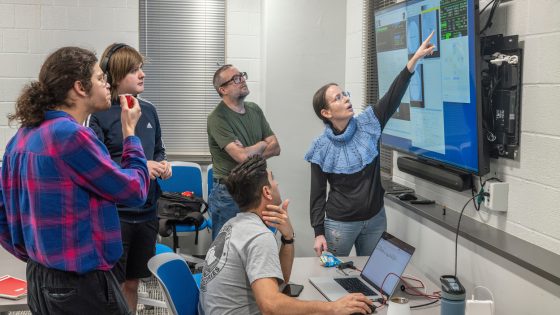
Physics students Gideon Underwood, Nicholas Meisinger, John Robbins and Assistant Teaching Professor Mohammad Saki, listen as Professor Erika Gibb analyzes readings from the NASA Infrared Telescope Facility.
The data on Comet 161P hasn’t been processed yet, but it will contribute to a growing database of comets and their varying compositions. One by one, patterns begin to emerge. Saki said observations of Comet 12P and Comet 13P, two Halley-type comets observed in 2024 with the James Webb Telescope, yielded unexpected results.
“We found surprisingly high carbon monoxide and methane,” Saki said. “These two were enriched in that comet. Even though they have an orbital period of about 70 years, these two comets have been to the inner part of solar system many, many times. They come and go every 70 years. On a scale of the solar system formation, that 70 years is nothing. So, they have done it hundreds of times. So, CO and CH4 should have been, in theory, depleted.”
Comet 161P has a shorter orbit of 21 years, and Gibb and Saki are interested to see if it also contains high amounts of carbon monoxide and methane. It’s possible the previous two comets are outliers, but another Halley-type comet enriched in those two molecules would present an interesting puzzle.
Gibb and Saki plan to compare their findings on Halley-type comets to available data on Jupiter-family comets, which have shorter orbits and travel through the inner solar system frequently, and Oort-Cloud comets, which have orbital periods of thousands of years. Ultimately, these comparisons will lead to a greater understanding of the building blocks of the early solar system.
That’s something Burns and Soto want to be a part of. They both plan to stay involved with comet observations and encourage others to join, as well.
“I think it’s something that anyone interested in astronomy and the universe would enjoy, not just physics or astrophysics majors,” Soto said. “I would definitely love to do it again. In fact, I’m already looking forward to the next observation.”