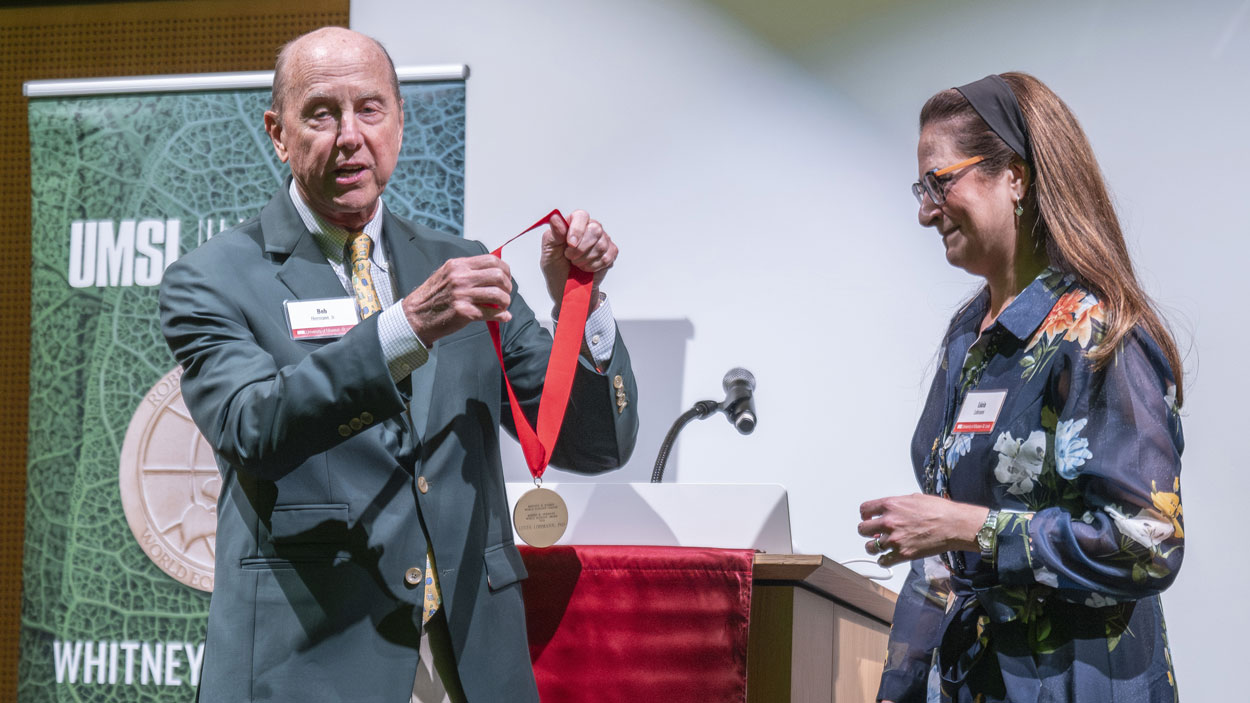
Robert R. Hermann Jr. presents the Robert R. Hermann World Ecology Award to Missouri Botanical Garden President Lúcia Lohmann at a gala on Friday night at the Missouri Botanical Garden. (Photos by Derik Holtmann)
Lúcia Lohmann saw a mix of old friends and mentors along with new colleagues staring back at her as she stood on stage peering out over the audience Friday evening in the ballroom of the Bayer Event Center at the Missouri Botanical Garden.
Lohmann had just become the 27th recipient of the Robert R. Hermann World Ecology Award from the Whitney R. Harris World Ecology Center at the University of Missouri–St. Louis. Robert Hermann Jr. had the honor of placing the medal – named for his late father, Robert R. Hermann Sr. – around Lohmann’s neck as she joined luminaries such as John Denver, Jacques Cousteau, Harrison Ford and E.O. Wilson who have been recognized for their work or philanthropic efforts to protect biodiversity while promoting ecology and conservation around the globe.
“I feel so honored and lucky and touched to be here,” Lohmann said as she began her remarks. “This is really a full-circle moment for me.”
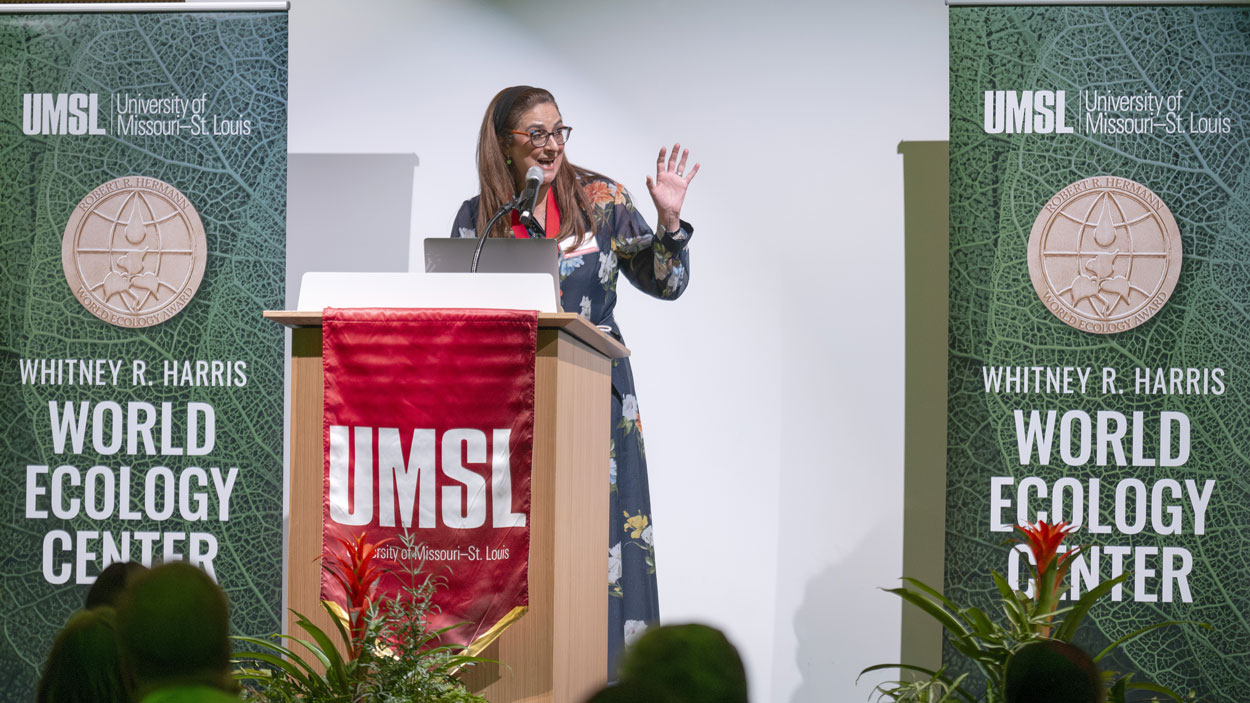
Missouri Botanical Garden President Lúcia Lohmann gives a presentation after accepting the Robert R. Hermann World Ecology Award from the Whitney R. Harris World Ecology Center.
Lohmann, now the president of the Missouri Botanical Garden, recalled attending the World Ecology Award Gala in April 1999 while a student pursuing her PhD in ecology, evolution and systematics and studying under noted botanist Elizabeth “Toby” Kellogg and her husband, Peter Stevens, at UMSL. She still had vivid memories of watching famed primatologist and anthropologist Jane Goodall accept the award at the Carriage Haus at Grant’s Farm.
“It was such a magical day,” Lohmann said. “I even remember that one Clydesdale was born that day, weighing 180 pounds. It was unbelievable. It ended up being named after Jubilee, the stuffed chimpanzee that Jane Goodall was gifted by her father on her first birthday.”
But Lohmann said she never imagined standing in Goodall’s position nearly three decades later.
Patricia Parker, the retired E. Desmond Lee Endowed Professor in Zoological Studies at UMSL and former director of the Harris Center, arrived at UMSL in 2000, when Lohmann was still a student. She has tracked Lohmann’s career ever since – her graduation from UMSL in 2003; her postdoctoral fellowship at the Missouri Botanical Garden, where she built on her doctoral research on trumpet creepers, or Bignoniaceae; and her appointment to the faculty at the Universidade de São Paulo in her native Brazil.
“I watched her emerge as a global leader,” Parker said. “In 2012 – that’s 12 years after I first met her – I saw her in Bonito, Brazil, at the international meeting of the Association for Tropical Biology and Conservation, and she was speaking as their executive director. Ten years later, we bumped into each other in Cambridge, Massachusetts, where she was inducted into the American Academy of Arts and Sciences as an honored international member.”
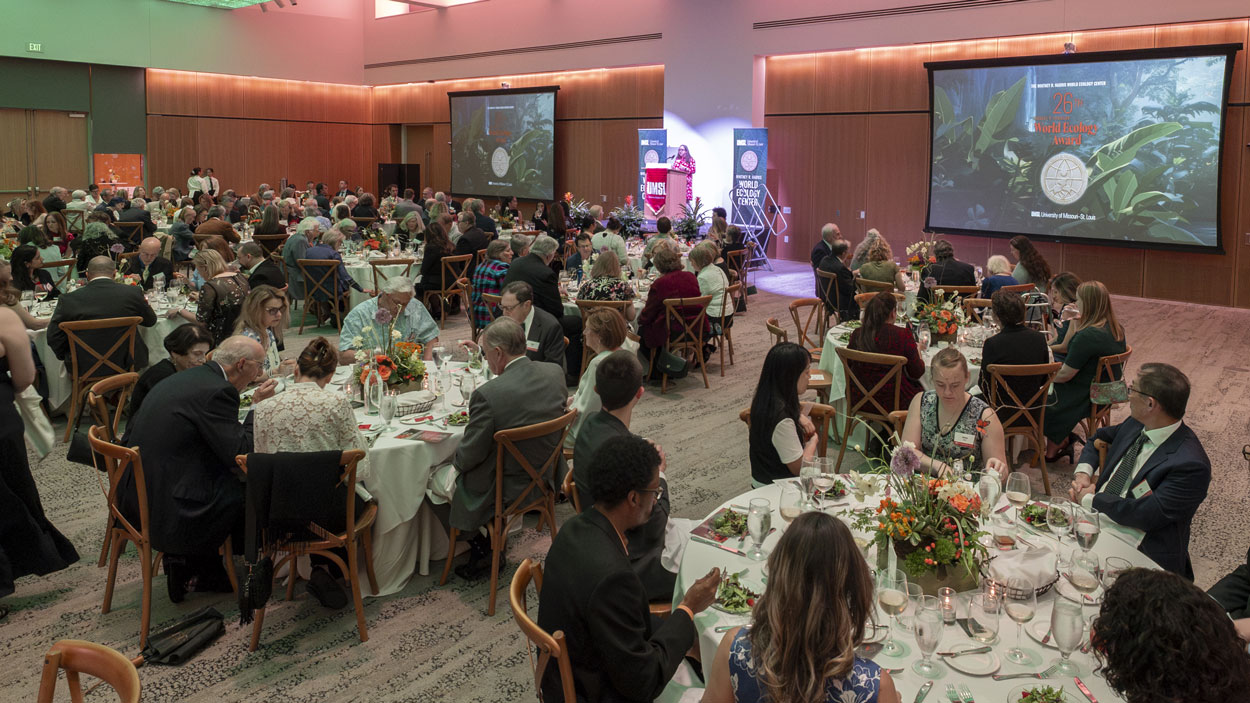
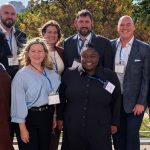
Nearly 200 people attended the Robert R. Hermann World Ecology Award Gala on Friday at the Missouri Botanical Garden.
Lohmann, who joined 2022 honoree Jaqueline Goerck as the only UMSL and Harris Center alumni to receive the World Ecology Award, is an internationally recognized botanist known for her research on plant diversity and conservation in the Amazon Basin and throughout the Neotropics.
In addition to previously serving as the executive director of the Association for Tropical Biology and Conservation, she is currently the president of the International Association for Plant Taxonomy. She also has held the title of George Engelmann Professor at Washington University in St. Louis since returning to St. Louis to serve as the president of the Missouri Botanical Garden in January 2025.
“She is the personification of the Harris Center’s mission,” Parker said.
The center has supported the training of more than 350 students from some 50 countries as they’ve pursued master’s degrees or PhDs in conservation and ecology science from UMSL’s Department of Biology since its founding as the International Center for Tropical Biology in 1990. Many of those alumni have returned to their home countries, where they’re leading research programs, advising governments and shaping conservation policies in places in the world where biodiversity is most under threat.
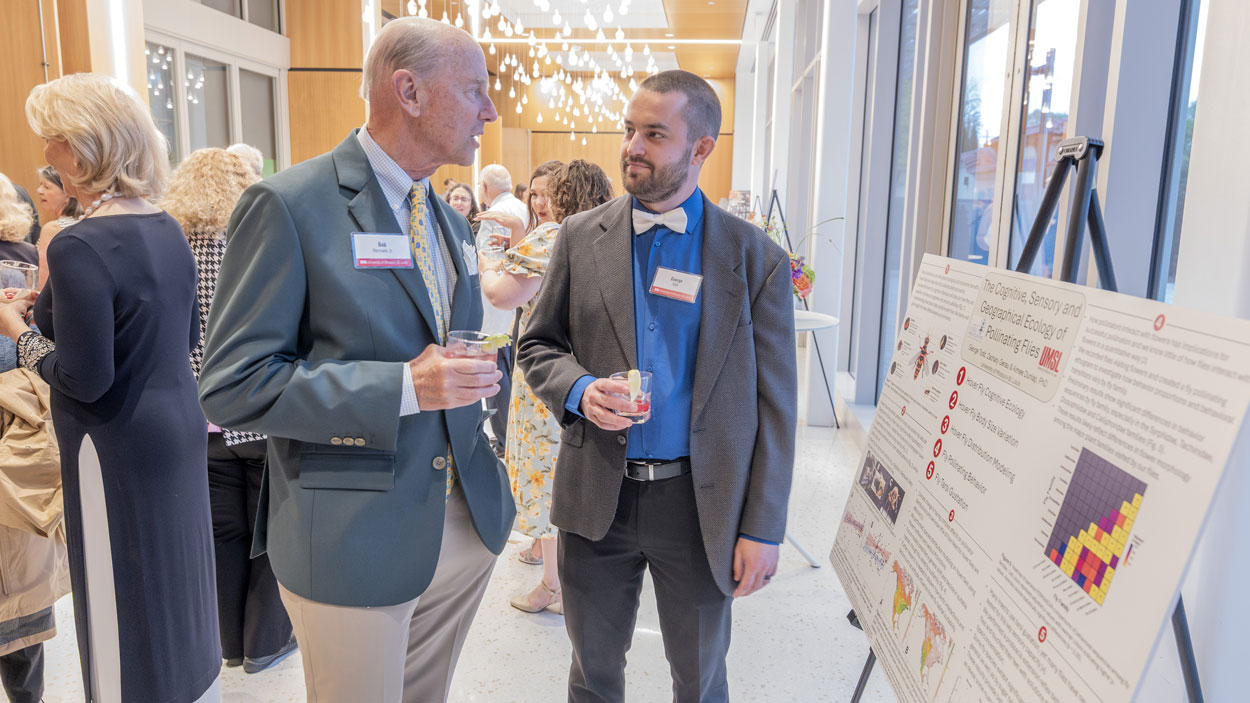
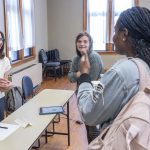
Biology doctoral student George Todd discusses his research with Robert R. Hermann Jr. during a cocktail hour at the Robert R. Hermann World Ecology Award Gala. Todd was one of several UMSL students, supported by the Whitney R. Harris World Ecology Center, to display their work.
There might be no more important environmental region than the Amazon, where Lohmann has focused her research throughout her career, starting as an undergraduate student in the early 1990s. She has been particularly invested in documenting and describing its flora.
“The Amazon hosts around 15% of the world’s known plant species, 10% of all freshwater fish, nearly one third of all the primates, and the diversity of microorganisms like insects or fungi or green algae has barely started to be explored,” she told attendees during a presentation on Friday evening.
The plants of the Amazon rainforest are also critical for absorbing global carbon emissions and releasing trillions of liters of water into the atmosphere through evapotranspiration each day to cool down the planet.
“I like to say that the plants don’t only support life on Earth; they actually make life possible,” Lohmann said.
Plant biodiversity remains largely unexplored. Lohmann noted estimates that only about a quarter of all the earth’s species have been formally described. Even with species that have been described, there’s often little information known about their morphology, distribution, genetics or geography.
Yet the plants that have been well studied have come to occupy critical roles as sources of food as well as medications such as aspirin, morphine, quinine and most modern medicines used in cancer treatment.
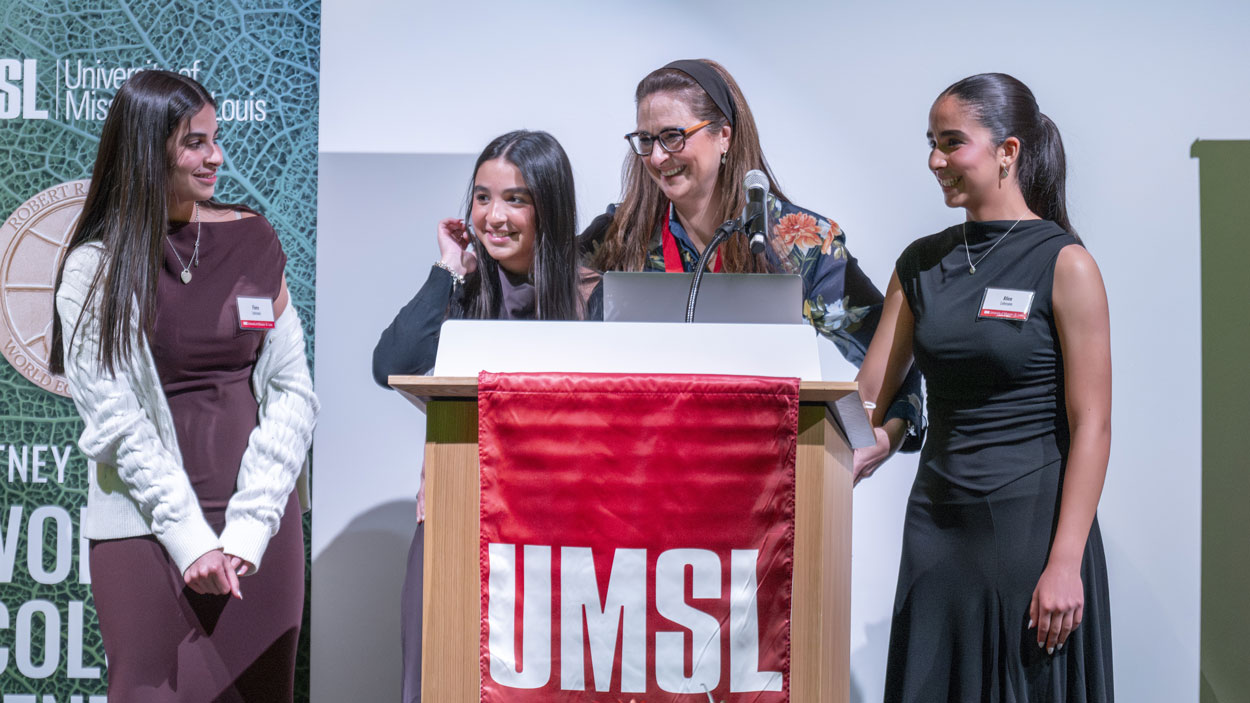
Lúcia Lohmann had her three daughters join her on stage at the end of her presentation at the Robert R. Hermann World Ecology Award Gala.
Lohmann laid out a case for the importance of accelerating the pace of species discovery, working collaboratively to complete a full inventory of all plant species before they disappear.
“Perhaps the most important question is, who will actually do the work and who will really carry the work forward?” Lohmann said. “We currently have amazing technologies, but there’s actually quite a limit to what the technologies can do. When we talk about species discovery, we’re actually talking about generating new knowledge. This is knowledge that is not out on the internet. It’s not on the Web of Science. It’s information that just doesn’t exist yet. So, we need to actually produce the knowledge.”
For Lohmann, that speaks to the importance of her career in academia, where she helped train biology students to build on her research and engage in their own discoveries.
It’s also central to the mission of the Harris Center as well as other organizations – including the Missouri Botanical Garden – doing work in plant biology in the St. Louis region.
“We really need a whole new generation of botanists and scientists who are fluent in data and technology, but above all, who are deeply grounded in plant biology, who really know the organisms and understand all the structures in detail, who are also broadly trained in multiple disciplines, and also who are able to work across cultures and really motivated by knowledge and also by impact,” Lohmann said. “And I should say, I really think we are in the best possible place in the world to train this next generation of scientists.”
Support the Whitney R. Harris World Ecology Center and students pursuing advanced degrees in ecology and conservation here.